Iran’s Foreign Minister Abbas Araghchi criticized Ukraine’s president after he urged stronger international action over Iran’s crackdown on protests.
In a post on X, Araghchi accused Volodymyr Zelenskyy of encouraging US military action against Iran.
“At the same time, he openly and unashamedly calls for unlawful US aggression against Iran in violation of the same UN Charter,” Araghchi wrote.
He also leveled accusations against Ukraine’s leadership, claiming Zelenskyy had misused Western support, and rejected calls for foreign involvement in Iran.
“Unlike your foreign-backed and mercenary-infested military, we Iranians know how to defend ourselves and have no need to beg foreigners for help,” Araghchi wrote.
Internet monitoring group NetBlocks said on Friday that Iran remained under a nationwide internet blackout entering its third week, with only limited signs of restored connectivity.
In a post on X, NetBlocks said there were “indications of an attempt to generate false traffic and manufacture narratives of a wider restoration.”
The group said overall connectivity had seen only a slight rise and that much of the activity appeared to involve tunneled users rather than a genuine return of internet access.

Tehran may have crushed street unrest with brute force, but it has no comparable solution for an economy gripped by surging inflation and collapsing incomes.
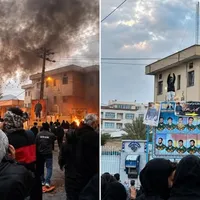
The protests initially erupted over a sharp spike in exchange rates but soon escalated into open calls for the overthrow of the Islamic Republic.
Many Iranians now say they personally know at least one or two people killed on January 8 or 9. Arrests and enforced disappearances—whose exact scale remains unknown—have also drawn countless families into the crisis, deepening fear and uncertainty.
According to people who have recently left Iran or managed to communicate via Starlink, businesses across the country are either closed or operating at minimal capacity, battered by currency turmoil and the prolonged internet shutdown.
On one side, customers have disappeared; on the other, sellers are reluctant to part with their goods.
Merchants say they cannot be sure they will be able to replace inventory amid exchange-rate volatility, turning even routine transactions into a gamble. Many now prefer not to sell at all.
Even before the unrest, businesses were under intense pressure.
Data published by the economic website Eco Iran show that bank lending from April to December rose 47 percent year-on-year. But 82 percent of loans to the productive sector went toward “working capital”—a sign that firms were borrowing not to expand, but simply to survive.
Shrinking purchasing power
Soon after the protests began, the government announced a plan to offset declining purchasing power following the removal of subsidized exchange rates for essential imports.
Under the plan, low- and middle-income individuals are to receive 10 million rials per month—about $7.50, roughly equivalent to one day’s wage for a construction worker.
Four months of payments were deposited at once, with recipients told they could spend one-quarter of the sum each month on 11 basic items, including rice, cooking oil, protein products, and dairy, at state-set prices in designated stores.
Prices for most of those goods in the open market have continued to surge, and some items have become scarce. Most readers responding to a poll by the news website Khabar Online said the subsidy was insufficient or ineffective.
One reader commented on the website that the handout offsets at most half the price increase for the 11 subsidized items, noting that rising food costs would also push up prices for everything from biscuits to restaurant meals, for which no compensation exists.
Many also fear the government will finance the program by printing money, further accelerating inflation, which official figures show had already surpassed 50 percent by December.
Cost of blackout
The nationwide internet shutdown, imposed on January 8 and still in place, has crippled hundreds of thousands of small and home-based businesses.
From home food producers to online language and music teachers, entire livelihoods have vanished overnight, with authorities offering no clear timeline for restoring connectivity.
These businesses relied almost entirely on online platforms for advertising and sales. Many were small producers in cities and even remote villages, selling handicrafts, agricultural goods, or homemade food directly to customers through Instagram.
Even before the shutdown, widespread filtering had forced them to pay for VPNs, further straining already fragile operations.
Kourosh, the manager of an advertising company who left Iran for Turkey after the January 8–9 killings, said all advertising activity had come to a halt.
“My clients have lost any hope of selling their products before the Iranian New Year, which is just two months away,” he told Iran International.
“People have no money, and even if they do, they won’t spend it on clothes, shoes, or home goods. Everyone was counting on sales in these final weeks of the year.”

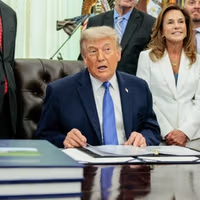
President Donald Trump said the United States is sending a “massive fleet” of naval forces toward Iran and warned that Washington is “watching Iran,” adding that “maybe we won’t have to use it."
“We have a big force going toward Iran. I’d rather not see anything happen, but we will see. We are watching them very closely. We have an armada, we have a massive fleet heading in that direction, and maybe we won’t have to use it. We’ll see," Trump said.

US conservative commentator Mark Levin told Iran International on Thursday that Iran has effectively become a “concentration camp” amid a deadly crackdown on protests, urging the United States to act to help topple the Islamic Republic.
“I can only speak for myself. I don’t need any more reminding about how bad this regime is and that somebody better do something about it, because if it’s not us, nobody’s going to do anything about it,” Levin said.
Levin said recent reports of increased US military deployments to the region suggested Washington was keeping its options open, although he said he had no insight into whether military action was being considered.
“Most revolutions, including America’s own, needed outside help,” he said. “What is happening in Iran is a counter-revolution against a regime that rules by force and fear.”
Levin also criticized decades of US engagement with Tehran, arguing that successive administrations believed the Islamic Republic could be managed through negotiations.
“This is an ideological regime,” he said. “They talk, they negotiate, but they have no intention of abandoning their mission, and that is why they so brutally suppress their own people.”
Iran has faced widespread internet disruptions during renewed unrest, with only limited information reaching the outside world through satellite connections and virtual private networks.
“I can tell you that tens of millions of Americans stand with the people of Persia. There’s no question about it,” Levin said. “We know the regime there is Hitleresque, Nazi-like. The regime is slaughtering innocent people, especially young people, raping them, and pillaging towns. We know that regime is the enemy of the American people. They’ve made that abundantly clear.”
Iran International has reported that at least 12,000 people have been killed since the protests began, while CBS News has cited estimates placing the death toll as high as 20,000.
Sources told Iran International on Wednesday that hospitals and morgues are facing shortages of body bags, forcing authorities to store bodies in corridors and other areas.
“We know they still want to build nuclear weapons. They back terrorism in our country, throughout Europe, and across the Middle East, but the people they terrorize the most are the Persian people,” Levin said. “I feel horrible about what’s taking place, and all I can do is use my platforms to draw as much attention to this as I can.”
Levin said Iranians possess a long civilizational history distinct from other countries in the region and said those who emigrate to the United States often integrate successfully and contribute to American society.
“If the people of Iran were free, the contributions they could make to science, culture, and technology would be extraordinary,” he said. “Instead, they are focused on survival under repression.”
A message from eyewitnesses in the industrial town of Fooladshahr, near Isfahan, sent to Iran International describes what locals say is a “massacre” of protesters and intense pressure on grieving families, including a case in which relatives kept a child’s body at home overnight using ice from neighbors because they could not bury him.
According to residents, families have been forced into long lines to wash the bodies of their loved ones, while security forces allegedly pressure them to register the dead as members of the Basij militia, a paramilitary force under the Revolutionary Guards.
In one reported case, the victim was a 16-year-old boy killed by shotgun pellets, and his mother at Bagh-e Rezvan cemetery had to wash corpses one by one just to find her son’s body among them, a scene that those present say reveals the scale and unprecedented nature of the killings.