US warned Iraq of oil sanctions, freezing ties over Iran ties - Reuters
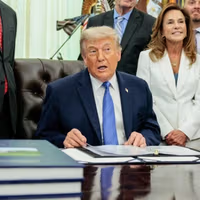
US officials told Iraqi leaders Washington would starve Baghdad of oil revenue if it kept up economic links with Iran and would suspend ties if politicians deemed close to Iran became ministers, Reuters reported on Friday citing sources.
The warnings would mark a sharp uptick in rhetoric on Iraq by the administration of US President Donald Trump as it pursues its maximum pressure campaign of sanctions against its Mideast arch-nemesis Iran.
Iran’s Supreme Leader Ali Khamenei ordered state media and security bodies to adopt a militarized approach toward controlling information, according to a new report by media freedom advocacy group DeFFI.
The Defending Free Flow of Information Organization (DeFFI) said its 2025 annual report documented 264 cases of intensified judicial and security pressure against journalists and media outlets, including arrests, interrogations, trials and operational disruptions.
The report says Iranian authorities now treat independent journalism as a security issue, framing the flow of information as a threat that requires a coordinated response by judicial, intelligence and media bodies.
According to DeFFI, 225 journalists and media outlets faced judicial or security measures last year, with 148 new judicial cases filed against media workers. At least 14 journalists were detained or had prison sentences enforced, while 8 media outlets were shut down or banned.
The report found that 34 female journalists were among those targeted and that judicial and security institutions violated legal rights in at least 396 documented instances.
The most frequently used charge against journalists was “spreading falsehoods,” applied in 106 cases, DeFFI added.
Sentences issued to 25 journalists and media managers collectively exceeded 30 years in prison, alongside nearly 293 million tomans (more than $2,000) in fines and five years of internal exile, according to the report.
The findings come as Iran has been under a near-total internet blackout since January 8, imposed amid nationwide anti-government protests.
The shutdown has severely restricted public access to global online platforms while allowing state-linked media and select institutions to remain connected.
Internet monitoring and human rights groups say the blackout, which has lasted for hundreds of hours, is among the longest and most comprehensive imposed by government in Iran.
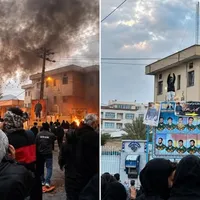
A witness to protests in Fardis, Alborz province, said the “main killing” occurred on Friday, January 9, when security forces intensified their crackdown and opened fire with live ammunition on protesters after initially allowing the gathering to proceed.
The witness told Iran International that on January 8, the first day of protests, security forces were caught off guard by the size of the crowd and that the number of fatalities that night was limited.
According to the witness, the situation escalated sharply the following day when Islamic Revolutionary Guard Corps forces and special police units, after permitting the protest to take place, opened fire from multiple directions using military-grade weapons.
“In some areas of Fardis there was widespread gunfire, and a large number of people were killed on Ahari Street,” the witness said.
The witness also reported seeing direct shootings, including what they described as execution-style “final shots” fired at elderly protesters.
According to the account, in several cases families of those killed by direct fire were later forced to sign commitments identifying the victims as members of the Basij militia. The witness said this was done because families were unable to afford the high costs demanded for the release of the bodies.
Iranian security forces deployed unknown chemical substances amid deadly crackdowns on protestors in several cities earlier this month, eyewitnesses told Iran International, causing severe breathing problems and burning pain.
They described symptoms that they said went beyond those caused by conventional tear gas, including severe breathing difficulties, sudden weakness and loss of movement.
“What was fired was not tear gas,” one protester said.
The USS Lincoln carrier strike group has not yet arrived in the CENTCOM area of responsibility, and has not crossed the line of demarcation from INDOPACOM to CENTCOM in the Indian Ocean, Fox news reported on Friday citing an official source.
"This means that the USS Lincoln is NOT yet in the Gulf of Oman within striking distance of Iran. It will be days, if not a week, before the aircraft carrier strike group will be on station," the report said citing distances involved and speed of strike group from open-source information.
Former and current senior commanders of Iran’s Revolutionary Guards say US President Donald Trump is “all talk” and has “picked the wrong path” on Iran, when asked by a state-television reporter to deliver a one-line message.
The video shared by the state TV features IRGC Aerospace Chief Majid Mousavi, IRGC Navy Commander Alireza Tangsiri, and Parliament Speaker Mohammad-Bagher Ghalibaf, a top IRGC general.