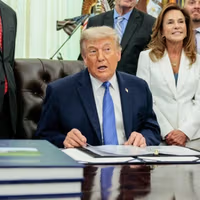
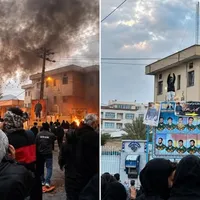
Iranian security forces deployed unknown chemical substances amid deadly crackdowns on protestors in several cities earlier this month, eyewitnesses told Iran International, causing severe breathing problems and burning pain.
They described symptoms that they said went beyond those caused by conventional tear gas, including severe breathing difficulties, sudden weakness and loss of movement.
“What was fired was not tear gas,” one protester said.
"People collapsed," another eyewitness said.

The USS Lincoln carrier strike group has not yet arrived in the CENTCOM area of responsibility, and has not crossed the line of demarcation from INDOPACOM to CENTCOM in the Indian Ocean, Fox news reported on Friday citing an official source.
"This means that the USS Lincoln is NOT yet in the Gulf of Oman within striking distance of Iran. It will be days, if not a week, before the aircraft carrier strike group will be on station," the report said citing distances involved and speed of strike group from open-source information.

Former and current senior commanders of Iran’s Revolutionary Guards say US President Donald Trump is “all talk” and has “picked the wrong path” on Iran, when asked by a state-television reporter to deliver a one-line message.
The video shared by the state TV features IRGC Aerospace Chief Majid Mousavi, IRGC Navy Commander Alireza Tangsiri, and Parliament Speaker Mohammad-Bagher Ghalibaf, a top IRGC general.

Tehran’s increasingly combative official statements suggest its leaders may be taking US military deployments more seriously than Washington’s signals of diplomacy.
The aircraft carrier USS Abraham Lincoln, along with several destroyers and warplanes, is set to arrive in the Middle East in the coming days, Reuters reported on Thursday, citing two US officials.
“We have a big force going toward Iran,” US President Donald Trump said on Thursday. “I’d rather not see anything happen, but we will see. We are watching them very closely. We have an armada, we have a massive fleet heading in that direction, and maybe we won’t have to use it.”
The strike group has been en route from the Asia-Pacific region even as Trump has spoken publicly about talks following Iran’s violent crackdown on protests, which has left thousands dead.
The tone from parts of Iran’s military establishment has been notably defiant—and at times confident—prompting questions about whether some in Tehran see war as politically useful, a major event that could overshadow the mass killing of protesters.
“We are preparing for a fateful war with Israel. We possess weapons no one else has,” said Yahya Rahim Safavi, a former commander of the Islamic Revolutionary Guard Corps and a senior adviser to Supreme Leader Ali Khamenei.
“The next war will end this conflict once and for all.”
Another senior commander, Ali Abdollahi, warned that any attack on Iran’s territory or interests would turn US interests, bases, and centers of influence into “legitimate and accessible targets.”
Revolutionary Guards Commander Mohammad Pakpour wrapped it up: Iran was prepared for any possibility, he said, “including an all-out war.”
Diplomatic messaging from Tehran has been more restrained but no less accusatory.
On Thursday, Foreign Minister Abbas Araghchi again accused the United States of instigating unrest inside Iran. An all-out confrontation, he wrote, would be “messy, ferocious and far longer” than Israel or its allies anticipate.
Araghchi’s tone contrasted with Trump’s remarks earlier in the week, in which he said he had pulled back from a strike after Iran reportedly halted plans to execute hundreds of detainees.
“Iran does want to talk, and we’ll talk,” the US president said at the World Economic Forum in Davos, Switzerland.
Hours later, aboard Air Force One, Trump reminded reporters that military action remained an option.
As ever, Trump appeared to be keeping his options open. In Tehran, however—perhaps mindful that Israeli strikes last June came amid US-Iran talks—officials appear to have drawn their own conclusions.

Several airlines, including Lufthansa, Air France, KLM, and Swiss have canceled their flights to the Middle East on Friday evening and Saturday including to Israel, the UAE, and Saudi Arabia, according to flight information published on airport websites, amid fears of a conflict involving Iran.
KLM said it has stopped flying to Israel, Saudi Arabia, and the United Arab Emirates, making it among the first major European airlines to suspend operations to several Middle Eastern destinations at once.
The airline told NOS that it will not fly to the Middle East until further notice due to "the geopolitical situation".
Air France said it had scrapped flights to Tel Aviv and Dubai due to the shifting security conditions in the region, adding that it has not yet set a date for resuming service.
British Airways said it has paused its evening flights to Dubai, noting that it is closely tracking developments and assessing whether further route changes are necessary.

US officials told Iraqi leaders Washington would starve Baghdad of oil revenue if it kept up economic links with Iran and would suspend ties if politicians deemed close to Iran became ministers, Reuters reported on Friday citing sources.
The warnings would mark a sharp uptick in rhetoric on Iraq by the administration of US President Donald Trump as it pursues its maximum pressure campaign of sanctions against its Mideast arch-nemesis Iran.
Citing three Iraqi officials and a source familiar with the matter, the news agency reported that US Charge d'Affaires in Baghdad Joshua Harris conveyed the warnings in conversations over the past two months with Iraqi officials from across its fractured political spectrum.
Iran relies closely on the banking sector its Western neighbor, where recent parliamentary polls kept Shi'ite Muslim parties in the ascendant and delivered gains for politicians from the kaleidoscope of militias and parties backed by Tehran.
The Islamic Republic's own economic lifeline of oil exports is under heavy pressure from US sanctions, even if export levels remain buoyant one year into Trump's second term, and Iraqi financial instruments help it skirt US curbs.
Following a 2003 US invasion, the United States has maintained de facto control over Iraqi oil revenues and its preponderant banking and financial puts the funds within its reach.
"The United States supports Iraqi sovereignty, and the sovereignty of every country in the region," Reuters quoted a US State Department spokesperson as saying in response to a request for comment. "That leaves absolutely no role for Iran-backed militias that pursue malign interests, cause sectarian division, and spread terrorism across the region."
US warnings also broached cutting off engagement with Baghdad if 58 members of parliament Washington views as linked to Iran are elevated by Prime Minister Shia al-Sudani to cabinet positions.
"The American line was basically that they would suspend engagement with the new government should any of those 58 MPs be represented in cabinet," Reuters quoted an Iraqi officials as saying.
"They said it meant they wouldn't deal with that government and would suspend dollar transfers," the source added.
Forming the new cabinet is due to take months and the US moves did not appear to be linked to a recent deadly crackdown on protestors in Iran, which resulted in new US sanctions on Iranian officials and oil shipping networks.