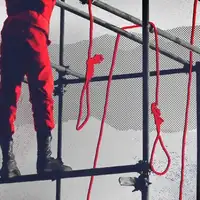
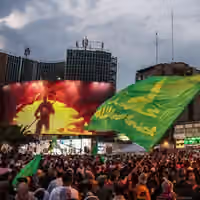
Iran will pursue legal action against US President Donald Trump and the family of Iranian exiled Prince Reza Pahlavi over their alleged role in nationwide protests, a judiciary official told state media.
Hasan Abdolianpour, head of Iran’s judiciary center for lawyers, blamed Trump and Pahlavi for the unrest, saying, “In the recent unrest, our main party is the criminal Trump and the Pahlavi terrorist organization."
He added that a complaint had been submitted to Tehran’s prosecutor and that authorities would follow the case in domestic and international courts, according to the same report.
Iran has repeatedly accused foreign governments and exiled opposition figures of stoking protests, accusations denied by activists and critics of the Islamic Republic
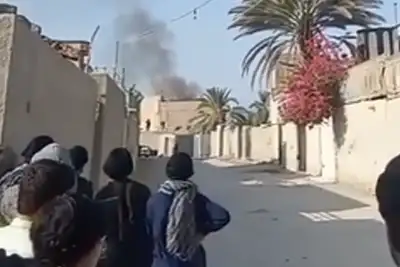
After Tehran's deadliest crackdown on dissidents in decades and with broad domestic security mobilization and sweeping internet blackout still in place, Tehran now tries to project an image of calm.
That effort is being carried out through the handful of government-owned media outlets still permitted to operate, and increasingly through individuals granted internet access via so-called “white SIM cards,” who portray a peaceful, orderly Iran.
As of midday January 16, state television’s rolling news channel, IRINN, had aired more than two dozen times an old video showing families visiting a ski resort in Chaharmahal and Bakhtiari province near Isfahan. “People are enjoying the beautiful snowfall,” the narrator says.

A senior Iranian diplomat based at the United Nations’ European headquarters in Geneva has left his post and applied for asylum in Switzerland, diplomatic sources told Iran International, amid mounting political unrest in Iran.
Alireza Jeyrani Hokmabad, a senior official at Iran’s permanent mission to the UN in Geneva, sought asylum together with his family after leaving his workplace, the sources said. He held the rank of counsellor and served as minister plenipotentiary, effectively the deputy head of Iran’s mission to the UN and other international organizations in Geneva.
The sources said Jeyrani decided not to return to Iran out of fear of potential repercussions linked to the ongoing political and social upheaval in the country, as well as concerns over the stability of the Islamic Republic’s governing structure.
Swiss authorities have not publicly commented on the asylum request.
Jeyrani joined Iran’s mission in Geneva in 2017 as an adviser and later rose through the ranks, representing Iran in economic bodies affiliated with the United Nations, including forums dealing with trade, development and investment.
Diplomatic sources said that growing international support for Iranian protesters, including statements by European leaders and the European Parliament, has contributed to rising anxiety among Iranian diplomats stationed in Europe.
Several Iranian diplomats have in recent weeks privately contacted authorities in European countries to explore or submit asylum requests, the sources said, speaking on condition of anonymity due to the sensitivity of the matter.
European sources said several governments are reviewing or have decided to more readily accept asylum requests from Iranian diplomats, even in cases where applicants cannot immediately demonstrate a direct threat to their lives.
Defections by Iranian diplomats during periods of domestic unrest are not unprecedented. Following the 2009 protests known as the Green Movement, several Iranian diplomats in Europe resigned and sought asylum, later citing electoral fraud and violent repression by the authorities.
Among those who defected at the time were Iran’s consul in Norway, Mohammad Reza Heydari; its chargé d’affaires in Finland, Hossein Alizadeh; the consul in Milan, Ahmad Maleki; and an embassy official in Brussels, Assadollah Farzad Farhangian.
Ebrahim Rezaei, spokesman for Iran’s parliamentary national security and foreign policy committee, accused the German, British and French ambassadors of helping to steer the recent protests, saying they “stood alongside terrorists” and played a role in directing the unrest.
He added that some acts of the protesters are classified as Moharebeh (“enmity against God”), which carries the death penalty under Iran’s Islamic law.
Rezaei also said there is documentation showing Western countries transferred dollars and foreign currency to organize “terrorist groups” and carry out killings inside Iran.
Iran’s foreign ministry summoned the ambassadors of Britain, Germany, France and Italy after their governments expressed support for protests in the country, state media reported last week.

After Tehran's deadliest crackdown on dissidents in decades and with broad domestic security mobilization and sweeping internet blackout still in place, Tehran now tries to project an image of calm.
That effort is being carried out through the handful of government-owned media outlets still permitted to operate, and increasingly through individuals granted internet access via so-called “white SIM cards,” who portray a peaceful, orderly Iran.
As of midday January 16, state television’s rolling news channel, IRINN, had aired more than two dozen times an old video showing families visiting a ski resort in Chaharmahal and Bakhtiari province near Isfahan. “People are enjoying the beautiful snowfall,” the narrator says.
Nowhere on the channel is the still-simmering nationwide discontent mentioned.
‘No tension, no police’
Other bulletins highlight news of a a “major oil contract”—not with a foreign partner, but with a group of well-connected domestic contractors authorized to sell Iranian oil on the black market using a “ghost fleet” geared toward evading US sanctions.
“The sooner this contract bears fruit, the sooner it will be a win-win agreement,” President Masoud Pezeshkian said of the deal in a clip posted on Telegram by the Revolutionary Guards-affiliated Fars News outlet.
On social media, one widely shared clip shows a street on the western edge of Tehran’s Grand Bazaar. Cars move quickly along empty roads, with no pedestrians and no open shops.
“There is no tension in the streets even without security forces present,” the voice in the video says.
The account does not explain why calm streets should appear unusual, though residents note that armored vehicles and machine-gun-mounted vans patrol other neighborhoods openly, especially after dark.
The clip raises another question: how the account’s administrator was able to access the internet while driving in a city that has been largely cut off from the outside world for more than 200 hours by January 16.
‘Cut Trump’s finger’
In another IRINN report, security chief Ali Larijani said he had spoken with his Swiss counterpart “about bilateral ties.”
Around the same time, international media reported that Switzerland—along with several other European countries—had summoned Iran’s ambassador to protest the violent treatment of demonstrators.
State television and state-aligned social media accounts have ignored the suspension of operations by several embassies in Tehran, including that of the United Kingdom, and more recently those of Portugal and New Zealand.
Notably, senior officials have largely disappeared from public view. Airtime has instead been given to former figures such as Mohsen Rezai, the Revolutionary Guards' first commander, who threatened to “cut off Trump’s finger if it is on the trigger” during a televised appearance.
State TV reported that President Pezeshkian thanked Russia for supporting Tehran at the United Nations during a phone call, but otherwise officials remain conspicuously absent.
It may be some time before they reappear. It may take even longer for the public to forget what they did—and failed to say—during the crackdown.

Abolfazl Heydari Mouselou, a 16-year-old protester, was killed during demonstrations on January 8 in the city of Qir in Iran’s Fars province after being shot by Islamic Revolutionary Guard Corps forces, a source close to the family told Iran International.
The source said authorities handed over his body under threats, on the condition that the family says he had not been killed in the protests and that the burial take place without crowds.
The family had planned to hold the funeral on Friday, January 9, but the source said authorities refused to prevent crowds from gathering and protests from erupting.
Abolfazl was buried early Saturday morning at Qir cemetery, with only his father and four security agents present, the source said.