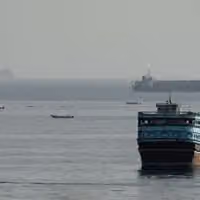
The United States is weighing the deployment of additional military assets to the Middle East, including a possible aircraft carrier strike group, as tensions with Iran escalate, ABC News reported on Friday.
According to the report, the Pentagon is considering sending the USS Abraham Lincoln carrier strike group to the region as a precautionary move during a period of heightened tensions.
US officials said such deployments are typically aimed at deterring attacks on American forces, with around 30,000 US troops stationed across countries including Qatar, Jordan, Iraq and Syria.
While social media users have shared posts and satellite images suggesting the USS Abraham Lincoln is moving toward the Middle East, US officials have not publicly confirmed its deployment to the region.

The body bags at Tehran’s main cemetery were stacked in their many hundreds on rows and on shelves, according to an eyewitness, who found among the corpses of slain protestors his friend, a 41-year-old mother of two.
Families stood in long lines outside, he added, waiting to be allowed in to look for loved ones among the dead.
Kiarash, whose last name Iran International is withholding for his safety, described the sprawling morgue as a "warehouse of bodies."
He was there to find the body of the woman, Nasim Pouaghai, after she was shot in the neck and died after a night in hospital.
Kiarash found himself face to face with what he believed to be up to 2,000 bodies brought in during a span of just a few hours on Saturday amid a nationwide internet blackout that sealed Iran off from the outside world.
“People were waiting to go inside of these warehouses to find their beloved and their killed body," Kiarash told Eye for Iran. "I saw two or three trucks that were in the queue … to unload the bodies."
His testimony is one of the few ground-level accounts of the mass killings in the worst crackdown on dissent in the country in decades as that shutdown persists.
At least 12,000 people were killed in just two days as the Islamic Republic unleashed a sweeping crackdown, according to tallies from medics and senior Iranian officials obtained by Iran International.
Kiarash said security forces were stationed at the entrance of Tehran's main cemetery, the Behesht-e Zahra. Inside, families were directed toward the main hall for washing corpses per Islamic practices, where he noticed the warehouses for the first time.
Through the open doors, he says, bodies were visible in stacked rows. Based on what he personally saw, he estimates that each warehouse held between 1,500 and 2,000 bodies by early afternoon. Trucks continued arriving, unloading more.
"I saw small bags," Kiarash added. "I found it out that there are children. There were many, many children."

'Holocaust' scenes
Phones were useless. There was no signal. When he tried to document what he was seeing but was stopped by security personnel. Around him, families broke down in tears as they searched through layers of bodies, sometimes forced to move one body aside to look for another beneath it.
He recalls one mother finding her son and begging others not to touch him, even as other families desperately searched beneath stacked bodies for their own loved ones.
Later that same day, during the blackout, Kiarash says he witnessed indiscriminate shooting at close range in Sa’adat Abad, a wealthy residential neighborhood in northwestern Tehran.
He says a shooter dressed in a black chador, traditional women's clothes in Iran, opened fire on a crowd. Bodies began hitting the ground.
“I heard bang, bang, pop, pop. Six times ... and I saw three people, they collapsed just near me. Two girls and one boy.”
Kiarash says he joined others in dragging the wounded into side streets as the shooter fled.
“We can’t stop this regime from killing the people. They’re not talking with us. They’re just killing," Kiarash said. “I just saw when they were throwing out the bodies in the cemetery. It was the same picture which we have here in Germany from the Holocaust.”
You can listen to Eye for Iran on any podcast platform of your choosing or watch on YouTube.
Exiled Prince Reza Pahlavi on Friday called on Iranians to sustain protests through nightly chants and nationwide strikes, dismissing claims by authorities that conditions in the country have returned to normal amid an ongoing crackdown on dissent.
Pahlavi said the Islamic Republic was seeking to “deceive the world and buy time” by portraying the situation in Iran as normal, while security forces continue to use lethal force against protesters.
"The blood of the best and bravest children of our homeland does not allow us to remain silent or retreat. If they have raised the cost of the streets through massacres and martial law, then our homes are the trenches of resistance and defiance: through strikes and not going to work, through nighttime chants and cries," Pahlavi said on X.
He urged Iranians to continue resisting through nonviolent means, including strikes and staying away from workplaces, as well as chanting and shouting slogans from their homes at night.
Pahlavi specifically called on people across Iran to take part in coordinated acts of protest from January 17 to 19, at 8 pm local time, by chanting what he described as national slogans.
“I assure you that together we will take Iran back and rebuild it anew,” he said.
An eyewitness who recently fled Iran and whose identity is being withheld for his safety recounts indiscriminate gunfire that turned city streets into a battlefield. He says he saw thousands of bodies stored at a cemetery as families searched for missing loved ones during a nationwide digital blackout.
He is risking his life to speak out and send a message to the world that the killings are still ongoing and Iranians urgently need help. He describes witnessing indiscriminate gunfire directed at unarmed civilians, narrowly escaping being shot himself.

At least 52 prisoners were executed in Iran based on prior non-political convictions during a period of nationwide protests and an ongoing internet shutdown, US-based rights group HRANA reported on Friday.
The report said the executions were carried out between January 5 and January 14 in at least 42 prisons across multiple provinces.
Those executed had previously been sentenced to death on charges including murder and drug-related offences, which HRANA said were non-political and non-security related.
The executions were reported during a time of severe restrictions on access to information, with a total internet blackout limiting public scrutiny and independent monitoring of judicial proceedings and the implementation of death sentences.
“At least 37 prisoners were executed between January 5 and January 12. Additional executions were reported in the days that followed, including a wave of executions between January 13 and January 14 in several prisons across the country,” the report said.
The group said prison authorities and relevant institutions had not officially announced the executions at the time of reporting.
Human rights organizations raised concerns about the continued use of the death penalty in Iran, particularly during periods of heightened security and restricted information flows.
“The continuation of executions amid internet shutdowns has intensified concerns over a lack of judicial transparency, access to fair trials and the increased risk of violations of the right to life,” HRANA said.
US President Donald Trump said on Friday authorities in Iran stopped what he called planned executions of more than 800 protestors.

A European diplomat, citing intelligence shared with Iran International, said their information indicates that at least 1.5 million people took to the streets in Tehran on Thursday, 8 January.
He said the number was lower on Friday, January 9, as security forces were heavily present in the streets and, in many cases, began shooting as people started to assemble, killing people en masse.
However, the European diplomat who spoke to the channel believes as many as half a million people were present in Tehran on Friday despite the mass killing.
The number of people in other cities is unclear due to the lack of foreign diplomatic presence outside Tehran—all embassies are in the capital.
However, their intelligence estimate is that at least 5 million people participated in nationwide protests on Thursday and Friday.
At least 12,000 people were killed in the deadliest crackdown in Iran’s contemporary history, carried out largely over two consecutive nights on January 8 and 9, Iran International’s editorial board concluded, based on a review of sources and medical data.