A mosque in the Iranian capital which was allegedly torched by protesters
State media in Iran have widely circulated images of damaged mosques and burned Qurans inside, blaming protesters they brand “terrorists” and portraying its deadly crackdown on a protest uprising as a sacred defense of holy places.
Officials assert that dozens of mosques and shrines across the country were deliberately attacked during protests.
Reports by eyewitnesses point to multiple mosques set ablaze in Tehran and Gilan province and in other major cities including Karaj and Isfahan.
In the past week, due to the near-total ongoing internet shutdown, state media have effectively become the primary source of visual material related to alleged damaged during the protests for many Iranians.
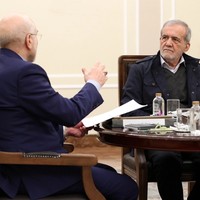
Tehran Mayor Alireza Zakani said on Thursday that more than 61 mosques were torched during unrest in the capital. President Masoud Pezeshkian echoed the condemnation on January 12, stating that “Iranian society does not accept those who burn mosques.”
Pezeshkian went further, saying: “They have trained some people inside and outside, brought terrorists into the country from abroad, and they burn mosques.”
State media are widely circulating images of charred interiors and half-burned copies of the Quran in Abu Dhar Mosque in Tehran and CCTV footage from an unnamed mosque in Isfahan that appears to show individuals setting fire to the building and its contents.
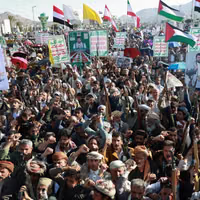
In pro-government rallies, some participants were seen holding half-burned Qurans, and the state TV showed several interviews with them reinforcing the narrative that demonstrators were “terrorists” attacking Islam itself.
Amplification beyond Iran
The images have not remained confined to Iranian media. They have been reshared widely on social platforms by supporters of the Islamic Republic, including some foreign influencers.
Accounts such as “Partisan Girl” (Sirin Girl) and Hamza Adi reposted the images, accusing supporters of Reza Pahlavi of burning the Quran.
Even amid internet restrictions, many pro-government users inside Iran continued to circulate the material online.
After Iran’s deadliest protest crackdown in decades, authorities have extended their response beyond the streets into morgues, hospitals and family homes, turning the protesters’ bodies into a key tool for suppressing dissent and controlling the narrative.
Iran International has received a large volume of videos, audio testimonies and written accounts describing how the bodies of protesters killed in the latest unrest are being collected, stored and released under strict security conditions.
While a nationwide internet blackout, now about a week, has made independent verification difficult in some cases, Iran International has cross-checked and verified key elements through corroborating footage, eyewitness commentary and the consistency of reports from multiple cities.
According to senior government and security sources speaking to Iran International, the number of protesters killed during the current unrest is believed to be in the thousands, with estimates placing the figure at around 12,000.
Videos verified by Iran International show the continued transfer of protesters’ bodies to the Kahrizak forensic medicine complex south of Tehran. One verified video, dated Wednesday, shows dozens of bodies laid out inside large warehouse-style halls at the facility. In the same footage, a trailer is seen as security forces unload additional bodies.
Similar videos and reports received from Tehran, Mashhad, Isfahan and Rasht show what appear to be large numbers of bodies stored in forensic facilities and hospitals.
Field reports describe heavily securitized conditions around morgues and hospitals, with access tightly controlled by security forces. Families seeking information about missing relatives have described chaotic scenes, long waits and limited communication.
Pressure on families
Multiple sources told Iran International that families attempting to retrieve the bodies of their relatives face intimidation and pressure from security forces, including plainclothes agents and members of the Islamic Revolutionary Guard Corps.
According to these accounts, security forces have raided the homes of victims’ families and their neighbors, searched mobile phones, verbally abused family members and, in some cases, fired shots at walls during nighttime raids. Hospital conditions have also been described as critical, with families reporting security presence inside medical facilities.
Sources said authorities have informed families that bodies can only be released during the early hours of the morning. Burial ceremonies, they said, are restricted to individual funerals and must be completed by 4 a.m.
Several families reported being warned that if they refuse to comply with these conditions, the bodies of their relatives would be buried collectively, without their consent.
Families mourn as they gather at a facility to collect the bodies of loved ones killed during protests. (January 2026)
Paying for the bullets
One of the most consistent elements across testimonies received by Iran International is the demand for money in exchange for the release of bodies.
According to multiple sources, families are being told they must pay for each bullet used to kill their relatives. The amounts demanded range from 700 million rials to 2.5 billion rials per bullet, depending on the case.
At the current exchange rate of approximately 1,450,000 rials to the US dollar, this translates to roughly $480 to $1,720. The average monthly income of a worker in Iran is less than $100, making such payments unaffordable for many families.
This practice is not new and has been used by Iranian authorities in previous crackdowns. However, they described its application during the current unrest as unusually widespread.
Forced Basij membership
In addition to financial demands, families have reported pressure to consent to their relatives being identified as members of the Basij militia, the paramilitary volunteer force of the Revolutionary Guards.
Rights monitors and sources said families are told that if they agree to a Basij membership card being issued posthumously for their relative, the body may be released without payment.
According to Dadban, a rights monitoring group, authorities in several cities have made free release of bodies conditional on families accepting that their killed relatives be registered as Basij members allegedly killed by protesters.
Rights groups say the practice amounts to forced identity alteration and an effort to inflate official claims of security force casualties, supporting authorities’ assertions that the unrest involved “terrorist elements.”
Hospitals overwhelmed
Audio testimonies sent to Tavaana, a civil society platform, describe hospitals overwhelmed by gunshot victims and bodies, with security forces intervening to prevent bodies from being released or funerals from taking place.
One audio account said security forces raided the homes of families who had managed to retrieve bodies. Another described a nurse who died by suicide after exposure to what was described as an overwhelming number of corpses.
Additional messages from Isfahan described widespread killings, mass arrests and refusal to release bodies. Some accounts said entire neighborhoods had lost at least one resident, with businesses shut down amid fear and anger.
Silencing grief
The restrictions placed on funerals and burials appear designed to prevent public mourning from becoming a focal point for further protest.
Families described being forced to bury their dead quickly, quietly and under surveillance. Some said they were instructed not to speak publicly or share images, while others reported continued monitoring after burial.
For many families, the process has turned private grief into a prolonged ordeal – one shaped by fear, financial coercion and the threat of erasure.
Iranian authorities have blamed foreign enemies, including the United States and Israel, for the unrest and have described the protests as a security threat. They have denied allegations of mass killings.
Uncertainty over Iran’s direction deepened on Wednesday as unrest at home coincided with mixed signals across the region, with military movements and diplomatic steps raising the risk of a broader conflict.
US officials said Washington began withdrawing some personnel from military facilities in the region, describing the move as a precaution as tensions rose.
The drawdowns came as the United States weighed its response to unrest inside Iran and after repeated warnings from Tehran that any US strike would be met with retaliation against American bases in neighboring countries.
US President Donald Trump struck an ambivalent tone, telling reporters he was monitoring the situation closely and suggesting reports of killings inside Iran were easing. He said he had received what he described as “a very good statement” from Iran, while stopping short of ruling out military action.
Privately, officials and diplomats from several countries said they remained concerned that US intervention was still possible, with some suggesting there was a limited window in which action could occur.
Regional governments, including Qatar, confirmed adjustments tied to heightened tensions, while Britain also reported precautionary measures involving its personnel.
Britain said it had closed its embassy in Tehran, citing security concerns, adding to signs of diplomatic retrenchment as foreign governments reassessed their presence in Iran amid the unrest.
Inside Iran, the leadership has sought to project control in what officials describe as the most serious unrest in decades. Iranian authorities have blamed foreign enemies, particularly Israel and the United States, for fueling violence, while insisting calm has returned after what they describe as a brief but intense period.
In a combative television interview with Fox News, Iranian Foreign Minister Abbas Araghchi rejected allegations that Iranian security forces carried out mass killings of protesters. He said the violence stemmed from clashes with what he called foreign-backed “terrorist elements,” and portrayed the unrest as part of a wider conflict imposed on Iran.
“There was fighting between our security forces and terrorist elements,” Araghchi said, dismissing accounts of widespread repression as misinformation and accusing Israel of trying to draw the United States into war.
Human rights groups outside Iran have reported high casualty figures, while an internet blackout has restricted independent verification on the ground. The information gap has fueled uncertainty, with competing narratives from Iranian officials, foreign governments and activists.
Iran has also intensified contacts with regional states in recent days, officials said. Tehran has urged neighboring countries to prevent any US military action, warning that American bases in the region would be at risk if Iran were attacked. Direct communication between Iranian and US officials remains suspended, they added.
Despite the scale of the unrest and mounting external pressure, Western officials have said Iran’s security apparatus appears intact and the government does not look on the brink of collapse. Iranian state media has broadcast images of funerals and rallies that it presented as evidence of continued public support for the Islamic Republic.
Iran’s judiciary said on Thursday that Erfan Soltani, a protester detained earlier this month, has not been sentenced to death, rejecting earlier claims by his family that such a ruling had been issued.
The judiciary said Soltani is being held at the central penitentiary in the city of Karaj and has been formally charged with “collusion against internal security” and “propaganda activities against the system,” according to state media.
It added that no death sentence has been issued and that capital punishment does not apply to those charges under Iranian law.
The judiciary said that if the charges are upheld by prosecutors and a court issues a legal ruling, the punishment by law would be imprisonment.
Soltani’s family had previously said that he had been sentenced to death, raising concerns among activists amid a broader crackdown on protesters following unrest across the country.
Iran has in past protest-related cases brought more serious charges such as moharebeh – commonly translated as “waging war against God” – which under the Islamic Republic’s penal code can carry the death penalty.
During earlier waves of unrest, rights groups and analysts said Iranian authorities used capital cases and charges including moharebeh and “corruption on earth” against some detainees, drawing international criticism over due process.
US Treasury Secretary Scott Bessent said on Wednesday Washington is tracking what he described as a surge of capital flight by Iran’s ruling elite, as fears grow over the possible collapse of the Islamic Republic amid unrest and threats of a US strike.
"As Treasury who carries out the sanctions we can see is we are now seeing the rats fleeing the ship because we can see millions, tens of millions of dollars being wired out of the country, snuck out of the country by the Iranian leadership," Bessent said in an interview with Newsmax.
"So they are abandoning ship, and we are seeing it come into banks and financial institutions all over the world," the Treasury Secretary added.
Iran’s nationwide protests began in late December 2025 over economic grievances but quickly evolved into an openly regime-change movement, with demonstrators calling for the end of the Islamic Republic itself.
Security forces responded by using live fire against protesters, killing as many as 12,000 people, according to Iran International’s findings.
Still, threats by US President Donald Trump to launch strikes against Iran have left the fate of the country’s leaders in limbo.
'US will trace Iran leaders' assets abroad'
In his Wednesday interview, the US Treasury Secretary vowed to trace the huge sums of money wired out of Iran by the country's leaders.
"What we do at Treasury is we follow the money, whether it is through the banking system or through digital assets. We are going to trace these assets and they will not be able to keep them."
Separately, Israel's Channel 14 reported on Wednesday that Iran's leaders have transferred $1.5 billion to escrow accounts in Dubai over the past two days.
"1.5 billion dollars have been transferred out of Iran in the last hours, not through banks but via cryptocurrency with one clear destination: Dubai," the report said citing a source familiar with the Revolutionary Guard's economic activities.
The report alleged that the Supreme Leader's son and one of his potential successors Mojtaba Khamenei is one of the people involved in these transfers.
"He transferred about $328 million to that same destination," Channel 14 said citing the unnamed source.
Iran has increasingly leaned on cryptocurrency rails to move money abroad as sanctions and banking restrictions complicate traditional transfers.
US Treasury actions in 2025 described “shadow” networks using overseas fronts and crypto transactions tied to Iranian oil revenue, portraying digital assets as one way to bypass chokepoints in the regulated financial system.
Israel’s apparent inaction amid Iran’s widespread unrest may look counterintuitive, but it reflects a long-standing strategic calculation rather than hesitation.
The wave of protests arrived at a sensitive moment for Israeli Prime Minister Benjamin Netanyahu: as he was pressing US President Donald Trump to nod ahead another round of Israeli strikes against Iran, especially its missile program.
For years, Netanyahu has argued in Washington that Tehran’s challenge cannot be resolved through containment or diplomacy alone, but only through the collapse of the Islamic Republic.
Against that backdrop, one might have expected Israel to seize on Iran’s internal instability and move decisively against its strategic assets. Instead, restraint has become policy.
Netanyahu is aware that any visible Israeli role could serve the interests of Iran’s rulers—by discrediting protesters as foreign-backed agents or by giving Tehran justification to escalate militarily against Israel.
Cautious calculation
Several considerations reinforce Netanyahu’s caution.
Israel is still emerging from a recent military campaign and has little appetite for being drawn into another direct confrontation with Iran. At the same time, Netanyahu continues to prefer US leadership on the Iran file, a long-standing strategic priority.
From his perspective, the most effective—and legitimate—pressure on Iran, including any potential military action, must come from the United States rather than Israel.
There is also a deeper calculation at play. Netanyahu may believe the Islamic Republic is closer than at any point in decades to a breaking point, and that overt Israeli involvement could delay or derail that process.
From this view, Israel’s most effective contribution to regime destabilization is to avoid becoming the focal point of Iranian nationalism or regime propaganda.
Restraint: pros and cons
Yet restraint carries risks of its own.
Iran’s theocratic rule may survive the current unrest and seek to exploit its vulnerability by pursuing a renewed nuclear agreement with the West. For Israel, this is a deeply troubling scenario as it could ease economic pressure on Tehran and extend the life of the Islamic Republic without addressing Israel’s core security concerns.
Nor would every political transformation in Iran necessarily serve Israeli or American interests.
A pro-Western restoration, such as the return of the Shah’s son, is far from certain. Other outcomes could include further radicalization of the regime or a decision to accelerate its nuclear program, moving more decisively toward a nuclear weapon.
In short, Israel is not rushing to exploit Iran’s internal crisis. Despite longstanding fears over Iran’s military buildup and a fundamental desire for regime change, Netanyahu is pursuing a policy of restraint shaped by caution, timing, and deference to US leadership.
Even so, restraint does not guarantee insulation. Israel could still be drawn into a broader conflict—particularly if the United States launches a military strike and Iran chooses to retaliate against Israeli targets.
For now, Israel’s posture reflects a familiar strategic logic: hoping for the best, while preparing for the worst.
The repeated sharing has helped frame the unrest in some Muslim countries such as Pakistan as an attack on religious sanctities rather than a political protest.
Criticism and Fact-Checking
Some opponents of the government argue that the information released is selective and misleading. They say the extensive focus on mosque imagery by outlets such as state broadcaster IRIB aims to discredit protesters and provoke religious sentiment against them.
Iranian fact-checking website Factnameh wrote: “What is being presented is an incomplete and misleading picture of reality, designed to stir religious emotions and mobilize the government’s religious supporters, as well as to inflame Muslim public opinion against protesters in Iran.”
At the same time, some anonymous social media accounts have explicitly encouraged attacks on religious sites. An account posting under the name “Imam Tusi” wrote on X: “People burned Fatemeh Zahra Mosque in Isfahan, too. People should torch all shrines, mosques, and religious seminaries together with the mullahs in them.”
Most mosques and religious employees receive state backing in the Islamic theocracy.
Some opposition figures have implicitly acknowledged mosque burnings.
Darya Safai, an Iranian-born member of the Belgian parliament, wrote on X: “In western Tehran, a great mosque burned. For forty-seven years, its minarets echoed with ‘Allahu Akbar,’ and in that name, Iranian women and men were chained, silenced and broken.”
Yet other observers blamed authorities for the damage,
“They did this themselves to provoke the people—impaling the Quran on spears, setting fires, and destroying the mosque are just the tools of deception used by these hypocrites,” a user posting as Hatam wrote on X, without providing evidence.
Mosques as security hub
Iran has an estimated 75,000 mosques, around two-thirds of which are believed to be largely inactive. Tehran's critics argue that unlike in other Muslim-majority countries, mosques in Iran function not only as religious spaces but also serve as function halls for the state's repressive apparatus, including the Basij militia which quashed protests.
Iranian authorities openly acknowledge this role. On January 9, Revolutionary Guards commander Hossein Yekta called on government supporters via state television to gather in mosques and Basij bases to confront “the enemies of the revolution.”
In August 2024, Iranian media quoted Brigadier General Heydar Baba-Ahmadi, head of the Mosques and Neighborhoods Affairs of Basij militia force, as saying that “79 percent of Basij resistance bases are located in mosques, with another 5 percent in other religious sites.”
During the 2021–2022 protests, CNN reported on networks of secret detention sites, some allegedly located inside mosques. The report asserted that these spaces were used for temporary detention and torture of protesters, run by Basij units based in mosques.