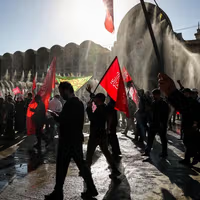
A mosque in the Iranian capital which was allegedly torched by protesters
State media in Iran have widely circulated images of damaged mosques and burned Qurans inside, blaming protesters they brand “terrorists” and portraying its deadly crackdown on a protest uprising as a sacred defense of holy places.
Officials assert that dozens of mosques and shrines across the country were deliberately attacked during protests.
Reports by eyewitnesses point to multiple mosques set ablaze in Tehran and Gilan province and in other major cities including Karaj and Isfahan.
In the past week, due to the near-total ongoing internet shutdown, state media have effectively become the primary source of visual material related to alleged damaged during the protests for many Iranians.
Tehran Mayor Alireza Zakani said on Thursday that more than 61 mosques were torched during unrest in the capital. President Masoud Pezeshkian echoed the condemnation on January 12, stating that “Iranian society does not accept those who burn mosques.”
Pezeshkian went further, saying: “They have trained some people inside and outside, brought terrorists into the country from abroad, and they burn mosques.”
State media are widely circulating images of charred interiors and half-burned copies of the Quran in Abu Dhar Mosque in Tehran and CCTV footage from an unnamed mosque in Isfahan that appears to show individuals setting fire to the building and its contents.
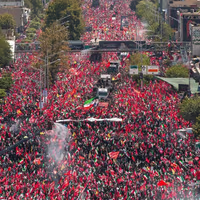
In pro-government rallies, some participants were seen holding half-burned Qurans, and the state TV showed several interviews with them reinforcing the narrative that demonstrators were “terrorists” attacking Islam itself.
Amplification beyond Iran
The images have not remained confined to Iranian media. They have been reshared widely on social platforms by supporters of the Islamic Republic, including some foreign influencers.
Accounts such as “Partisan Girl” (Sirin Girl) and Hamza Adi reposted the images, accusing supporters of Reza Pahlavi of burning the Quran.
Even amid internet restrictions, many pro-government users inside Iran continued to circulate the material online.
The repeated sharing has helped frame the unrest in some Muslim countries such as Pakistan as an attack on religious sanctities rather than a political protest.
Criticism and Fact-Checking
Some opponents of the government argue that the information released is selective and misleading. They say the extensive focus on mosque imagery by outlets such as state broadcaster IRIB aims to discredit protesters and provoke religious sentiment against them.
Iranian fact-checking website Factnameh wrote: “What is being presented is an incomplete and misleading picture of reality, designed to stir religious emotions and mobilize the government’s religious supporters, as well as to inflame Muslim public opinion against protesters in Iran.”
At the same time, some anonymous social media accounts have explicitly encouraged attacks on religious sites. An account posting under the name “Imam Tusi” wrote on X: “People burned Fatemeh Zahra Mosque in Isfahan, too. People should torch all shrines, mosques, and religious seminaries together with the mullahs in them.”
Most mosques and religious employees receive state backing in the Islamic theocracy.
Some opposition figures have implicitly acknowledged mosque burnings.
Darya Safai, an Iranian-born member of the Belgian parliament, wrote on X: “In western Tehran, a great mosque burned. For forty-seven years, its minarets echoed with ‘Allahu Akbar,’ and in that name, Iranian women and men were chained, silenced and broken.”
Yet other observers blamed authorities for the damage,
“They did this themselves to provoke the people—impaling the Quran on spears, setting fires, and destroying the mosque are just the tools of deception used by these hypocrites,” a user posting as Hatam wrote on X, without providing evidence.
Mosques as security hub
Iran has an estimated 75,000 mosques, around two-thirds of which are believed to be largely inactive. Tehran's critics argue that unlike in other Muslim-majority countries, mosques in Iran function not only as religious spaces but also serve as function halls for the state's repressive apparatus, including the Basij militia which quashed protests.
Iranian authorities openly acknowledge this role. On January 9, Revolutionary Guards commander Hossein Yekta called on government supporters via state television to gather in mosques and Basij bases to confront “the enemies of the revolution.”
In August 2024, Iranian media quoted Brigadier General Heydar Baba-Ahmadi, head of the Mosques and Neighborhoods Affairs of Basij militia force, as saying that “79 percent of Basij resistance bases are located in mosques, with another 5 percent in other religious sites.”
During the 2021–2022 protests, CNN reported on networks of secret detention sites, some allegedly located inside mosques. The report asserted that these spaces were used for temporary detention and torture of protesters, run by Basij units based in mosques.
"There are a lot of headlines out there that are, in my view, not accurate. President Trump's resolve [to attack Iran] is not the question. Question is, when we do an operation like this, should it be bigger or smaller?" Republican Senator Lindsey Graham told reporters on Thursday.
"I'm in the camp of bigger. Time will tell. I'm hopeful and optimistic that the regime days are numbered. There are a lot of headlines out."
In a post on his X account, Graham also criticized Arab countries for trying to dissuade Donald Trump from attacking Iran, saying he would dramatically rethink US alliances with Arab partners if the reports were accurate.
"All the headlines suggesting that our so-called Arab allies have intervened on behalf of Iran to avoid decisive military action by President Trump are beyond disturbing," Graham said.
"The ayatollah’s regime has American blood on its hands. They are slaughtering people in the streets. If it is accurate that the Arab response is “action is not necessary against Iran” given this current outrageous slaughter of innocent people, then there will be a dramatic rethinking on my part regarding the nature of the alliances now and in the future."
Iran’s nationwide internet blackout has entered its second week, with connectivity still severely restricted 168 hours after authorities imposed the shutdown, internet monitoring group NetBlocks said on Thursday.
“Exactly one week ago to the hour, Iran fell into digital darkness as authorities imposed a national internet blackout,” NetBlocks said in a post on X.
"Through the following days Iranians continued to protest and demand liberty despite a draconian crackdown," it added.
Security forces have stepped up their presence and activity across several parts of Tehran, a resident said in a message sent to Iran International.
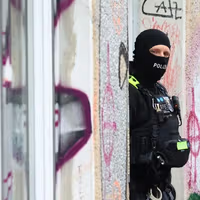
The resident said security forces are patrolling neighbourhoods on motorcycles and pickup trucks with their faces covered, firing shots into the air, shining lasers into homes and verbally abusing residents.
According to the resident, security agents are also raiding people’s homes and confiscating satellite TV equipment, including satellite dishes and receivers.
The resident added that security forces entered his sister’s home in her absence and took away her satellite TV’s receiver.
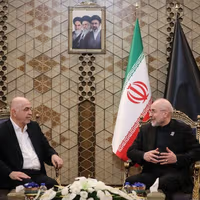
Ali Larijani, the head of Iran's Supreme National Security Council, pays condolences for a Revolutionary Guards commander assassinated by Israel in this file photo.
The United States sanctioned Iran's influential security chief on Thursday along with top military officers it accused of being behind a deadly crackdown on protests, ramping up Washington's standoff with Tehran as it weighs a potential attack.
The designation of Larijani cites his affiliation to the Iranian Supreme Leader Ali Khamenei. Elevated to leadership of Iran's Supreme National Security Council last year, he is a veteran security and political insider of the theocracy.
Larijani, the treasury said in a statement, was "one of the first Iranian leaders to call for violence in response to the legitimate demands of the Iranian people."
"LARIJANI, Ali (Arabic: علی لاریجانی) (a.k.a. LARIJANI, Ali Ardeshir), Tehran, Iran; DOB 03 Jun 1958; POB Najaf, Iraq; nationality Iran; Additional Sanctions Information - Subject to Secondary Sanctions; Gender Male; Passport D10010646 (Iran) expires 05 Sep 2027 (individual) [IRAN-EO13876] (Linked To: KHAMENEI, Ali Husseini)," the entry on the US Treasury Department's website read.
Other sanctions targeted top officers in Iran's Islamic Revolutionary Guard Corps including provincial commanders.
The Treasury also added 13 entities to its Specially Designated Nationals (SDN) list, including Fardis Prison and companies allegedly linked to US-sanctioned Iranian trade in the United Arab Emirates, Singapore and the United Kingdom.
“The United States stands firmly behind the Iranian people in their call for freedom and justice,” said Secretary of the Treasury Scott Bessent said in a statement.
“At the direction of President Trump, the Treasury Department is sanctioning key Iranian leaders involved in the brutal crackdown against the Iranian people. Treasury will use every tool to target those behind the regime’s tyrannical oppression of human rights.”
The United States is moving a carrier strike group toward the Persian Gulf as President Trump has mooted attacking the country for its killing of protestors.
At least 12,000 people have been killed in Iran in the largest killing in the country's contemporary history, much of it carried out on January 8-9 during an ongoing internet shutdown, senior government and security sources told Iran International.
"Elements of Iran’s Islamic Revolutionary Guard Corps (IRGC) have even attacked wounded protesters in one hospital in Ilam Province, firing tear gas and metal pellets into the hospital grounds and assaulting patients, family members, and medical workers," the treasury added.
"The officials sanctioned today—and their organizations—bear responsibility for the thousands of deaths and injuries of their fellow citizens as protests erupted in each of these provinces."