Tehran’s show of strength—and the cracks beneath

Behrouz Turani
Iran International

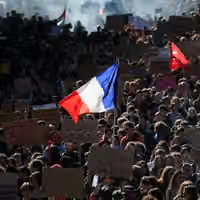
Tehran is signaling no retreat in the face of escalating protests, issuing fresh threats and hardening its rhetoric even as unrest continues across multiple cities.
Iran International
Tehran is signaling no retreat in the face of escalating protests, issuing fresh threats and hardening its rhetoric even as unrest continues across multiple cities.
Rather than acknowledge public anger or suggest compromise, Iran’s leadership has moved to project defiance—tightening control, mobilizing loyalists and insisting that the state remains firmly in charge.
That posture was most clearly on display on state television on Friday, with thinly veiled threats against protesters, including warnings to parents to keep their children off the streets “if they care about their safety.”
Channel 3, one of the country’s most-watched stations, framed the unrest as a coordinated assault on the state, while commentators denounced protesters for demanding basic civil rights even as images showed security forces firing tear gas and live ammunition into crowds.
Tehran’s mayor, Alireza Zakani, said protesters in the capital had set fire to dozens of buses and public buildings, branding them “terrorists” while omitting that many of those buses are routinely used to transport detainees.
Parallel universes
Leading this hard line—as always—was Supreme Leader Ali Khamenei, who delivered a defiant, threat-laden speech after a night of furious protests. He accused demonstrators of acting on behalf of foreign enemies and vowed to confront what he called “sabotage” with force.
Throughout the day, television screens depicted two Irans unfolding in parallel.
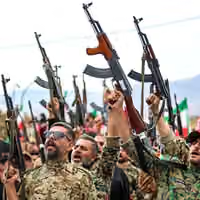
On one channel, young men with patchy beards sang aging anthems glorifying violence and sacrifice in the name of religious devotion. On another, images showed frustrated protesters attacking a supermarket—only to leave without taking anything. The two sides appeared to inhabit different moral and political universes.
The attacks on regime icons, including toppled effigies of former IRGC Qods Force commander Qasem Soleimani, point to something deeper than rage: the breaking of a spell.
For decades, Khamenei cultivated the image of an untouchable ruler—a giant towering over a society long conditioned to fear the machinery of repression. But power often begins to erode symbolically before it does materially.
An unmistakable shift
The Islamic Republic’s response to loud cries of rejection has been to insist, ever more loudly, that nothing essential has changed. Yet the need for such insistence is itself revealing. Giants do not announce their strength; they assume it.
When power must be constantly performed, restated and enforced on screen, it is often because the myth that sustained it is beginning to crack.
Iran’s leadership may yet suppress the unrest. It still commands formidable coercive tools. But the scenes now unfolding—even through the narrow lens of state television—suggest that something has shifted.
The state is shouting certainty into a country that no longer appears convinced. And once that moment arrives, the fall of a giant is no longer unthinkable—even if it is not yet complete.