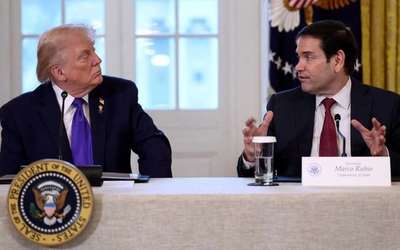
Iran’s Foreign Minister Abbas Araghchi reached out to White House envoy Steve Witkoff over the weekend amid President Donald Trump’s threats of military action in response to protests in Iran, Axios reported on Monday, citing two sources with knowledge of the matter.
The outreach appeared to be an attempt by Tehran to de-escalate tensions with Washington or buy time before any US action, the sources said.
One source said Araghchi and Witkoff discussed the possibility of holding a meeting in the coming days.
German lawmaker Hannah Neumann on Monday called on the European Union to expel Iranian ambassadors and official representatives, citing Tehran’s response to protests and what she described as a nationwide communications blackout.
In a post on X, Neumann said there could be no return to normal diplomatic relations with Iran under the current circumstances.
“No diplomatic normality with a regime that responds to peaceful protests with deadly headshots and cuts all communication lines for its people,” she wrote.
“Iranian ambassadors and official regime representatives should be expelled from the EU,” she added. “Anything less signals acceptance.”

Dutch Foreign Minister David van Weel said on Monday he was shocked by reports and images coming out of Iran and strongly condemned the use of violence against peaceful protesters.
In a post on X, van Weel called on the European Union to take action, including listing Iran’s Revolutionary Guards as a terrorist organization and imposing targeted sanctions.
“Shocked and appalled by the images and stories coming out of Iran. I strongly condemn the use of violence against peaceful protesters,” he wrote.
“Time for action: the EU should list the IRGC as a terrorist organization and impose targeted sanctions on human rights violators and those enabling repression through shutting down communication channels,” he added.
“The violence should stop now,” he said.
Italian lawmaker Giorgio Gori said on Monday that thousands of Iranians living in Italy were in distress over the crackdown in their home country and urged Europe and the Italian government to use all available means to pressure Tehran.
In a post on X, Gori said communications with Iran had been cut off since Thursday, leaving many without direct news from family members.
“For the 25,000 Iranian citizens living in Italy, these are days of anguish,” he wrote. “Communications with Iran are blocked. Since Thursday they have had no more contact or direct news.”
He said they were aware that many people had been killed in the repression and feared for the future of their country.
“They hope that Europe and the Italian government will use all the tools at their disposal to put pressure on the authorities in Tehran, and they hope for our support,” Gori wrote.
“Not making them feel alone is our task,” he added.
German lawmaker Norbert Röttgen said on Monday that Iran’s clerical leadership would eventually be overthrown, urging Western countries to prepare for what he described as a revolutionary process.
In a post on X, Röttgen, a member of Germany’s parliament, pointed to past and current waves of protests in Iran as signs of deepening unrest.
“The mullah regime in Iran will and must fall. It's only a matter of time,” he wrote. “We must prepare for the overthrow of the mullahs and support the revolutionary process.”
The European Union said on Monday it was ready to propose tougher sanctions on Iran following what it described as a violent crackdown on protesters.
Speaking at a news conference in Brussels, European Commission spokesperson Anouar El Anouni said the bloc stood in solidarity with the Iranian people and condemned the use of force.
“We do stand in full solidarity with the Iranian people, and we condemn the use of force against demonstrators. We are appalled by the reports of casualties,” he said.
El Anouni said the EU was prepared to move ahead with new measures, but that any decision would require the backing of all member states.
“We stand ready to propose new, more severe sanctions following the violent crackdown on protesters. This is a decision for Member States to take unanimously in the Council,” he said.
He added that the EU already had a legal framework in place targeting those responsible for serious human rights violations in Iran.
“We have a dedicated legal framework that is targeting perpetrators of serious human rights violations and abuses in Iran,” he said.