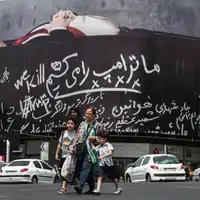
A group of Iranians living in New York City gathered in a public rally on Friday to voice support for Iran’s national uprising and for exiled prince Reza Pahlavi.
Participants said the protest aimed to show solidarity with demonstrators inside Iran, as authorities imposed nationwide internet shutdown during unrest. Shutting down connectivity, they said, would not silence dissent, adding that public anger and demands for change continue despite restrictions.

Foreign ministers from Australia, Canada and the European Union issued a joint statement on Saturday praising Iranian protesters and condemning the authorities’ actions.
“We commend the bravery of the Iranian people as they stand up for their dignity and their fundamental right to peaceful protest,” the ministers said. They also condemned the killing of protesters, violence, arbitrary arrests and intimidation by the authorities against civilians.
The statement urged Iran to immediately end the use of lethal force by its security bodies, including the Islamic Revolutionary Guards Corps and the Basij. Iranian authorities, it added, bear responsibility for protecting freedom of expression and peaceful assembly without fear of reprisal.

Iranian Prince Reza Pahlavi on Saturday called on protesters to continue their street demonstrations for two more nights and seize city centers, while urging energy and transport workers to start nationwide strikes.
In a message addressed to protesters, Pahlavi praised what he described as their “courage and resilience” after millions heeded his call for protests on Thursday and Friday, saying their mass turnout delivered a decisive response to threats issued by the Islamic Republic’s leadership.
He said the scale of the demonstrations had shaken the ruling establishment and exposed the fragility of its security apparatus.
Pahlavi said the next phase of the movement must focus on both sustained street presence and economic pressure, arguing that cutting off the Islamic Republic's financial lifelines would cripple its ability to continue its crackdown.
He specifically called on workers in transportation, oil and gas, and the broader energy sector to begin a nationwide strike.
The exiled prince urged protesters to take to the streets again on Saturday and Sunday evenings starting at 6 p.m., calling on them to carry national flags, symbols, and images and to reclaim public spaces.
He stressed that the objective had shifted beyond symbolic demonstrations, saying protesters should prepare to seize and hold central areas of major cities.
To achieve this, Pahlavi encouraged demonstrators to move toward city centers from multiple routes, link separate crowds together, and prepare for prolonged stays in the streets by arranging basic supplies in advance.
Addressing members of the security forces and armed units who have expressed support for the opposition’s defection platform, Pahlavi urged them to further slow and disrupt what he described as the Islamic Republic's “repression machine,” saying the goal was to disable it entirely at a decisive moment.
He also said he was making preparations to return to Iran, pledging to stand alongside the Iranian people at what he described as the victory of a “national revolution,” adding that he believed such a moment was approaching rapidly.

The Islamic Republic has entered a decisive rupture, with intensifying protests and internet blackouts pointing to a government increasingly reliant on force — dynamics that senior Western officials and analysts suggested may mark the beginning of an endgame.
Demonstrations have spread across major cities and provinces despite a nationwide internet and phone blackout, with rights groups reporting at least 42 people killed and more than 2,000 arrested since unrest began.
Supreme Leader Ali Khamenei on Friday accused foreign powers of fueling the protests and warned demonstrators of severe punishment, as security forces fired live ammunition in several regions.
Tom Tugendhat, a British MP and former UK security minister, told Eye for Iran the moment reflects a system confronting its own limits.
“I think this is the end game for the regime,” Tugendhat said.
“What we’re watching is not whether or not the regime survives, but how many people does it try to kill?” he added.
His remarks came as Iranian prosecutors threatened protesters with charges carrying the death penalty, and the Revolutionary Guards’ intelligence arm warned that the continuation of protests was “unacceptable.”
Western officials reassess as fear appears to erode
Early this week, US intelligence assessed that the protests lacked the momentum to threaten regime stability, US officials told Axios, but that assessment is now being reconsidered in light of recent developments.
“This is truly an extraordinary moment,” said Norman Roule, a former senior CIA official, who served as the national intelligence manager for Iran at the Office of the Director of National Intelligence from 2008 to 2017.
“We are watching a regime that is clearly in its dying days,” Roule said.
Roule said the leadership’s response shows narrowing options.
“It’s a government that can sustain itself, but it’s incapable of decisions that can stop this,” he said.
US President Donald Trump has warned Iran’s authorities against killing demonstrators, praising Iranians as “brave people” and signaling consequences if repression escalates. European officials and the UN human rights chief have also condemned the crackdown and the communications blackout.
Policy analysts say the current unrest is not an isolated episode but part of a longer erosion of regime authority.
“The Iranian people have the singular ability to expose the regime for its illegitimacy,” said Jason Brodsky, policy director at United Against Nuclear Iran.
“Since 2017 onwards, the Iranian people have come to the conclusion that the Islamic Republic can’t be reformed and therefore has to be overthrown,” Brodsky said.
Journalist and author of Nuclear Iran David Patrikarakos said the protests differ fundamentally from earlier waves that focused on specific demands.
“These aren’t issue-based protests anymore. These are existential,” Patrikarakos said.
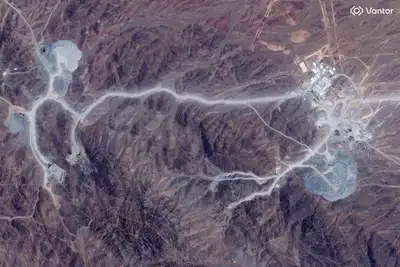
He said the leadership now faces a dangerous calculation. “If the Ayatollahs are tempted to think he’s bluffing, they should take a look at the ruins of their nuclear facilities,” he said, referring to recent US and Israeli strikes.
Protesters defy repression as blackout deepens
Verified videos circulating on social media show protesters confronting security forces in Tehran, Mashhad, Zahedan and other cities, even as authorities cut communications and deploy live fire.
One widely shared video shows a wounded protester declaring: “I’m not scared. For 47 years, I’ve been dead.”
The demonstrations have drawn participation across Iran’s political, ethnic and religious spectrum. Exiled Prince Reza Pahlavi praised the nationwide turnout and urged coordinated nightly protests, while Sunni cleric Molavi Abdolhamid warned of deepening poverty and backed the demonstrations.
International pressure has continued to build. The UN human rights chief said he was “deeply disturbed” by reports of killings and internet shutdowns, while EU officials accused Tehran of using blackouts to conceal violence.
Despite uncertainty over how events will unfold, guests on Eye for Iran converged on a central conclusion: the Islamic Republic is confronting a crisis in which repression remains its primary instrument, even as its effectiveness appears increasingly uncertain.
You can watch Episode 85 of Eye for Iran on YouTube or Listen on any podcast platform of your choosing.
The US State Department has warned Iran on Friday not to underestimate American resolve in response to the ongoing crackdown on protesters, in a statement to Washington Free Beacon.
"The Iranian regime is fully aware of President Trump's warning and should not test US resolve," a State Department spokesperson said in response to paper’s questions about the situation in Iran. "The Iranian regime should carefully consider the consequences of its actions and not underestimate the resolve of the United States under President Trump's leadership."
Senior Iranian official and ideologue Hassan Rahimpour Azghadi said on Friday that Iran should capture US President Donald Trump, just like what he did to Maduro, in response to Washington's stance on the protests in Iran.
“Given Trump's stance, any kind of operation inside US territory, in all its states and cities including destructive operations like those they carry out here, would be permissible… against American officials and those linked to them,” Azghadi said.
“Iran must do with Trump what they did to Maduro,” Azghadi, a member of Iran's Supreme Council of the Cultural Revolution, said. “Trump must pay the price during or even after his presidency and I personally hope Trump would be captured.”