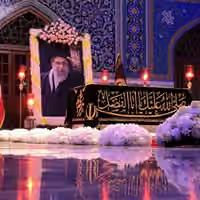
Mourners display large portraits of Arash Tolou Sheikhzadeh during a memorial gathering in Iran.
A 35-year-old protester arrested after January demonstrations in Mashhad died in hospital after weeks in a coma caused by severe torture in Revolutionary Guards intelligence detention, according to information received by Iran International.
Arash Tolou Sheikhzadeh was detained on February 6 when agents from the intelligence arm of the Islamic Revolutionary Guards Corps raided his home about a week after he shared videos of protests held in Mashhad on January 8 and 9.
After several days without contact and with his phone switched off, his mother went to his apartment and found it ransacked, with broken windows and no sign of her son, a source close to the family said.
Guards intelligence officials later confirmed he was in custody but refused to allow visits or calls and warned the family to remain silent, saying their other son could face consequences if they spoke publicly, the source added.
Iranian slain protester Arash Tolou Sheikhzadeh
Transfer to hospital in critical condition
On February 12, the family learned through a hospital contact that Arash had been transferred to Velayat Hospital in Mashhad with broken arms, legs and severe head injuries, including a damaged skull. He was admitted to intensive care with a level of consciousness of 2.5 and placed on a ventilator.
The first time his mother was allowed into the hospital, she could only see him from behind a glass partition after repeated requests, the source said.
“His head was bandaged, his hands and feet were bandaged, and he was completely unconscious,” the source said. “When she asked why her son was like this, the officer told her, ‘We did nothing. He had a stroke.’”
Family members said Arash had not been injured during the protests and had continued going to work in the days before his arrest.
Life support cut despite signs of improvement
Arash’s condition showed relative improvement during his stay in intensive care, according to a hospital source who contacted the family. His level of consciousness rose from 2.5 to 5 over three days.
Despite this, his ventilator was switched off on February 15, leading to his death, the source said.
“His condition was clearly getting better,” the source said. “But they turned off the ventilator and effectively killed him.”
When relatives went to the hospital after learning of his death, security personnel denied them access and told them he was alive and had been moved to another ward, the source added.
Burial under tight security
Authorities informed Arash’s mother on February 20 that his body would be handed over the next day. They imposed conditions including no autopsy, a quiet burial and attendance limited to immediate relatives.
“They said they would hand over the body. You are not allowed an autopsy. A quiet burial, only first-degree relatives. Wearing bright clothes, clapping, celebrating, dancing – none of that is permitted. Very quietly. Otherwise, we will not release the body,” the source said.
The body was delivered on Saturday, February 21, at Behesht Reza cemetery in Mashhad, where plainclothes and uniformed forces were deployed in large numbers. The handover was delayed beyond the announced time, the source said.
Despite warnings not to open the shroud, Arash’s mother and relatives briefly uncovered his face before burial.
“When they brought the body, his face was bruised and swollen and there was a clear baton mark on his fractured skull,” the source said. “They tortured him badly.”
Flowers placed on grave during a memorial for Arash Tolou Shekhzadeh.
A young man active on social media
Arash, born on December 14, 1988, lived alone in Mashhad and worked as a barista at a café. His Instagram posts showed an interest in social and political issues. He had used the hashtag “Revolution 1401” in support of the “Woman, Life, Freedom” uprising and in one earlier post criticized what he described as superstitious religious beliefs, warning that ignorance lay at the root of many problems.
Arash’s mobile phone remains in the possession of Guards intelligence, the source close to the family said. Friends have noticed that his Instagram account appears to remain active, suggesting that security agents may be monitoring the social media activity of his contacts.