Trump backs Iran protesters, calls them ‘brave people’

US President Donald Trump warned Iran’s authorities against killing protesters amid nationwide demonstrations on Thursday, praising Iranians as “brave people.”

US President Donald Trump warned Iran’s authorities against killing protesters amid nationwide demonstrations on Thursday, praising Iranians as “brave people.”
Millions of Iranians took the streets across the country for a national rally called by exiled Prince Reza Pahlavi.
Trump told podcaster Hugh Hewitt that the Iranian leaders "have been told very strongly… that if they do that, they’re going to have to pay hell.”
This is the third time since the start of protests on December 28 that Trump has warned Tehran not to kill demonstrators or face possible US intervention.
Addressing Iranians directly, he urged them to “feel strongly about freedom,” and said: “There’s nothing like freedom. You’re brave people. It’s a shame what’s happened to your country.”
Protesters in Iran have appealed directly to Trump for protection. Rights groups say at least 36 people have been killed since the protests began on December, while more than 2,000 people have been arrested or detained.
A nationwide internet blackout hit Iran on Thursday according to live network metrics from network monitoring groups.
Asked if he would meet exiled Prince Pahlavi, Trump said he still waits to see what happens in Iran before meeting or endorsing any opposition figure.
"Well, I've watched him, and he seems like a nice person, but I'm not sure that it would be appropriate at this point to do that as President," Trump responded. "I think that we should let everybody go out there and see who emerges. I'm not sure necessarily that it would be an appropriate thing to do."
‘US Back people of Iran’
Vice President JD Vance said the administration stands by “anybody who is engaged in peaceful protests” and seeking to exercise “their rights of free association and to have their voices heard,” including in Iran.
"Obviously, the Iranian regime has a lot of problems, as the President of the United States has said, the smartest thing for them to have done, it was true two months ago, it's true today, is for them to actually have a real negotiation with the United States about what we need to see when it comes to their nuclear program," Vance said to reporters at the White House.
"I'll let the President speak to what we're going to do in the future. But we certainly stand with anybody across the world, including the Iranian people, who are advocating for their rights,” he added.


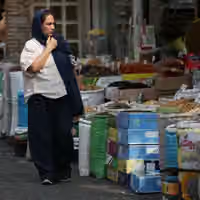
It began with metal shutters dropping in Tehran. At two neighboring shopping centers, shopkeepers on Dec. 28 pulled down their doors as security forces moved in, and the first chants rose from the corridors into the street.
“Honorable merchants; support, support!” When security forces arrived, the most urgent refrain was not yet a political manifesto. It was a promise of mutual protection: “Don’t be afraid, don’t be afraid; we’re all in this together.”
From there, the videos show how quickly what many initially read as an economic protest widened into something explicitly political.
Iran International reviewed 463 clips from the uprising’s first 10 days – recorded in 91 cities, towns and villages – and coded every instance in which chants were clearly audible.
Across the footage, we identified 93 distinct chants heard across 641 recorded chant instances, or occurrences of chants in the videos, not a count of unique slogans or unique events.
The slogans heard across that footage trace a rapid shift: from strike calls and solidarity to direct rejection of the Islamic Republic and, increasingly, calls for the return of monarchy.
That first day, the footage was narrow. Beyond one clip from Shoush market – where merchants chanted, “Pezeshkian, have some shame; give up the presidency” – few other slogans from outside the merchants’ immediate world were clearly audible in the videos we reviewed.
On the second day, strike calls such as “Close up, close up” still echoed through the bazaars – but the protest vocabulary broke decisively into open confrontation with the Islamic Republic.
In Tehran, chants like “Until the cleric is buried, this homeland won’t become a homeland” and “Cannons, tanks, fireworks; mullahs must go” signaled a shift from trade grievance to political defiance.
That same day, a line surfaced that would come to define the first 10 days in our video analysis: “This is the final battle; Pahlavi will return.”
From this point forward, the uprising’s slogans were no longer simply about pressure or protest. They were about power – and what should replace it.
The pro-Pahlavi chant was heard in universities too, surprising some observers and even triggering accusations of video manipulations.
At Allameh Tabataba’i University, students chanted, “Neither Pahlavi nor the Supreme Leader, freedom and equality.” At Beheshti University, a line from the Woman Life Freedom movement of 2022 was heard: “You’re the lecher; you’re the whore; I am a free woman."
As the days went on, the geography widened.
The footage moved beyond Tehran into smaller cities and towns – Kouh-Chenar, Farsan, Asadabad, Juneghan – while protests continued in dormitories as well as streets.
What stood out across these scenes was not only the spread of the demonstrations, but the repetition of two dominant political poles in what people shouted: opposition to the Islamic Republic, and support for the Pahlavi family.
By the middle of the 10-day period, the uprising’s language also began to absorb the weight of mourning. Chants were not only rallying cries, but elegies.
In Kouhdasht, mourners chanted: “This flower has been torn apart; it has become a gift to the homeland.” They also repeated the slogans already familiar from the streets: “Pahlavi will return,” and “Death to the dictator.”
In Fooladshahr, mourners chanted “Death to Khamenei” at the burial of Dariush Ansari, one of the first protesters killed in this round of unrest. In Marvdasht, at the burial of Khodadad Shirvani Monfared, “Long live the Shah” was also chanted.
The uprising was not speaking in one register. It was speaking in many – anger, grief, defiance, and sometimes myth.
In Zahedan, footage recorded “Allahu Akbar” and “Death to Khamenei” after Friday prayers. In a village in Hamedan province, another line appeared: “Wail, Seyyed Ali (Khamenei); Pahlavi is coming.”
In Shiraz University’s dormitory courtyard, students chanted: “The Shah is coming home; Zahhak will be overthrown” – using the mythic tyrant Zahhak as a stand-in for Khamenei.
Toward the end of the 10 days, the volume of videos fell – fewer clips surfaced in our review – yet some of the most intense scenes were recorded in that period.
Funerals in Malekshahi, Ilam province, for Latif Karimi, Reza Azimi, and Mehdi Emami-Pour were marked by chants including “I will kill, I will kill, whoever killed my brother.”
One clip recorded citizens pleading “Police force; support, support” during an attack on a hospital in Malekshahi, even as officers stormed the facility.
Day 9 brought a quieter map but a sharper political profile. In the footage published from eight cities and villages, three chants rose most clearly: “Long live the Shah,” “Death to the dictator,” and “Neither Gaza nor Lebanon; my life for Iran.”
In Chenar-Sheikh (Chenar Sofla), the biggest village in Hamedan province, protests continued, and one line that drew attention – “Khamenei is a murderer; in your dreams” – echoed a Persian-language comment posted by Elon Musk under one of Ali Khamenei’s posts on X.
Then, on the tenth day, the footage suggested renewed momentum. Protests were recorded across 19 cities, with the signature chants against "the dictator" and for Pahlavi leading the chorus.
In some campuses, students continued – sometimes with the simplest insistence of all: “Freedom, freedom, freedom”; sometimes with a pledge of endurance: “Don’t think it’s just today, our appointment is every day.”
Across the footage, one thing is constant: people are not only protesting, but naming an alternative.
The future of this latest round of unrest is not written. But another chapter in Iranians' journey towards an Iran without the Islamic Republic is being drafted, line by line - and in the open.

A nationwide internet outage has gripped Iran, according to London-based internet monitoring group NetBlocks, shortly after massive crowds poured into the streets following calls for nationwide protests.
The shutdown, also confirmed by Tehran-based outlets, comes as anti-government protests continue to escalate and demonstrators take to the streets in the capital and nationwide despite deadly crackdowns by security forces.
“The incident follows a series of escalating digital censorship measures targeting protests across the country and hinders the public's right to communicate at a critical moment,” Netblocks added.
Iran has cut internet access before during mass unrest in 2022, 2019 and 2009. Those moves coincided with deadly attacks on demonstrators which ultimate quashed the protest movements.
Social media platforms are routinely difficult for Iranians to access even in normal times, with official curbs sending many users to virtual private networks, or VPNs, to bypass official censorship.
The "digital blackout", as described by Netblocks, started immediately after huge crowds of people took to the streets across the country heeding a call for nationwide protests at 8 pm by Prince Reza Pahlavi.

British lawmaker Tom Tugendhat told parliament on Thursday that there were reports of Russian cargo aircraft landing in Tehran and quantities of gold leaving the country.
“We’re also seeing Russian cargo aircraft coming and landing in Tehran, presumably carrying weapons and ammunition, and we’re hearing reports of large amounts of gold leaving Iran,” Tugendhat said. It was unclear what reports he was referencing.
Anti-government protests have gripped Iran since Dec. 28 in one of the biggest challenges yet to the near 50-year rule of the Islamic Republic.
US-based rights group HRANA reported that 34 protestors and 2 members of the security forces have been killed.
Tugendhat asked the government to comment on the information that he said could indicate preparations “for life after the fall.”
Responding to the remarks, UK Minister for the Middle East and North Africa Hamish Falconer said he was “not in a position to give a detailed update” on the assertions.
Britain, Hamish added, believed freedom of assembly and the right to protest were “inalienable rights of the Iranian people” and should be respected by the Iranian authorities.
Tugendhat had earlier suggested senior figures in Iran’s government may already be reaching out to foreign intelligence services and trading secrets in search of protection if the government falls.
“How many senior regime officials are reaching out to foreign intelligence officials and trading secrets for security when the regime collapses?” Tugendhat posted on X on Friday.
“The leadership will be suspicious that many are looking for safe landing but paranoia won't help many of the leaders are doing it too,” he added.

Iranian officials have begun publicly blaming one another and foreign foes for ongoing unrest across the country, exposing sharp divisions in Tehran on one of the greatest challenges yet to the Islamic Republic.
Members of parliament have accused both the government and the public of contributing to the economic collapse that triggered the unrest.
President Massoud Pezeshkian and members of his administration, in turn, have pointed the finger back at parliament, underscoring a familiar pattern of elite infighting during periods of crisis.
Speaking at a meeting with officials and academics on Tuesday, January 6, Pezeshkian acknowledged that responsibility for the current situation was shared.
In a characteristically self-critical tone, he said his administration and the Majles both bore blame for the failures that had led to the unrest.
Elephant in the room
Notably absent from official statements has been any reckoning with the role of Supreme Leader Ali Khamenei or the effects of decades of centralized rule.
In his only intervention on protest so far, Khamenei appeared to urge authorities to tighten the control.
“Protest is legitimate, but protest is different from rioting,” he said on Saturday. “We talk to protesters, but there is no use in talking to rioters. Rioters must be put in their place.”
Protesters have made Khamenei a central target, accusing him of bankrupting the country through military adventurism and the financing of regional proxy groups.
‘US mercenaries’
As demonstrations continued for an eleventh consecutive day on Wednesday, hardline lawmakers reiterated familiar rhetoric dismissing the protests as foreign-instigated.
Fatemeh Mohammadbeigi, a lawmaker from Qazvin, labeled protesters “rioters” and said they should be intimidated into ending what she called their “mutiny.”
“Enemies are importing weapons into Iran,” she asserted, calling on security forces to “confront the rioters with strict measures.”
Rights groups and activist networks say at least 36 protesters have been killed since the unrest began, with many more injured. A hospital in the uniquely restive province of Ilam was attacked to arrest wounded demonstrators.
MP Mohammadbeigi alleged in an interview with moderate outlet Rouydad24 that “Israeli and US mercenaries” were responsible for the hospital raid as well as for shutting down markets and damaging property.
Infighting unabated
Similar claims were echoed by Esmail Kowsari, a Tehran lawmaker, IRGC officer and member of parliament’s national security committee.
Speaking to the state-linked ILNA news agency, Kowsari accused “enemies” of attempting to sow discord in Iran, arguing that Israel and the United States, which he said had been “defeated in the war with Iran,” were now waging a “soft war” through social media.
Kowsari also criticized the government for “leaving the markets uncontrolled” and suggested parliament should summon the president to explain the situation.
Moderate figures have warned that such moves risk deepening the crisis.
Hassan Rassouli, a former governor of the protest hotbed Lorestan, warned that questioning Pezeshkian in parliament “would be tantamount to attacking the commander during a battle.”
In an interview with moderate outlet Khabar Online on Wednesday, he accused hardline lawmakers of staging “a show of authority” at a moment when Tehran—in his words—should focus on containing unrest, not escalating internal power struggles.

The Western Iranian province of Ilam has emerged as one of the epicenters of nationwide protests, with some of the deadliest confrontations yet between demonstrators and security forces.
Roughly half of all reported fatalities so far—around 20 protesters—have occurred by direct gunfire in western provinces, according to activist and local reports.
Many of the deaths have occurred in Ilam, Lorestan, Chahar-Mahal and Bakhtiari, and Kohgiluyeh and Boyer-Ahmad, areas that have long ranked among Iran’s most economically deprived and are home largely to ethnic Kurdish and Lor populations.
The scale of unrest has been especially striking in Ilam.
On Tuesday night, videos showing large crowds protesting peacefully in Abdanan, a city of about 25,000, circulated widely on social media, surprising many Iranians.
A day later, similarly large demonstrations took place in Aligudarz, a city of fewer than 100,000 in neighboring Lorestan, where crowds chanted slogans against Supreme Leader Ali Khamenei.
Witness accounts and videos suggest participation levels unusual for cities of that size—an indication, activists say, of how deeply economic grievances and political anger have penetrated Iran’s smaller, poorer communities.
Despite this, state media have continued to minimize the protests.
The state-affiliated Tasnim News Agency described demonstrations in Lorestan as failed “riots,” claiming people “did not show up,” while acknowledging that inflation there has exceeded the national average.
Attack on hospital
Anger across Ilam intensified further after events at Imam Khomeini Hospital in the provincial capital on Sunday, following the transfer of wounded protesters from demonstrations in Arkavaz, the center of Malekshahi county.
State outlets accused protesters of attacking the hospital, saying police entered the facility to restore order. Eyewitnesses, however, described a security raid in which tear gas was fired inside the hospital and injured protesters were removed.
A rare on-the-ground report by the moderate daily Ham-Mihan, citing multiple witnesses and medical staff, said protesters arriving at the hospital were unarmed and had been shot after a peaceful march.
Several were already dead on arrival, while others later died from gunshot wounds, including injuries caused by military-grade bullets. Some families, the report said, rushed wounded relatives out of the hospital to prevent their arrest.
The incident drew a rare official response from the government.
The Health Ministry stressed the “sanctity” of medical facilities, saying any entry by security forces into hospitals or harm to patients violated humanitarian principles.
Government spokeswoman Fatemeh Mohajerani said damage to medical centers was unacceptable “under any circumstances” and announced that President Masoud Pezeshkian had ordered an investigation, dispatching a representative to Ilam to prepare a report.
For many residents, however, the episode has come to symbolize a broader breakdown: a protest movement spreading from Iran’s margins, met not only with lethal force in the streets, but—according to witnesses—even inside places meant to offer refuge.