Iran crossed a political threshold
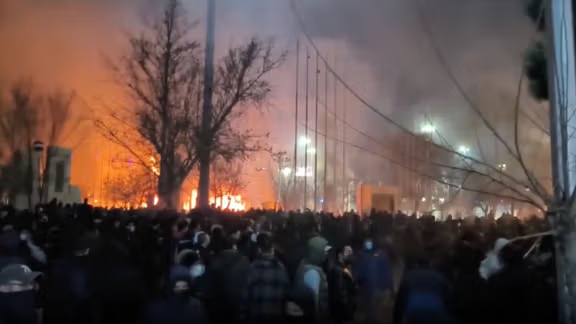

What happened in Iran on Thursday night was not simply another protest. Coordinated mass demonstrations unfolded nationwide in response to a direct call from Prince Reza Pahlavi that specified not only the action but also the timing.
Calls for action from outside Iran have been issued many times over the years and largely ignored. This one was answered, simultaneously and at scale. The precision of the call and the response to it surprised supporters and skeptics alike. Thursday night did not produce regime change, but it marked something no less significant: a visible crossing of a political threshold.


What happened in Iran on Thursday night was not simply another protest. Coordinated mass demonstrations unfolded nationwide in response to a direct call from Prince Reza Pahlavi that specified not only the action but also the timing.
Calls for action from outside Iran have been issued many times over the years and largely ignored. This one was answered, simultaneously and at scale. The precision of the call and the response to it surprised supporters and skeptics alike. Thursday night did not produce regime change, but it marked something no less significant: a visible crossing of a political threshold.

Revolutions do not begin on a single night. They surface after long periods of accumulated rupture. Iran has been politically and psychologically boiling for roughly two decades. What we are witnessing today is the outward expression of a process that began with the collapse of legitimacy in 2009.
That year’s presidential election shattered the Islamic Republic’s claim to popular consent. Until then, despite deep frustration, many Iranians still believed meaningful change was possible through participation, through the ballot, reformist candidates, and gradual adjustment within the system. The blatant manipulation of the vote and the violent suppression of mass protests ended that belief. What followed was not merely repression, but an emotional and moral divorce between society and state. The system survived, but consent did not.
The 2015 nuclear agreement briefly altered the trajectory. It reopened the possibility that Iran might normalize and that ordinary people could reclaim what they often describe as a “normal life.” That hope proved fleeting. Billions of dollars entered the country after nuclear-related sanctions were lifted, yet resources were overwhelmingly diverted toward missile and drone programs and the expansion of proxy networks in Syria, Iraq, Lebanon, and Yemen. Meanwhile, the national currency collapsed, inflation surged, and household purchasing power steadily eroded.
These economic realities are widely known. What has been far less understood, particularly across Western media and policymaking circles, is what was happening beneath the surface. Iranian society had largely exited the Islamic Republic at the level of belief. This was no longer dissent or protest. It was post-loyalty. People were no longer asking how to reform the system. They were asking what could replace it.
Symbols matter when legitimacy erodes, especially when long-standing taboos break. A critical moment came in 2018, when a mummified body, widely believed to be that of Reza Shah, was discovered at a construction site in Shahr-e Rey, near Tehran, where his mausoleum once stood before being demolished after the revolution. Whether the remains were authentic was ultimately irrelevant. What mattered was the reaction. Public chants of “Reza Shah, may God bless your soul” emerged, chants that would have been unthinkable in public space just years earlier.
At first, these slogans were interpreted as expressions of anger toward the Islamic Republic rather than positive reassessment of the Pahlavi era. That reading did not hold. The chants returned, spread geographically, and grew more explicit. A psychological barrier had been crossed.
By the mid-2020s, this symbolic shift became increasingly evident on social media, where attention clustered around Reza Pahlavi. Some observers dismissed his prominence there as a product of manipulation or as evidence that social media itself is an unreliable gauge of political reality. Yet the pattern was unmistakable. Content linked to him consistently generated unusually high engagement across Persian-language platforms, circulating organically, resurfacing repeatedly, and sustaining visibility well beyond individual protest cycles.
The current wave of protests made this underlying reality impossible to dismiss. From the outset, calls for Pahlavi’s return were explicit and widespread. Some skeptics again attempted to discredit the scenes by claiming that videos were manipulated or that slogans had been dubbed in. That explanation did not withstand repetition or scale. The same chants were heard across multiple cities and nights in unrelated recordings, revealing in public what had been forming beneath the surface for years.
The significance of Thursday night lies not in raw numbers alone, but in coordination and credibility. Many external calls in the past produced little or nothing. This one did not. For the first time, a call issued for a specific hour was answered across the country. Demonstrations began simultaneously at the designated time, offering clear evidence of collective response rather than scattered unrest. That precision, and the response to it, marked a qualitative shift in Iran’s political dynamics.
The Islamic Republic still controls the machinery of the state. What it lost on Thursday night is exclusivity over its remaining political legitimacy, both domestically and internationally. From this point on, foreign governments are no longer dealing with an uncontested representative of the Iranian nation, but with a regime whose claim to speak for Iran is openly challenged. Power maintained by force can endure for a time. Power stripped of legitimacy does not recover it.
At the same time, Reza Pahlavi crossed a line that many before him failed to reach. This was not symbolism, nostalgia, or digital noise. It was a successful act of political command. Others issued calls from abroad and were ignored. He issued one, and it was answered nationwide and on schedule. That is not popularity. That is operational leadership.
With this, Iran’s opposition space has been fundamentally reordered. The question is no longer whether Iranians are searching for an alternative or whether a leader could emerge. Both questions have been settled. A focal point now exists, and the regime is forced to reckon with it.
From this moment on, Iranian politics operates under new constraints. The state must now respond not to spontaneous unrest, but to an identifiable center of mobilization. History shows that regimes can survive protests. They struggle far more to survive leaders.
After Thursday night, the Islamic Republic faces a reality it has long sought to prevent. It no longer confronts a crowd. It confronts a contender.
Three days after merchants ignited strikes across Iran, the country’s bazaar is now openly defying the Islamic Republic, marking a historic break between conservative traders and a state accused of sacrificing livelihoods to missiles and security spending.
Historically, in Iran, religious institutions and conservative merchants—the Bazaaris—were inseparable allies. It was the Bazaaris who bankrolled the anti-state revolution of 1979, famously chartering the plane that carried Ayatollah Khomeini back to Tehran.
Yet, 46 years later, the Islamic Republic has managed to alienate its oldest and most critical constituency. For the Iranian merchant today, that alliance is dead, and commerce has become a losing game.


Three days after merchants ignited strikes across Iran, the country’s bazaar is now openly defying the Islamic Republic, marking a historic break between conservative traders and a state accused of sacrificing livelihoods to missiles and security spending.
Historically, in Iran, religious institutions and conservative merchants—the Bazaaris—were inseparable allies. It was the Bazaaris who bankrolled the anti-state revolution of 1979, famously chartering the plane that carried Ayatollah Khomeini back to Tehran.
Yet, 46 years later, the Islamic Republic has managed to alienate its oldest and most critical constituency. For the Iranian merchant today, that alliance is dead, and commerce has become a losing game.
Despite having no hand in inflation, merchants are often blamed as price gougers. If they reject state-mandated pricing, they are accused of hoarding and tampering with the market; if they comply, they may not be able to afford to restock their inventory, selling their way into bankruptcy.
Simultaneously, the centralized allocation of foreign currency for imports drags on for months, while exporters are forced to sell their hard-earned foreign currency at losses due to state pressure.
The atmosphere grew more volatile last week with the announcement of a new gasoline pricing policy, which exacerbated existing anxieties about the economy.
The release of the next year’s budget was the last straw. With oil revenues projected to cover a mere 5% of administrative costs, the government wants the public to foot the bill through deficit spending and significant tax increases.
The trade-off is stark: while every subsidy has been stripped from the ledger, the budget for security and defense has increased. By prioritizing the military and security over public welfare, the state has effectively transferred the entire burden onto the people’s dinner tables.
The market is rejecting this pressure. Merchants argue that they are being suffocated to fund the state's regional ambitions. Facing chronic 60% inflation and the weight of sanctions, business owners can no longer survive, let alone profit.
The message from the bazaar is clear: the economy cannot sustain the vows to rebuild the missile arsenal.
The state’s response to the protests has been predictable: a photo-op meeting with a handpicked group of supportive businessmen and the scapegoating of the Central Bank Governor.
The dismissal of Mohammad-Reza Farzin had been on the table for months, held in reserve as a sacrificial offering. Now, with protests spreading throughout the country, the administration offers his firing as a promise of change.
But the Iranian people see through this theater. They know the Central Bank Governor is not an independent policymaker, but a mere functionary. Replacing him with Abdolnaser Hemmati—a recycled official previously fired from the same post over rial's devaluation—signals continuity, not reform.
Public slogans reveal that the bazaar and the street are now speaking with one voice. The grievances have moved beyond daily economics; they challenge the specific governing priorities that drive this decline. The public understands that their economic distress is not an accident of mismanagement, but the calculated cost of the state's strategic choices.
This leaves the Islamic Republic with a binary choice: abandon regional ambitions and missile proliferation to return to the negotiating table, or double down on repression.
As evidenced by the direct fire opened on protesters yesterday, the regime has chosen the path of force. The market’s message is unmistakable: the people want fundamental change. The government’s answer is not reform, but bullets.

Free speech. Open dialogue. People having access to one another, the ordinary ability to speak freely and exchange ideas. These might be the downfall of the system patiently built up by Supreme Leader Ali Khamenei, not foreign weapons.
A public sphere not mediated by state television or controlled narratives. People simply talking to each other, in real time, in a forum beyond the reach of power.
That is the fear.
I say this not as a theorist or a politician, but as the host of a nightly call-in program that attempts, modestly and imperfectly, to make such exchanges possible.
The experiment is simple.
There are no slogans, no marching crowds, no images calibrated for cable news. Instead, there is a microphone, a live line, and an invitation so unassuming it almost sounds apolitical: talk. Not perform. Not chant. Not rehearse ideology. Just talk, to one another, in real time, about what has gone wrong, what hurts, what frightens, and what still feels imaginable.
A society that cannot speak to itself is condemned to repeat its errors. A society that can speak cannot be governed indefinitely by myth.
Fractured by fear
Iran is among the most politicized societies in the world, yet genuine political dialogue is structurally impossible.
Families learn which subjects to avoid at the dinner table. Schools train obedience rather than inquiry. State media speaks incessantly but listens to no one.
Even social media, often romanticized as a space of resistance, is fractured by fear, surveillance, and mutual suspicion.
The result is not apathy, but exhaustion.
Questions accumulate without resolution. Why does a country rich in oil and gas fail to provide reliable electricity? Why do rivers vanish while neighboring desert states manage water abundance?
Why does each generation inherit fewer prospects than the one before it? Is war inevitable? Is collapse? Is change possible without catastrophe?
These questions never cohere into shared understanding.
Online, coordinated campaigns flood debates with distraction and distortion, contaminating the very spaces where collective reflection might otherwise take shape. Fragmentation serves power.
A society arguing with itself is a society distracted from those who govern it.
The most dangerous conflict in Iran today is not between the state and the people, but among the people themselves, along ideological, generational and emotional fault lines.
In the aftermath of the recent brief war with Israel, many Iranians found themselves at a crossroads, unsure whether the future demanded silence, rupture, or something harder and more fragile.
Dialogue, in this context, is not reconciliation with power, nor a plea for moderation as a moral posture. It is not an elite exercise in rhetoric.
Real dialogue is untidy. It requires listening to voices one distrusts. It rests on a radical premise: that no one, neither the dissident nor the conscript, neither the exile nor the factory worker, is disposable by default.
The right to speak, and to hear
On my program, I try to create space for that premise to be tested. The format is open, live, and unfiltered. Callers speak without ideological vetting. What matters is not agreement, but participation.
Recently, callers from Tehran, Rasht, Shiraz and Zahedan spoke openly about leadership, foreign intervention, a monarchy versus a republic, internet shutdowns, nonviolent resistance and the ethics of accountability if the Islamic Republic falls.
Some urged speed. Others warned against vengeance. Some placed hope in figures abroad. Others insisted that change must be rooted domestically.
At one point, a caller argued that anyone associated with the state must be punished. Another responded that a society cannot be rebuilt on the promise of mass retribution. Justice, he said, requires distinction, between those who committed crimes and those who merely survived within a coercive system.
In most democracies, such an exchange would pass unnoticed. In Iran, it is revolutionary.
It is precisely this kind of public, imperfect, unscripted reasoning that authoritarian systems fear most.
The Islamic Republic today appears brittle. Its supreme leader speaks of progress while citizens search for medicine and hard currency. Parliament performs loyalty. The judiciary enforces obedience. State media manufactures fake optimism. Yet none of these institutions command belief.
What they cannot tolerate is unity that does not require uniformity.
A national conversation produces legitimacy, among citizens. It generates shared language, moral boundaries, and, eventually, political imagination. Once people agree on what the problem is, power loses its monopoly on explanation.
Speech connects. Connection organizes.
Silence, by contrast, is a slow death. It corrodes trust. It persuades people that their doubts are solitary.
They are not. Iran does not lack courage. It lacks space.
Every Thursday night, that space opens briefly on my show, long enough to remind people that the most radical demand is not vengeance, or even freedom, but the right to speak, to be heard, and to understand one another before history forces the conversation in blood.
That, ultimately, is what terrifies Iran’s supreme leader.

Power politics in Tehran has reached a stage where even the most routine public affairs—a film festival, an environmental report or the World Cup draw—spiral into controversy, as if the system cannot tolerate anything resembling normalcy.
Last week, an international film festival was held in the historic city of Shiraz. To emphasize the festival’s international character, organizers invited one of Turkey’s most acclaimed filmmakers Nuri Bilge Ceylan to head the jury.
The announcement angered hardliners, who framed it as a cultural intrusion. Culture Ministry officials who organized the event did not dare explain the meaning of “international.” Even if they had, few would have listened.
While the festival attempted to celebrate cinematic creativity in a conspicuously muted way—so as not to provide ammunition to political rivals—security forces in Tehran raided a private birthday gathering of Iranian filmmakers and arrested several for drinking.
It was another reminder that even culture, perhaps especially culture, cannot escape the state’s instinctive need to police spontaneity.
On air sagas
That same week, cleric Abdolrahim Soleimani Ardestani sparked outrage during a live debate on a popular YouTube-based platform when he asserted that a Shi'ite Imam was killed by his wife after discovering he had taken a second wife.
Fundamentalists and hardliners swiftly accused him of insulting religious sanctities—an allegation that could carry the death penalty—ultimately forcing him to apologize.
In the same week, a local official in the western province of Kohgiluyeh and Boyer-Ahmad openly questioned President Masoud Pezeshkian’s water policy during a televised event.
Visibly angry, Pezeshkian shouted that the dams in question were not signed off by him. The live broadcast was abruptly cut off when the official produced documents that proved the president wrong.
A mundane administrative event turned combustible in a system where power is perpetually on edge.
Everything—even football
Then came the 2026 World Cup draw in Washington DC, and the saga surrounding entry permits for Iran’s delegation.
Tehran first announced it would boycott the event after the United States issued visas to only four of the nine delegates—a high number, as countries typically send one to four representatives.
After two weeks of heated debate in Tehran, the boycott was abandoned and two delegates were sent to the draw following “consultations with the Foreign Ministry.”
Predictably, no one asked why such consultations had not taken place before the hasty boycott. Nor did anyone question why the federation or government failed to protest the ban on Iranian spectators traveling to the US for the 2026 World Cup.
Sports diplomacy became yet another venue where reflexive posturing overtakes basic competence.
Strange as it may seem, this was simply another ordinary week in Iran—a week where the smallest acts are politicized, the simplest decisions are derailed, and the state’s fear of normalcy turns daily life into a continuous cascade of avoidable crises.