Why Iran should take Trump’s threat seriously

Bozorgmehr Sharafedin
Iran International
Iran International
Unlike his predecessors who largely stayed silent in the early days, Donald Trump issued an unusually blunt warning over the killing of demonstrators in Iran, a message Tehran appears unable to dismiss lightly given its speed, tone, and source.
On the second day of protests, he condemned the Iranian government for firing on demonstrators. On day six, he went further, warning that if the killing of protesters continued, US forces “will come to their rescue.”
This amounts to the fastest and most explicit reaction by an American president to a wave of unrest in Iran in the past 45 years. The question is whether this posture translates into concrete diplomatic steps or credible military pressure—or remains a largely symbolic deterrent message.
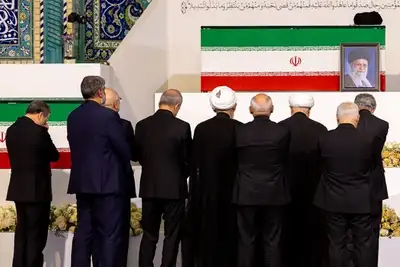




Within a week of the outbreak of protests in Iran against the Islamic Republic and its rulers, US President Donald Trump weighed in twice with direct comments.
On the second day of protests, he condemned the Iranian government for firing on demonstrators. On day six, he went further, warning that if the killing of protesters continued, US forces “will come to their rescue.”
This amounts to the fastest and most explicit reaction by an American president to a wave of unrest in Iran in the past 45 years. The question is whether this posture translates into concrete diplomatic steps or credible military pressure—or remains a largely symbolic deterrent message.
In 2009, former US president Barack Obama responded cautiously to Iran’s Green Movement protests. At the time, he had sent a second letter to Iran’s supreme leader, Ali Khamenei, and had yet to receive a reply. Obama feared that open support for protesters could undermine the secret backchannel he was attempting to establish with Khamenei to resolve the nuclear standoff.
At the same time, his advisers warned that overt US backing could backfire: protesters might be branded as “foreign agents,” giving the government a pretext to crack down even harder.
Those concerns are far less salient for Trump, at least for now. On one hand, there is currently no meaningful or active diplomatic channel between Tehran and Washington that a sharp US stance could weaken or shut down.
On the other hand, Iranian officials have for years accused protesters of being agents of hostile powers—a charge repeated by Khamenei himself in a recent speech on the unrest—rendering the label largely meaningless. There is little indication that demonstrators now fear either foreign support or accusations of outside ties.
Years later, Obama acknowledged that his cautious approach to the Green Movement had been a mistake, arguing that the United States should support popular, pro-freedom movements wherever they arise. Trump’s swift and blunt reaction suggests he has avoided a similar error.
The Obama administration’s experience also underscores another lesson: firm rhetoric is not enough. In 2012, Obama declared that the use of chemical weapons by the Syrian President Bashar al-Assad constituted a US “red line.”
Yet a year later, a sarin gas attack on Eastern Ghouta, a rebel-held suburb to the east of Damascus, killed hundreds of civilians, but the United States did not launch a military strike. Instead, Obama pursued a diplomatic route to remove Syria’s declared chemical weapons stockpiles.
That effort reduced—but did not end—the use of chemical weapons in Syria, and it significantly weakened Obama’s standing, and that of the United States, among Syrian opposition groups.
Trump, by contrast, appears keenly aware that unfulfilled threats erode both his personal authority and the projection of American power. He has acted on threats toward Iran twice: first, with the killing of Qassem Soleimani exactly six years ago, on January 3, 2020, and second, with a strike on Iranian nuclear facilities around 200 days ago.
On Saturday, Trump also followed through on recent threats against Venezuelan President Nicolas Maduro, announcing that the United States had carried out a major operation against Venezuela and detained Maduro and his wife, removing them from the country.
Tehran moved quickly to respond to Trump’s threat against the Islamic Republic’s repressive forces targeting protesters, suggesting that Khamenei is attentive to the speed and clarity of the message and the prospect of its implementation.
A phrase used by US President Donald Trump in support of Iran’s protesters carries a specific military meaning, analysts say, going beyond political rhetoric to signal a state of readiness for action.
International relations scholar Kamran Matin described Trump’s wording as an explicit threat that could be interpreted as readiness for military action.
Matin told Iran International that in Trump’s latest remarks, the scope of the threat appeared to expand beyond Iran’s missile or regional activities to include the government’s violent response to domestic protests.
At the same time, he cautioned that Trump’s personal style must be taken into account, noting that the president is known for shifting positions and statements that allow for multiple interpretations.
However, Matin said that verbal threats do not always translate into action.
Despite signs of military preparedness by the United States and Israel in the region, Matin emphasized that there remains a significant gap between verbal threats, actual military readiness, and the political decision to launch a direct attack.
Read more about 'locked and loaded'
A phrase used by US President Donald Trump in support of Iran’s protesters carries a specific military meaning, analysts say, going beyond political rhetoric to signal a state of readiness for action.
In a message published on his Truth Social account, Donald Trump warned that if Iran’s rulers kill peaceful protesters, the United States would act to save the Iranian people.
"If Iran shots and violently kills peaceful protesters, which is their custom, the United States of America will come to their rescue. We are locked and loaded and ready to go."
The phrase “locked and loaded” is a classic military expression in English, meaning a weapon is armed, ammunition is in place, and it is ready to fire. Its roots lie in military training, particularly in the US armed forces, and the term has appeared in military literature since at least the eighteenth century.
Formally incorporated into weapons manuals around the time of World War II, the expression has long carried an operational and warning connotation. It is not merely a metaphor or casual figure of speech, but language traditionally used to indicate readiness for immediate action.
The expression has also become widely familiar through popular culture. In Hollywood war films, beginning notably with the 1949 film Sands of Iwo Jima starring John Wayne, “lock and load” is commonly used to signal the imminent start of combat. The phrase has since been embedded in video games such as Call of Duty and Battlefield, where it typically precedes intense fighting scenes.
Trump has used similar language in previous high-tension situations, including during confrontations involving North Korea and Syria.
Senior US officials have also employed the term in moments of crisis, signaling that the military option is not only under consideration but operationally prepared.
'US ready for military action'
International relations scholar Kamran Matin described Trump’s wording as an explicit threat that could be interpreted as readiness for military action.
Matin told Iran International that in Trump’s latest remarks, the scope of the threat appeared to expand beyond Iran’s missile or regional activities to include the government’s violent response to domestic protests.
At the same time, he cautioned that Trump’s personal style must be taken into account, noting that the president is known for shifting positions and statements that allow for multiple interpretations.
However, Matin said that verbal threats do not always translate into action.
Despite signs of military preparedness by the United States and Israel in the region, Matin emphasized that there remains a significant gap between verbal threats, actual military readiness, and the political decision to launch a direct attack.
Protests by Tehran shopkeepers highlight growing economic strain on small businesses in Iran, economist Ahmad Alavi said in an interview with Iran International.
Profitability has not only declined but has “become impossible” amid the rial’s steep fall, market turmoil, rising taxes, and collapsing consumer purchasing power, Alavi added.
“The decline in purchasing power is transferred directly to shopkeepers and small-scale economic activity,” Alavi said, adding that most Tehran market traders operate as small economic units with limited capital and very low risk tolerance.
He said rial's exchange-rate volatility has made planning impossible for importers, merchants, and small sellers.
“Planning, which is the basis of profitability and stability, disappears when the currency market is chaotic,” he said.
Alavi said rising direct and indirect taxes have added pressure on small business owners while weakening consumer demand further reduces sales.
He added that many shopkeepers have cut working hours and laid off employees or apprentices in order to continue operating, as inflation accelerates and purchasing power falls.
Iran’s draft budget for the coming year, submitted to parliament this week, is being widely described by economists as the most contractionary in decades, shifting the burden of deficit control onto workers and consumers.
President Masoud Pezeshkian presented the draft budget bill for the Iranian year 1405 (starting on March 21, 2026) to parliament on Wednesday.
Lawmakers have until March 20, 2026, to review and approve the proposal, which has already sparked heated debate among economists, labor representatives, and political commentators.
The government says the budget was prepared with an emphasis on fiscal discipline, realistic revenue and expenditure estimates, and greater transparency.
Officials argue that the bill aims to control the budget deficit and curb inflation, which remains above 40 percent according to official figures and closer to 50 percent by independent estimates.
According to the bill, the total budget for next year amounts to roughly 10,144 quadrillion rials.
For the first time, the figures are presented using Iran’s newly approved rial unit, adopted in November, which removes four zeros. Under the new system, the same amount is recorded as 10,144 billion rials.
Total government spending is projected to rise by 28 percent.
Reliance on taxes instead of oil revenues
A central feature of the bill is its reliance on tax revenues rather than oil sales. Skepticism over the feasibility of this strategy is widespread, particularly amid expectations of intensified sanctions that could limit oil revenues and further strain businesses.
“Growth in the country’s tax revenues exceeds the inflation rate, and given that we have no economic growth—or even negative growth—this is not economically justifiable,” Gholamreza Salami, a senior tax expert, told the reformist daily Shargh.
Morteza Afqah, a professor of economics, voiced similar concerns in remarks to Entekhab, warning that higher tax revenues are unrealistic in the absence of economic growth.
“Continuing this trend will lead to the widespread closure of small and medium-sized enterprises, resulting in rising unemployment, deeper economic recession, and a further decline in consumers’ purchasing power,” he said.
Under the bill, the government plans to raise the value-added tax (VAT) rate from 10 to 12 percent and distribute the additional revenue directly to citizens through electronic food vouchers. Part of the proceeds would also be used to adjust pension payments for retirees.
Supporters argue that this approach is more targeted than broad subsidies, while critics warn it will further weaken household consumption.
Cutting subsidized currency and fuel signals
The draft budget also signals a significant reduction in subsidized foreign currency for imports to save 5.7 quadrillion rials (billion in the new system). While about €11 billion (around $12.9 billion) was allocated this year for importing essential goods, that figure will fall to €7 billion (around $8.2 billion) next year.
Currently, selected importers receive preferential currency at 280,500 rials per dollar, compared to a free-market rate that has surpassed 1.35 million. The recent suspension of this rate for rice and medicine imports has already driven steep price increases. Proponents of eliminating preferential rates argue that the wide gap between official and market exchange rates has fueled corruption and rent-seeking.
The government also plans to allocate nearly 5.5 quadrillion rials (billion in the new system) rials from revenues generated by imported gasoline sales to direct cash subsidies. Analysts say this strongly suggests gasoline price hikes next year.
In addition, the budget anticipates 2.9 quadrillion (billion in the new system) rials in revenue from selling wheat at non-subsidized rates, indicating a likely reduction—or complete removal—of preferential currency for wheat imports.
Pressure on salaried workers
Despite inflation exceeding 40 percent, the bill proposes only a 20 percent increase in salaries for government employees and retirees. At the same time, it significantly raises the tax-exempt income threshold, meaning nearly all teachers and about 70 percent of public-sector employees would be fully exempt from income tax.
Economist Kamran Nadri told Jam-e Jam that the cost of fiscal tightening is falling primarily on employees. He argued that the government is seeking to close the deficit not by eliminating inefficient institutions or redundant budget lines, but by suppressing wage growth.
According to Nadri, the projected increase in tax revenues would, if realized, fall largely on consumers and could fuel inflationary pressure. However, he added that if the government avoids monetary expansion, inflation caused by higher taxes and the removal of subsidized currency would not necessarily be permanent.
Opaque spending and institutional budgets
Despite official claims of transparency, the budget allocates around €7.5 billion (around $8.8 billion) in oil revenues to vaguely defined “special projects,” with no clear breakdown of expenditures. This extra-budgetary category accounted for nearly one-fifth of last year’s budget and, according to Donya-ye Eghtesad, more than two-thirds of the operational deficit.
Critics have also targeted increased funding for religious and promotional institutions, as well as state broadcaster IRIB, which is set to receive a 20 percent budget increase. The reformist daily Arman-e Melli warned that such allocations, combined with limited wage growth, risk fueling social unrest.
“The combination of severe inflation, soaring prices, and wage increases that cover less than half of current inflation should be a warning to the government that this kind of budgeting prepares the ground for future protests,” the paper wrote.
Nevertheless, hardline conservatives have also protested funding levels. Quds newspaper criticized cuts to the budget for promoting the “culture of pilgrimage.” Nasrollah Pejmanfar, a member of parliament from Mashhad, told the paper: “Unfortunately, neglect of the issue of pilgrimage has meant that people have not been able to benefit from it properly and have faced difficulties.”
Speaking to Arman-e Melli, reformist politician Fayyaz Zahed urged President Pezeshkian to seek Supreme Leader Ali Khamenei’s backing to gradually reduce funding for institutions reliant on public money. “If the president were to cut these budgets today,” he said, “his government would not last even a month. This is a very difficult and frightening confession to make.”