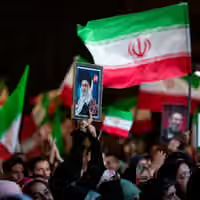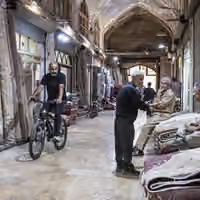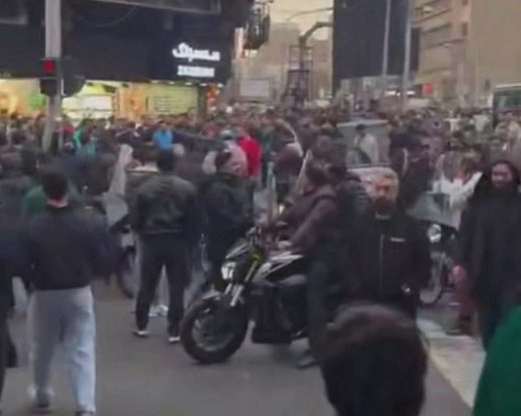
Protests by Tehran shopkeepers highlight growing economic strain on small businesses in Iran, economist Ahmad Alavi said in an interview with Iran International.
Profitability has not only declined but has “become impossible” amid the rial’s steep fall, market turmoil, rising taxes, and collapsing consumer purchasing power, Alavi added.
“The decline in purchasing power is transferred directly to shopkeepers and small-scale economic activity,” Alavi said, adding that most Tehran market traders operate as small economic units with limited capital and very low risk tolerance.
He said rial's exchange-rate volatility has made planning impossible for importers, merchants, and small sellers.
“Planning, which is the basis of profitability and stability, disappears when the currency market is chaotic,” he said.
Alavi said rising direct and indirect taxes have added pressure on small business owners while weakening consumer demand further reduces sales.
He added that many shopkeepers have cut working hours and laid off employees or apprentices in order to continue operating, as inflation accelerates and purchasing power falls.


Iran’s draft budget for the coming year, submitted to parliament this week, is being widely described by economists as the most contractionary in decades, shifting the burden of deficit control onto workers and consumers.
President Masoud Pezeshkian presented the draft budget bill for the Iranian year 1405 (starting on March 21, 2026) to parliament on Wednesday.
Lawmakers have until March 20, 2026, to review and approve the proposal, which has already sparked heated debate among economists, labor representatives, and political commentators.
The government says the budget was prepared with an emphasis on fiscal discipline, realistic revenue and expenditure estimates, and greater transparency.
Officials argue that the bill aims to control the budget deficit and curb inflation, which remains above 40 percent according to official figures and closer to 50 percent by independent estimates.
According to the bill, the total budget for next year amounts to roughly 10,144 quadrillion rials.
For the first time, the figures are presented using Iran’s newly approved rial unit, adopted in November, which removes four zeros. Under the new system, the same amount is recorded as 10,144 billion rials.
Total government spending is projected to rise by 28 percent.
Reliance on taxes instead of oil revenues
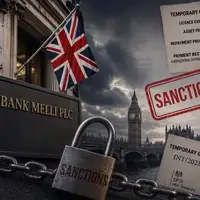
A central feature of the bill is its reliance on tax revenues rather than oil sales. Skepticism over the feasibility of this strategy is widespread, particularly amid expectations of intensified sanctions that could limit oil revenues and further strain businesses.
“Growth in the country’s tax revenues exceeds the inflation rate, and given that we have no economic growth—or even negative growth—this is not economically justifiable,” Gholamreza Salami, a senior tax expert, told the reformist daily Shargh.
Morteza Afqah, a professor of economics, voiced similar concerns in remarks to Entekhab, warning that higher tax revenues are unrealistic in the absence of economic growth.
“Continuing this trend will lead to the widespread closure of small and medium-sized enterprises, resulting in rising unemployment, deeper economic recession, and a further decline in consumers’ purchasing power,” he said.
Under the bill, the government plans to raise the value-added tax (VAT) rate from 10 to 12 percent and distribute the additional revenue directly to citizens through electronic food vouchers. Part of the proceeds would also be used to adjust pension payments for retirees.
Supporters argue that this approach is more targeted than broad subsidies, while critics warn it will further weaken household consumption.
Cutting subsidized currency and fuel signals
The draft budget also signals a significant reduction in subsidized foreign currency for imports to save 5.7 quadrillion rials (billion in the new system). While about €11 billion (around $12.9 billion) was allocated this year for importing essential goods, that figure will fall to €7 billion (around $8.2 billion) next year.
Currently, selected importers receive preferential currency at 280,500 rials per dollar, compared to a free-market rate that has surpassed 1.35 million. The recent suspension of this rate for rice and medicine imports has already driven steep price increases. Proponents of eliminating preferential rates argue that the wide gap between official and market exchange rates has fueled corruption and rent-seeking.
The government also plans to allocate nearly 5.5 quadrillion rials (billion in the new system) rials from revenues generated by imported gasoline sales to direct cash subsidies. Analysts say this strongly suggests gasoline price hikes next year.
In addition, the budget anticipates 2.9 quadrillion (billion in the new system) rials in revenue from selling wheat at non-subsidized rates, indicating a likely reduction—or complete removal—of preferential currency for wheat imports.
Pressure on salaried workers
Despite inflation exceeding 40 percent, the bill proposes only a 20 percent increase in salaries for government employees and retirees. At the same time, it significantly raises the tax-exempt income threshold, meaning nearly all teachers and about 70 percent of public-sector employees would be fully exempt from income tax.
Economist Kamran Nadri told Jam-e Jam that the cost of fiscal tightening is falling primarily on employees. He argued that the government is seeking to close the deficit not by eliminating inefficient institutions or redundant budget lines, but by suppressing wage growth.
According to Nadri, the projected increase in tax revenues would, if realized, fall largely on consumers and could fuel inflationary pressure. However, he added that if the government avoids monetary expansion, inflation caused by higher taxes and the removal of subsidized currency would not necessarily be permanent.
Opaque spending and institutional budgets
Despite official claims of transparency, the budget allocates around €7.5 billion (around $8.8 billion) in oil revenues to vaguely defined “special projects,” with no clear breakdown of expenditures. This extra-budgetary category accounted for nearly one-fifth of last year’s budget and, according to Donya-ye Eghtesad, more than two-thirds of the operational deficit.
Critics have also targeted increased funding for religious and promotional institutions, as well as state broadcaster IRIB, which is set to receive a 20 percent budget increase. The reformist daily Arman-e Melli warned that such allocations, combined with limited wage growth, risk fueling social unrest.
“The combination of severe inflation, soaring prices, and wage increases that cover less than half of current inflation should be a warning to the government that this kind of budgeting prepares the ground for future protests,” the paper wrote.
Nevertheless, hardline conservatives have also protested funding levels. Quds newspaper criticized cuts to the budget for promoting the “culture of pilgrimage.” Nasrollah Pejmanfar, a member of parliament from Mashhad, told the paper: “Unfortunately, neglect of the issue of pilgrimage has meant that people have not been able to benefit from it properly and have faced difficulties.”
Speaking to Arman-e Melli, reformist politician Fayyaz Zahed urged President Pezeshkian to seek Supreme Leader Ali Khamenei’s backing to gradually reduce funding for institutions reliant on public money. “If the president were to cut these budgets today,” he said, “his government would not last even a month. This is a very difficult and frightening confession to make.”

Tehran’s newly announced fuel price changes have been presented as a long-overdue reform of an unsustainable subsidy system, but they amount to an undeclared form of austerity aimed at rolling back subsidies with minimal political exposure.
Rather than opening a public debate, officials are rolling out a complex web of fees, pricing tiers and regulatory adjustments that allow revenue to be raised quietly.
The move marks the first fuel price hike since November 2019, when a sudden increase sent Iranians into the streets and was followed by a violent crackdown that killed several hundreds.
That episode has loomed over economic policymaking ever since. Presidents have changed, inflation has surged and the currency has collapsed, but fuel prices remained largely frozen.
After years of hesitation, the administration of President Masoud Pezeshkian has moved to increase prices, but through a layered system that disperses the impact across rules and clauses.
The new policy replaces a flat rate with a multi-tier structure. More consequential, however, are the discretionary powers embedded in the legislation. It allows for annual price adjustments linked to inflation.
In practice, this means fuel costs can rise automatically in an economy where inflation remains high and largely policy-driven.
The reform also separates the base price of gasoline from additional “operational” or service charges that were previously bundled into the final cost. These fees are loosely defined and not capped, giving authorities room to raise the effective price without formal announcements or parliamentary debate.
Equally significant is a sunset clause affecting subsidies themselves.
Under the new rules, newly registered domestic vehicles are excluded from subsidized fuel. While officials have floated the possibility of delays or exemptions, the legislation is explicit. Over time, as the existing vehicle fleet is retired, fuel subsidies would effectively disappear.
To accelerate that transition, the state has introduced a set of regulatory incentives. High-consumption and foreign-made vehicles are removed from subsidy eligibility, while permits for new car production or imports are increasingly tied to the scrapping of older vehicles.
Critics warn this could create a secondary market for scrap permits, potentially benefiting intermediaries with political connections.
Officials argue that gasoline prices are artificially low, encouraging waste and disproportionately benefiting wealthier households with multiple vehicles.
On paper, these arguments align with standard economic theory, and the stated goal of reducing regressive subsidies has broad support among technocrats. What that framework often assumes, however, is a functioning market economy.
In Iran, price signals operate within heavy state control. The government seeks the revenue discipline of market pricing while retaining monopolies and administrative control.
Officials routinely point to excessive domestic consumption, yet President Pezeshkian himself has acknowledged that roughly 20 million liters of fuel are smuggled out of the country each day.
That scale of smuggling suggests organized networks rather than individual consumers.
Enforcement efforts, critics argue, have focused far more on end users than on the structures enabling large-scale arbitrage.
At the same time, consumers have limited ability to adjust. The state dominates the auto industry, restricting imports and leaving households reliant on inefficient domestic vehicles.
Chronic inflation—driven in part by fiscal deficits and monetary expansion—further erodes purchasing power, meaning price increases quickly translate into broader hardship.
Supporters of the reform counter that Iran’s budget constraints leave few alternatives and that some form of adjustment is unavoidable. They argue that delaying price reform only increases the eventual cost.
But standard market logic assumes choice.
In Iran, consumers cannot easily switch vehicles, suppliers or energy sources. Price increases function less as signals than as transfers, falling on a population already weakened by years of inflation.
For decades, the Islamic Republic has absorbed the costs of its regional and strategic ambitions by shifting the burden inward. Today, with limited room to ask for sacrifice, it appears to be relying instead on administrative complexity to impose it.
The mechanisms may be opaque and the data buried, but the effects are harder to disguise—and will ultimately be measured by what is no longer in the fridge.

Mohammad Javad Zarif’s latest Foreign Affairs article follows a familiar pattern in his narrative: recasting Tehran’s militarization and domestic repression as reactive responses to external pressure rather than deliberate internal choices.
Zarif argues that relations between Iran and the United States have long been trapped in a cycle of “securitization,” in which each side responds defensively to the other’s actions.
The Islamic Republic, he writes, has been “forced” to prioritize military spending over development because of attacks by Iraq, Israel, and the United States.
The argument downplays Iran’s own role in shaping that trajectory.
Contrary to Zarif’s account, the theocracy’s turn toward securitization gained pace in the aftermath of the Iran–Iraq war, particularly under the late President Ali Akbar Hashemi Rafsanjani, who helped embed the military in politics and the economy as a pillar of postwar reconstruction and state survival.
But Zarif shifts responsibility for Iran’s unbalanced development outward.
Western pressure, not decisions taken by Iran’s leadership, is blamed for a system in which missile programs expanded while welfare sectors such as housing, employment, and healthcare stagnated.
The implication is that Iran’s strategic priorities were imposed rather than chosen.
Zarif further suggests that reduced pressure from Washington would lead Tehran to de-escalate. Yet this claim sits uneasily with his own account of events following the 2015 nuclear deal.
One of the achievements Zarif frequently cited was the lifting of sanctions not only on Iran’s nuclear program but also on arms-related restrictions, including sanctions on Iran Air, allowing the airline to modernize its fleet.
By Zarif’s own account, however, the easing of sanctions did not lead to restraint.
In a 2021 interview with the economist Saeed Leylaz, Zarif acknowledged that Iran Air flights were used by the Islamic Revolutionary Guard Corps to transfer weapons to Syria, with such flights increasing sharply after the nuclear deal. When Zarif raised concerns with Qassem Soleimani, the then-commander of the Quds Force, he said Soleimani replied that “Iran Air is safer.”
Zarif later described this dynamic as the “dominance of the battlefield over diplomacy,” an admission that key decisions about militarization were made within Iran’s power structure, not imposed from abroad.
Indeed, the period following the nuclear deal saw expanded investment in missile programs and a deepening of Iran’s regional proxy network, financed in part by newly available resources.
Yet in the Foreign Affairs article, Zarif presents increased uranium enrichment and the repression of domestic protest as reactions to Western pressure—once again shifting responsibility for violent crackdowns repression away from the rule in Tehran.
“The external securitization of Iran has fed into a parallel dynamic at home,” he writes, “as the state adopted a stricter approach in dealing with domestic social challenges, responding to these challenges with tighter restrictions.”
A similar pattern appears in Zarif’s account of Iran’s role in Syria.
In the same 2021 interview, he suggested that Iran’s direct military involvement followed a visit by Soleimani to Moscow, framing the escalation as the product of Russian strategy to undermine the nuclear deal rather than a decision taken by Iran’s leadership.
The role of Supreme Leader Ali Khamenei and Iran’s own security institutions is largely absent from this narrative.
The tendency to externalize responsibility extends to other areas as well.
After the nuclear deal, the release of several dual nationals and the unfreezing of Iranian assets raised expectations of de-escalation. Instead, a new wave of arrests of dual nationals followed, a pattern widely seen as deliberate leverage rather than a response to external pressure.
Zarif’s article also describes Israeli strikes in June 2025 as “unprovoked,” without reference to decades of official Iranian rhetoric calling for Israel’s destruction or the expansion of armed proxy groups along Israel’s borders.
The broader context of the current confrontation—including Hamas’s October 7, 2023 attack on Israel, praised by Iranian officials—is notably absent.
Iran has had multiple opportunities to break the cycle Zarif describes, from the early years after the revolution to the post-nuclear-deal period. Each time, its leadership made choices that reinforced militarization and repression rather than curbing them.
The question raised by Zarif’s essay is not whether external pressure mattered—but why internal agency continues to be written out of the story.

Tehran’s recent gestures of apparent flexibility—from looser enforcement of the hijab to an embrace of nationalist symbolism—recall moments in Communist history when a brief opening exposed risks the system ultimately moved to contain.
In 1956, Soviet leader Nikita Khrushchev stunned the communist world by denouncing Joseph Stalin’s crimes in a closed-door speech at the Communist Party Congress.
The address, later leaked, raised expectations that the Soviet system might be capable of reform from within. Instead, it exposed pressures the leadership struggled to contain, contributing to unrest at home and rebellion abroad—notably in Hungary—and ultimately reinforcing the limits of permissible change.
That pattern—tactical relaxation under pressure, followed by retrenchment—offers a useful lens for understanding Iran’s current moment.
Since June’s 12-day war with Israel and the United States, the Islamic Republic has been navigating what officials privately describe as a convergence of external threat and internal fragility.
Internationally, Tehran faces deepening isolation and a US administration that has shown a willingness to use force. Domestically, the aftershocks of the 2022 Woman, Life, Freedom uprising continue to shape public behavior and elite anxiety.
Lifeline: patriotism
Against that backdrop, the state has adopted a dual strategy.
On one track, it has sought to soften flashpoints—particularly hijab enforcement—that could reignite street unrest. Police patrols have become less visible, enforcement more uneven, and officials have emphasized “cultural” rather than coercive methods.
On another track, the leadership has leaned into a form of state-sponsored nationalism that draws selectively on Iran’s pre-Islamic past.
Last month, authorities unveiled a statue in Tehran depicting the Roman Emperor Valerian kneeling before the Sassanid king Shapur I, commemorating a third-century Persian victory over Rome. The accompanying slogan—“You will kneel before Iran again”—was echoed in imagery portraying Israel’s prime minister in a similar posture.
Such symbolism would have been unthinkable for much of the theocracy’s history, when pre-Islamic iconography was treated with suspicion or outright hostility.
Supreme Leader Ali Khamenei reinforced this shift in July when, in his first public appearance after the war, he asked a religious eulogist to perform “Ey Iran,” a nationalist song associated with the pre-revolutionary era.
The gesture was widely read, both inside Iran and abroad, as an attempt to blur the line between religious authority and national identity—and by some, as a signal of potential recalibration.
‘Let a hundred flowers bloom’
History suggests caution. Authoritarian systems have often reached for controlled liberalization or symbolic inclusion during moments of acute stress, only to reverse course once the immediate danger recedes.
Mao Zedong’s 1957 “Hundred Flowers” campaign—launched in part to manage the fallout from Khrushchev’s de-Stalinization—famously invited criticism before giving way to a sweeping crackdown when dissent exceeded official expectations.
Iran’s trajectory over recent months has followed a similar arc.
Even as officials spoke of unity and restraint, legislation advanced to tighten restrictions on speech, expand capital punishment for acts of dissent, and broaden the security services’ remit online.
Arrests and executions have continued at a steady pace, and pressure on journalists, activists and minority communities has intensified.
Earlier this month, Khamenei dismissed criticism of hijab laws as part of a Western ideological campaign, warning domestic media against amplifying such views. The judiciary chief swiftly followed suit, announcing a more coordinated effort involving police and prosecutors—a signal less of retreat than of reorganization.
The episode underscores a recurring dynamic in the Islamic Republic’s history: moments of apparent opening that generate speculation about reform, followed by moves that reassert control once the boundaries of dissent become clearer.
As with Khrushchev’s speech nearly seven decades ago, the significance may lie less in the promise of change than in what the response reveals about the system’s underlying anxieties—and the limits it is ultimately prepared to enforce.

As the Middle East enters the final weeks of 2025, the aftershocks of two years of regional war since October 7, 2023 are yielding to a quieter, consequential realignment of regional power.
The Hamas attack, the 12-day Iran-Israel war in June and Israel’s relentless strikes on Iranian-aligned actors did not end the region’s conflicts, but they changed how states now manage them.
In place of grand diplomacy or formal pacts, a loose alignment has begun to form from overlapping security, political and economic imperatives.
Stretching informally from Baghdad to Damascus, this nascent arc of stability is emerging less as a peace project than as a constraint on Iran’s regional reach—interlocking with the logic of the Abraham Accords and pressing against the network of proxies through which Tehran has long projected power.
This shift has unfolded alongside a parallel Iranian track: diplomatic outreach, particularly towards Saudi Arabia and other Arab neighbors, aimed at preserving room for manoeuvre even as Tehran’s proxy network comes under strain.
That dual approach matters, shaping regional calculations as Iran seeks both to absorb pressure and to prevent the emergence of a more openly consolidated front against it.
Iraq: on the mend but shaky
In Iraq, the aftermath of the recent elections and the government’s brief attempt to designate Lebanese Hezbollah and the Houthis as terrorist organisations—followed by a rapid reversal—highlight a deeper struggle over sovereignty.
An emergent bloc of political, clerical and institutional actors is pushing for greater state consolidation, while Iran-backed networks seek to preserve the hybrid armed–political order entrenched since the fight against Islamic State in 2014.
Senior clerics linked to the orbit of Grand Ayatollah Ali al-Sistani have repeatedly warned that the continued power of militias is eroding national unity and hollowing out state authority.
At the same time, developments inside Iraq are complicating Tehran’s position. Efforts to expand domestic gas production, reduce reliance on Iranian imports and attract Western investment after the withdrawal of sanctioned Russian firms are slowly reshaping the economic outlook.
Improved, if fragile, coordination between Baghdad and the Kurdistan Regional Government on revenue sharing and border controls has also narrowed institutional fissures Iran has long exploited.
These shifts are incremental and uneven, and their durability remains uncertain. Yet together they form the first pillar of a broader regional realignment rooted less in ideology than in state capacity and economic necessity.
Iraq may also prove the weakest link: its politics remain volatile, and Iran-aligned actors retain deep organizational and financial networks. Still, even limited consolidation across security, energy and governance would tilt the strategic balance of the Levant in ways long thought unattainable.
Syria: stabilizing but weak
The fall of Bashar al-Assad a year ago, and the rise of a Salafi-leaning transitional authority have opened a period of uncertainty, marked by serious risks but also new constraints on external actors.
Syria is unlikely to join the Abraham Accords or pursue formal normalisation with Israel soon. Nevertheless, quiet contacts involving Damascus, Israel and Qatar—aimed at limiting spillover, restraining militias and establishing narrow de facto understandings—point to the emergence of a pragmatic, if tentative, security framework.
Events beyond Syria’s borders have sharpened regional sensitivities.
Israel’s attempted attack against Hamas leaders in Qatar which failed to kill their intended targets unsettled several US Arab partners and may have influenced strategic thinking even where public positions remained measured.
More significant is the regional effect of a Syria no longer fully aligned with Iran’s strategic priorities. A stabilizing Syrian state, broadly aligned with Iraq and Jordan, would sharply restrict the land and air corridors Iran has long used to supply Hezbollah in Lebanon.
Recent interceptions of Iranian weapons shipments across Syrian and Jordanian territory by Israel and Jordan underscore that Iran may still see Syria as a transit point for its weapons.
A pattern emerging
This informal Baghdad–Damascus alignment intersects with the logic of the Abraham Accords, which the Trump administration’s November 2025 National Security Strategy identifies as the US priority to build up security in the region.
The document frames Arab and Muslin normalization with Israel not as a legacy achievement but as a functional framework for missile defence, maritime security as well as intelligence and regional burden-sharing.
While Saudi Arabia, Qatar, Oman and Kuwait remain outside the Accords formally, growing patterns of de facto cooperation—through air-defence coordination, early-warning integration, maritime security arrangements and intelligence exchanges—suggest the Accords already function as an organising principle for states reluctant to make public commitments.
The spine is formal, but the supporting structures are increasingly informal, sustaining the framework without requiring every participant to commit publicly.
The restrained language of the 2025 strategy reflects a broader shift in Washington’s approach. Rather than relying primarily on American primacy, the United States now appears focused on containing Iran by reinforcing regional structures anchored in the Accords and complemented by emerging alignments in Iraq and Syria.
Across the region, a discernible pattern is taking shape.
Iraq’s uneven institutional recovery, Syria’s cautious stabilisation, Jordan’s intensified border security, the Persian Gulf states’ expanding coordination and Israel’s sustained security posture together form the outlines of the most coherent countervailing structure the region has seen in more than a decade.
The contest, however, remains unresolved. Iran retains significant capacity, adaptive networks and a proven ability to rebuild and readjust.
The Baghdad–Damascus arc nonetheless represents a challenge to Tehran’s regional strategy rooted not in declarations or grand bargains, but in overlapping state interests and practical constraints—an alignment shaped by necessity rather than design.