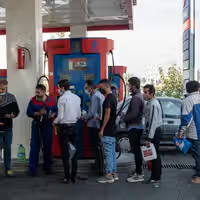
Security forces opened direct fire on protesters during demonstrations on Thursday in the western Iranian city of Nurabad, in Lorestan province, wounding several people, according to eyewitness accounts and videos sent to Iran International.
An eyewitness said the shooting occurred during street demonstrations on Thursday, with videos showing protesters in the streets amid tense security presence.
The source also said a police vehicle was set on fire during the protests.
No official reports have been released on the number of those wounded or their condition.

Tehran’s response to the protests this week has looked markedly different, whether out of calculation or necessity, with Iranian media reporting on the unrest, the government striking a conciliatory tone and the internet remaining largely accessible.
The protests, triggered by rising prices, quickly moved beyond economic grievances. Slogans once again targeted the ruling system itself, with demonstrators openly calling for its downfall.
In both 2019 and 2022, when similar chants echoed across Iran, authorities moved swiftly to shut down the internet, cutting off communication with the outside world and crippling domestic news coverage. Protesters were rapidly branded as enemy foot soldiers, and state media framed the unrest almost exclusively as a foreign-backed security threat.
This time, the state broadcaster appears to have adopted a more cautious line, quoting hardline outlets on the causes of the protests while limiting its own commentary, perhaps to avoid provoking demonstrators—or to reclaim an audience long lost to social media and foreign-based Persian-language outlets.
‘Right to protest’
State television presenters have repeatedly asserted in recent days that “protesters have every right to protest rising prices.”
That framing mirrors President Massoud Pezeshkian’s recent assertion that “protesters do not need a permit to take to the streets under the Iranian Constitution.”
The statement was always legally correct, but no senior official or major outlet had previously expressed it so plainly.
At a December 31 press conference, government spokeswoman Fatemeh Mohajerani reiterated that the administration recognizes the public’s right to protest, adding that Pezeshkian has pledged to listen to citizens and resolve their problems.
The new central bank governor, Abdolnasser Hemmati, issued sweeping promises: to control inflation, end privileges for well-connected individuals and address banking irregularities, including unauthorized withdrawals from government accounts.
Hemmati previously held senior economic posts under Presidents Rouhani and Pezeshkian without achieving those goals, but on December 31 he insisted he now has “full authority” and is determined to deliver.
Cities shut down
At the same time, the government has taken steps to sap momentum from the streets.
Beginning December 31, schools and offices in 26 of Iran’s 31 provinces were closed for four days, a move widely seen as an attempt to replace open unrest with a fragile calm—particularly as the closures were announced amid unusually clear weather in the capital, rather than the pollution that has forced similar shutdowns in recent months.
As heavy smog over Tehran briefly lifted after months, some protesters remarked—almost incredulously—that Mount Damavand was visible again on the northeastern horizon, an unintended symbol of dissent long presumed dormant but never extinguished.
Yet an ominous sign looms as well.
Ali Fadavi, the IRGC’s deputy commander, has been replaced by Ahmad Vahidi, a figure known for harsher methods and strict loyalty to Supreme Leader Ali Khamenei. Reports already suggest that shootings at demonstrators and arrests increased on Thursday, the fifth day of unrest.
It remains to be seen whether Tehran sustains its current posture if unrest deepens—or reverts to its familiar factory settings of internet disruption and brute force.
Protesters in Iran’s holy city of Qom joined nationwide demonstrations, chanting “Long live the Shah,” according to videos received by Iran International.
The footage shows demonstrators voicing support for Iran's exiled prince Reza Pahlavi.
Qom is one of Iran’s most important Shi’ite religious centres and a key political stronghold of the Islamic Republic, home to major seminaries and senior clerics who traditionally support the government.
Another video from protests in Qom on Thursday shows demonstrators remaining in the streets despite a heavy security presence and attempts by security forces to disperse the crowd.
Six women detained during protests in Tehran have been transferred to the women’s ward of Evin prison, US-based rights group Human Rights Activists News Agency (HRANA) said.
The women were moved late on Wednesday after spending a day in intelligence custody, HRANA reported, citing an informed source.
They were identified as Elnaz Kari, Negar Ghanbari, Helena Rostami, Masoumeh Nouri, Fatemeh Hashempour and Aida, who was identified only by her first name.
Israel's Minister of Innovation, Science and Technology Gila Gamliel voiced support for nationwide protests in Iran, urging international backing for the demonstrators.
“You are not alone. I call the world to hear your cry for freedom and to support you,” said Gila Gamliel in a post on X, accompanied by a video addressed to the Iranian people.
“Let’s make Iran great again,” she added, tagging Iran’s exiled prince Reza Pahlavi.

Dariush Ansari Bakhtiarvand, a 37-year-old protester from Fooladshahr in Iran’s Isfahan, was killed by direct gunfire during overnight demonstrations on Wednesday, according to information received by Iran International.
Ansari, sources said, was shot by government forces during the protests and died before reaching hospital. Iran International had verified his identity and reviewed video footage showing his body.
He was targeted while participating in the demonstrations, a relative told Iran International. The head of Isfahan province’s criminal police confirmed the death of a “37-year-old citizen” in Fooladshahr on Wednesday night, without giving details.
The human rights group Hengaw also said he was killed by direct fire from security forces.