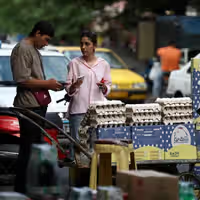
Mehdi Beik, the political editor of Tehran-based Etemad newspaper, had not been heard of since Monday after he went to central Tehran to report from the field on gatherings by bazaar merchants, his wife said on Tuesday.
The newspaper later announced that Beik had been arrested by security forces on Monday and was released a few hours ago.


At least five students were arrested on Tuesday during protests in Tehran, according to student Telegram channels.
Mobin Aminian, an undergraduate student in chemical engineering; Shahin Shokouhi, a PhD student in sociology; Aref Hadi-Nejad, an undergraduate student in philosophy; and Mani Eidi, an undergraduate student in philosophy, were arrested outside the University of Tehran campus in downtown Tehran.
Abolfazl Morovvati, a graduate student in computer engineering at Sharif University of Technology, was also arrested by security forces.

At least eleven protesters were arrested on Tuesday on Sabounian Street near Tehran’s Shoush Square, according to human rights groups.
A video circulating on social media purportedly shows the moment security forces were transferring the detainees.

An Iranian vice president on Tuesday defended Tehran’s ballistic missile capabilities as essential for deterrence, after the US president warned of further attacks if Iran moves to develop its missile program which was severely damaged in a June war.
"Iran must have missiles; without them, we would be defenseless. We must stand for Iran’s dignity," Vice-President for Executive Affairs Mohammad-Jafar Ghaempanah said.
"If we are to bow our heads to whatever the United States says, then tomorrow we will have to answer to future generations."
Mohsen Rezaei, a former commander of Iran’s Islamic Revolutionary Guard Corps, wrote on his X account: “Iran’s missile and defense capability is neither negotiable, nor stoppable, nor containable.”
“In the event of any new adventurism, the will and capability of the armed forces to respond to the enemy and defend the Iranian nation will be very different from the past," Rezaei said, responding to Trump's threats.
Trump said on Monday he would support possible Israeli strikes on Iran if the Islamic Republic develops its ballistic missile or nuclear programs, warning Tehran against rebuilding military capabilities destroyed in Israeli and American airstrikes in June.
Speaking to reporters alongside Israeli Prime Minister Benjamin Netanyahu in Florida, Trump said the United States will deal a heavy blow on Iran if it tries to recover from the US and Israeli strikes in June.
"I'm hearing that Iran is trying to recover—if that happens, we'll have to hit them hard," Trump added.
"If they will continue with the missiles, yes. The nuclear, fast. Okay? One will be yes, absolutely. The other was, we'll do it immediately," Trump said when asked if he would support Israel's strikes on Iran in case it further develops its ballistic missile and nuclear programs.
Ghaempanah said "no regime should have the power to threaten us."
"If our missiles had not been effective against Israel, they would certainly not have proposed a ceasefire," he said.
On June 13, Israel launched a surprise military offensive against Iran, followed by US strikes on June 22 that targeted key nuclear facilities in Isfahan, Natanz and Fordow.
The attacks killed several Iranian nuclear scientists as well as hundreds of military personnel and civilians. Iranian retaliatory strikes killed 32 Israeli civilians and one off-duty soldier.
The 12-day war ended with a ceasefire brokered by Donald Trump.
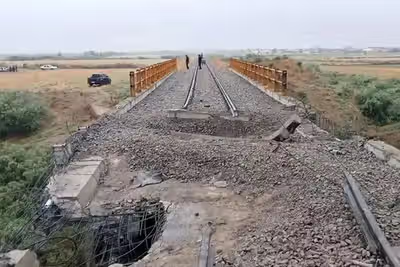
Security forces retreated as students at the University of Tehran moved toward the main gate chanting anti-leadership slogans on Tuesday, according to video shared by a student channel.
Footage published by the Telegram channel United Students showed groups of students chanting “death to the dictator” as they advanced toward the university’s main entrance.
Iranian reformist figure Behdad Nabavi said in an interview published Tuesday that reform means peaceful, legal change within the current system, while acknowledging that the process has become so difficult it could take decades.
In comments to Jamaran, Nabavi said reformism does not seek to overthrow the system or use illegal or violent methods.
“Reformism means changing the existing situation to a desirable one through a legal and peaceful path,” he said. “It does not want to overthrow the system.”
He said reformists aim to move the country toward what they define as a better outcome “within this same structure” and through “calm and legal” methods.
Nabavi added that he has concluded the reform path is now “very winding” and difficult, arguing that today’s young people have little tolerance for a gradual process.
“It may take 50 years,” he said, describing a slow legal route that, in his view, struggles to meet the urgency of public expectations.