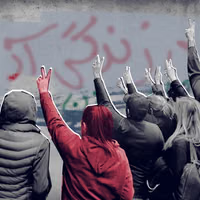
Iran jails eight Baha’i women on charges of promoting their beliefs
Ten Baha'i women whose prison sentences were upheld by a court in Isfahan
Eight Baha’i women were arrested on Saturday morning after reporting to the Isfahan Office for the Enforcement of Sentences and were transferred to a local prison to begin serving their prison terms, Iran International has learned.
The Baha’i women have been charged with “propaganda against the Islamic Republic,” “promoting Baha’i beliefs,” and “cooperating with hostile groups.”
Their case has been designated as “security-related and confidential," sources told Iran International.
They have been identified as Yeganeh Rouhbakhsh, Arezou Sobhaniyan, Shana Shoqifar, Neda Emadi, Neda Badakhsh, Mojgan Shahrezaei, Parastoo Hakim, and Negin Khademi.
Among those detained, Arezou Sobhaniyan and Yeganeh Rouhbakhsh, 19, are mother and daughter.
Earlier, the Isfahan Court of Appeals upheld sentences totaling 90 years in prison and fines of 900 million tomans against ten Baha’i women including the eight arrested on Saturday.
The appellate proceedings were held in absentia, without the defendants present.
Iran does not recognize the Baha’i faith as an official religion, unlike Christianity, Judaism or Zoroastrianism.
Baha'is constitute the largest religious minority in Iran and have faced systematic harassment and persecution since the Islamic Revolution of 1979.
The recent arrests are part of a renewed crackdown on Baha’is inside Iran and rising anti-Baha’i rhetoric on state media.
In October, a hardline commentator on Iranian state television, Ali Shirazi, alleged that the Baha’i minority holds “an unbreakable bond with Zionism,” claiming that “Baha’i and Israel are one and the same.”
His remarks followed reports by the Baha’i International Community (BIC) that at least 22 members of the faith had their homes and businesses raided in coordinated operations across six provinces.
Iranian authorities have long accused the Baha’i community of links to Israel, partly because the faith’s spiritual center is located in Haifa, where its founder’s shrine stands. Rights groups say such claims have been used to justify arrests, confiscations, and lengthy prison sentences.
Nearly three quarters of documented violations against religious minorities in Iran over the past three years have involved Baha'is, according to the US-based Human Rights Activists News Agency (HRANA).
Iranian security and law enforcement forces prevented families of political prisoners executed in the 1980s, including during the mass killings of summer 1988, from entering Tehran’s Khavaran cemetery on Friday to commemorate their relatives, according to activists and witnesses.
Security and police forces were deployed at the site from early Friday morning and, as in previous years, sealed the cemetery gates to block families from entering, a Telegram channel called Charter of Freedom, Welfare and Equality reported. The forces also prevented relatives from gathering outside the entrance, displaying photographs of their loved ones or laying flowers.
Despite the restrictions, some families marked the anniversary by scattering flowers along the road leading to the cemetery or throwing bouquets over the walls into Khavaran, the report said.
Khavaran is widely known as the main burial site for victims of mass executions carried out in the 1980s, particularly during the summer of 1988, when thousands of political prisoners were executed following orders issued by Ruhollah Khomeini. Special tribunals later referred to by survivors as “death commissions” ordered the executions while many prisoners were already serving sentences.
Exact figures remain unknown due to official secrecy, but rights groups estimate that around 5,000 political prisoners – mainly supporters of the People's Mojahedin Organization of Iran, also known as Mojahedin-e-Khalq, and leftist movements – were executed in 1988 alone.
Unanswered appeals to the president
The restrictions come despite repeated appeals by families. In January 2024, dozens of relatives of those executed in the 1980s wrote an open letter to President Masoud Pezeshkian, saying they had been barred from Khavaran for more than 11 months and subjected to humiliating treatment by officials in charge of the site. They demanded an end to other burials at the cemetery and the removal of all obstacles to mourning and remembrance.
No public response from Pezeshkian has been reported, and access restrictions have continued.
Erasing evidence
The Telegram channel also said burials of deceased Baha’i citizens continue in mass graves at Khavaran, despite longstanding objections from families and the Baha’i community. In March 2024, the Baha'i International Community reported the destruction of more than 30 Baha’i graves at the site.
Families have repeatedly warned that such actions amount to desecration and an attempt to erase evidence of past crimes. “Commemorating loved ones and collective mourning is the most basic human right,” the group said, adding that preventing memorials denies the dignity of the victims and seeks to silence demands for justice.
A 56-year-old Iranian radiologist who evaded execution but received a long prison term for his participation in Iran’s 2022 protests says he has launched a hunger strike to protest what he describes as “inhumane” treatment in prison.
In an audio file obtained by Iran International, Hamid Qarahassanlou (Gharehassanlou) said he started the hunger strike on Thursday, December 25, in protest at “inhumane and shocking” conditions of detention in the Yazd Central Prison.
Qarahassanlou and his wife Farzaneh were arrested on November 4, 2022, in Karaj after participating in protests where a member of the Basij militia, Rouhollah Ajamian (27), was beaten to death by angry protesters but both denied any involvement in the incident.
Qarahassanlou was initially sentenced to death and his wife to twenty-five years prison, but their sentences were later reduced due to a strong backlash on social media and lack of evidence of their involvement in a second trial.
Farzaneh is serving a five-year jail term in Mashhad prison, over 900 km (565 miles) away from Yazd, where her husband is jailed.
In the audio recording, Hamid said that although two and a half years have passed since his imprisonment in Yazd Prison, he remains held in the prison’s quarantine ward and, despite repeated requests to the prison administration, has not been transferred to the political prisoners’ ward.
He named the prison’s warden as Hassan Madadi Moghaddam, who he said would be responsible for any consequences.
Qarahassanlou further warned that his life is under threat in the quarantine ward, and emphasizes that he has been “deprived of the basic rights of a prisoner,” that his access to welfare facilities has been restricted, and that he has been exposed to multiple illnesses.
Hamid Qarahassanlou hospitalized, image released in February 2023 by Iranian state-media
Later in the audio file, he also spoke of inadequate food and months-long deprivation of sunlight, saying: “I have faced numerous problems in terms of nutrition and have been deprived of sunlight for months.”
“Given my lack of access to any means to seek justice, I have no choice but to go on a hunger strike. I hereby announce the start of my hunger strike until my demands are met, and any harm to my life resulting from this will be the responsibility of the prison warden, Mr. Madadi.”
While Qarahassanlou was spared execution in the Basij militant’s murder case, the Islamic Republic’s judiciary executed two young protesters, Mohammad Mehdi Karami, 22, and Mohammad Hosseini, 39, in January 2023 over Ajamian’s death after a hasty trial that human rights activists called a travesty of justice.
Iran carried out at least 1,922 executions in 2025, more than twice the number recorded the previous year and the highest figure documented in over a decade, according to a new annual report published by a US-based human rights group.
The report by the Human Rights Activists News Agency (HRANA), covering the period from January 1 to December 20, said executions rose by 106% compared with 2024, marking a sharp escalation in the use of capital punishment by Iran’s judiciary.
At least 10 executions were carried out in public, the report said, while the vast majority were conducted behind closed doors.
95% of executions, according to the findings, were not officially announced by Iranian authorities or state-affiliated media, underscoring what HRANA described as a systematic lack of transparency.
In addition to those executed, at least 168 people were newly sentenced to death in 2025, while Iran’s Supreme Court upheld death sentences in at least 56 cases.
Of those executed whose gender could be confirmed, 1,681 were men and 59 were women. The gender of roughly 10% of those put to death could not be verified due to limited official information, HRANA said.
Drug and murder cases dominate
Executions, the report found, were overwhelmingly linked to two categories of charges. Murder cases accounted for 47.55% of executions, while 46.10% were related to drug offences.
Human rights organizations have long criticized Iran’s use of the death penalty for narcotics-related crimes, arguing that such cases often involve unfair trials and disproportionately affect poorer and marginalized communities.
HRANA also documented the execution of at least two individuals who were under the age of 18 at the time of the alleged offences, placing Iran among the few countries worldwide that continue to carry out executions of juvenile offenders, in violation of international law.
Prisons and provinces most affected
Executions were unevenly distributed geographically. The highest numbers were recorded in Alborz province, which hosts Ghezel Hesar prison – one of the country’s main execution sites – followed by Khorasan Razavi, Isfahan, Fars and Lorestan provinces.
The prisons with the highest number of executions included Ghezel Hesar in Karaj, Dastgerd prison in Isfahan, Adelabad prison in Shiraz, Vakilabad prison in Mashhad and Dieselabad prison in Kermanshah, the report said.
HRANA’s data shows that executions declined between 2015 and 2020, before rising sharply from 2021 onward, reaching a peak in 2025.
Part of broader repression
The report placed the surge in executions within a wider pattern of human rights violations. In 2025, HRANA recorded at least 2,606 protests and strikes across Iran, including more than 2,100 protest gatherings and over 400 labor strikes, many linked to unpaid wages, inflation and deteriorating living conditions.
It also documented thousands of cases of prisoners’ rights violations, including prolonged detention without trial, denial of medical care, solitary confinement and transfers to unsuitable detention facilities.
The increase in executions has drawn international concern. Earlier this month, the UN General Assembly adopted a resolution condemning Iran’s human rights record, with particular emphasis on capital punishment. Mai Sato, the UN special rapporteur on human rights in Iran, has warned that the scale and secrecy of executions could amount to crimes against humanity.
Institutions and officials linked to rights violations
In another section of its report, HRANA identified state institutions and officials most frequently linked to reported human rights violations in 2025, based on data collected throughout the year.
A total of 480 legal entities affiliated with different branches of the Islamic Republic, according to HRANA, were identified as human rights violators. Among them, 10 institutions accounted for the highest number of recorded cases over the past year.
The Ministry of Intelligence topped the list with 231 reported cases, followed by the Intelligence Organization of Iran’s Law Enforcement Forces (FARAJA) with 172 cases, and the Islamic Revolutionary Guards Corps with 146 reports.
Judicial bodies also featured prominently. Branch 26 of Tehran’s Revolutionary Court was linked to 42 cases, followed by Evin Prison with 36 reports and Branch 36 of Tehran’s Court of Appeal with 24 cases.
HRANA also identified individuals who, based on documented cases, played the most direct roles in human rights violations. These figures, the report said, were predominantly judicial officials who contributed through issuing verdicts, handling cases or playing key roles in judicial and security processes.
According to the data, those named include Iman Afshari, Abbasali Houzan, Mohammad Taghi Taghizadeh, Mostafa Azizi, Abolghasem Salavati, Sajjad Dousti, Mohammadreza Tavakkoli, Qasem Hosseini Kouhkamarei, Ahmad Darvish-Goftar and Ali Ansari.
Afghan refugees deported from Iran have faced arbitrary detention, torture and extrajudicial killings after returning to Afghanistan, according to an investigation by Afghanistan International.
The investigation documented at least six extrajudicial killings and 11 cases of detention involving Afghans expelled from Iran, though the outlet said the true number of victims is likely higher. Families of those killed or detained have blamed the Taliban, describing a recurring pattern of violence against people forcibly returned from Iran.
The findings come amid a sharp rise in deportations following the announcement of a ceasefire in a 12-day war in June by US President Donald Trump. According to the International Organization for Migration, more than 500,000 Afghan nationals were expelled from Iran between June 24 and July 9 alone. Iran’s Interior Minister Eskandar Momeni later said about 1.5 million Afghans had been deported this year.
Targeted after forced return
Many deportees, Afghanistan International said, were refugees at immediate risk, including former government officials, journalists and civil society activists who fled Afghanistan after the Taliban takeover in 2021. Several were killed or detained shortly after their return.
Among the cases documented was the killing of Kamin Jan, a former interior ministry employee, who was shot dead in Takhar province in October 2025, weeks after being deported from Iran. Two weeks earlier, the body of another former Afghan soldier who had also been expelled from Iran was found in Farah province.
Kamin Jan, a former interior ministry employee, who was shot dead in Takhar province in October 2025.
In another case, the body of Gul Ahmad, a former interior ministry employee, was discovered in Farah in October 2025 after he was taken from his home by armed men carrying Taliban intelligence identification cards. His family said he was held for more than three months before his body was returned.
A similar incident occurred in Kabul, where the body of Abdulwali Naimi, a former Afghan special forces officer from Panjshir province, was found in September 2025, two weeks after his deportation. International organizations, including the United Nations, have reported sustained retaliatory attacks against former Afghan security personnel since the Taliban takeover.
Abdulwali Naimi, a former Afghan special forces officer from Panjshir province
One day after deportation
Some deaths followed almost immediately after expulsion. In July 2025, Ezzatullah, a former commander affiliated with the Junbish-e Milli (National Islamic Movement of Afghanistan) party in Sar-e Pol province, was killed just one day after returning from Iran. Ezzatullah had fled to Iran after the Taliban takeover but was forced to leave when his visa expired, a party spokesperson said.
Civil society activists were also targeted. Hamza Ulfat, a former Taliban detainee and civil activist, was shot while fleeing Taliban forces shortly after crossing back from Iran and later died from his wounds.
Detention, torture and silence
Beyond killings, the investigation documented multiple cases of detention and torture. Khal Mohammad, a former Afghan army colonel deported from Iran in October 2022, said Taliban forces tortured him and his elderly mother in separate incidents. Afghanistan International said it reviewed videos and medical records showing signs of abuse.
Despite repeated warnings from human rights groups, Iran has continued deportations. Filippo Grandi, the UN high commissioner for refugees, has called forced returns from Iran and Pakistan alarming, warning they return people to unsafe conditions.
killings extend inside Iran
The investigation comes as Afghan opposition figures have also been targeted inside Iran. On Wednesday, former Afghan police general Ikramuddin Sari was shot dead by masked assailants near his home in Tehran, the second such killing in under four months. Sari, who had served as police commander in Baghlan and Takhar provinces, fled to Iran after 2021 and was an outspoken critic of the Taliban.
His killing followed the September shooting of Maroof Ghulami in Mashhad. People close to both men blamed the Taliban, with an Afghan military source describing the attacks as the start of Taliban “extraterritorial assassinations.” Iranian authorities have not publicly commented on Sari’s killing or released findings from the Ghulami investigation.
Rights advocates say the pattern of violence raises serious concerns about violations of the international principle of non-refoulement, which bars returning individuals to places where their lives or freedom are at risk.
An Iranian revolutionary court in the northwestern city of Urmia has sentenced a man to death on charges of cooperating with Israel, according to information received by Iran International and people familiar with the case.
The defendant, identified as Yaghoub Karimpour, a resident of Miandoab in West Azarbaijan province, was arrested by Iran’s intelligence ministry during the 12-day conflict between Iran and Israel earlier this year, the sources said.
Karimpour, born in 1984, was convicted of “corruption on earth” through alleged cooperation with Israel and the transmission of data, they added. He is currently being held in Urmia Central Prison.
According to the sources, Karimpour has denied the charges throughout his detention and trial, saying he had no links to Israel and had not passed any information. They said he told investigators that confessions attributed to him were extracted under coercion.
Iran’s judiciary has not publicly commented on the case, and Reuters was not able to independently verify the allegations.
Iranian authorities have intensified arrests, prosecutions and executions on charges of espionage or collaboration with Israel in the months following the brief war. Officials say the measures are necessary to safeguard national security, while rights groups say the trials often lack transparency and rely on forced confessions.
In recent weeks, Iran has carried out several executions linked to espionage allegations.
Earlier in December, authorities executed Aghil Keshavarz, an architecture student, after convicting him of spying for Israel, state-linked media reported.
The Hengaw human rights organization said that at least 17 people have been executed in Iran this year on charges related to cooperation with Israel, 15 of them after the conflict.
Iranian officials have arrested hundreds of people since the war on suspicion of espionage or collaboration with Israel.
Many of the cases have been pursued under a law passed by parliament in October that broadened definitions of espionage and cooperation with “hostile states,” including Israel and the United States, and allows for capital punishment in a wide range of activities involving alleged information sharing.