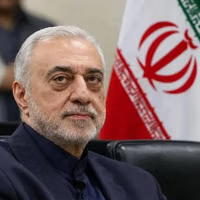
Iran foreign minister says enemies seek to fuel unrest through economic pressure

Iran’s Foreign Minister Abbas Araghchi warned on Thursday of what he called a new attempt to destabilize the country through economic pressure, urging national unity.

Iran’s Foreign Minister Abbas Araghchi warned on Thursday of what he called a new attempt to destabilize the country through economic pressure, urging national unity.
“A new plot is underway, with the enemy seeking to worsen economic conditions in order to fuel dissatisfaction and create internal problems for the system,” Araghchi said, dismissing what he described as attempts to destabilize the country from within.
Araghchi said Iran’s adversaries were aiming to exert economic pressure to provoke unrest, but vowed such efforts would fail, drawing parallels with what he called Iran’s resilience during a recent 12-day war.
“Just as we overcame the 12-day war using domestically built missiles, the resistance of our armed forces and the efforts of our people and government, we must now stand together to defeat this economic crisis and the enemies’ attempts to impose harsh conditions,” he said.
Iran had weathered four decades of sanctions and the presence of global military powers, Tehran’s top diplomat adding that the country had emerged from the latest conflict “with pride,” and would do so again in the face of economic pressure.


Iran’s Revolutionary Guards said they will hold a military drill on Thursday and Friday in Tehran province, warning residents they may hear loud sounds during the exercise.
“Any sounds of explosions or gunfire heard during these two days will be related to the drill and will be fully controlled,” Ghorban Valizadeh said, according to Mehr news agency. He urged residents to remain calm.
Valizadeh, commander of the Sayyed al-Shohada Guards unit in Tehran province, said the exercise, known as “Beit al-Moqaddas 16,” will include staged scenarios and will be carried out by ground units.
He said the drill is held every year under the same name by ground forces of the Revolutionary Guards in different parts of the country, framing it as a standard exercise rather than a new development.
The Guards’ ground forces are tasked with homeland defense and the suppression of internal threats.


Contradictory reports on missile activity
The announcement follows contradictory reports earlier this week after an IRGC-aligned outlet reported missile tests over several Iranian cities, including Tehran, Isfahan and Mashhad. State television later denied that any missile launches had taken place, saying circulating images were not linked to a test.
Israel’s Prime Minister Benjamin Netanyahu said on Monday that Israel was aware Iran was conducting military exercises and was making preparations.
Defense analyst Farzin Nadimi told Iran International that the reported drills could be read as a signal, saying the Guards were showing they could carry out coordinated military activity across different parts of Iran.
Iranian officials have repeatedly said the country’s military activities are defensive. Earlier this week, Foreign Ministry spokesperson Esmaeil Baghaei said Iran’s defense capabilities were not open to discussion.

Iran’s Supreme National Security Council has instructed domestic media outlets to refrain from publishing what it described as biased or false reports about Venezuela, according to a directive reviewed by Iran International.
The directive, circulated to editors and media managers, warned that Western media coverage of Venezuela in recent weeks and months formed part of what it called a US-led campaign of economic and psychological pressure against the government of President Nicolas Maduro.
Without citing specific examples, the council said such reporting aimed to wage “psychological warfare” and urged Iranian media to verify information before publication and avoid highlighting narratives that could, in its words, reinforce US pressure on the Venezuelan state and population.
The Supreme National Security Council, chaired by President Masoud Pezeshkian, did not specify which reports it considered misleading or inaccurate.
Iranian authorities have repeatedly issued editorial guidance to domestic media over coverage of foreign policy issues, national security matters and relations with the United States and its allies.
Several such directives, including earlier instructions on how to report remarks by US President Donald Trump in Israel’s Knesset, have previously been obtained by Iran International.
Iran and Venezuela have maintained close political, economic and security ties for years, dating back to the presidency of Hugo Chavez. The relationship has deepened as both countries face US sanctions and diplomatic isolation.
Iran’s Supreme Leader Ayatollah Ali Khamenei recently criticized US pressure on Venezuela and condemned the seizure of a Venezuelan-linked oil tanker in the Caribbean.
President Pezeshkian also reaffirmed Tehran’s support for Caracas in a recent phone call with Maduro, describing Venezuela as a “friend and ally.”
Tehran and Caracas signed a 20-year cooperation agreement in 2022 covering sectors including energy, trade and industry. Both governments have also acknowledged cooperation in defense-related fields, though details remain limited.
Western governments and research institutions have reported that Iran has assisted Venezuela with drone technology and energy infrastructure, allegations that both countries have either denied or declined to comment on.
The United States has closely monitored Iran-Venezuela ties. US Secretary of State Marco Rubio said in recent comments that Venezuela served as a platform for Iranian influence in Latin America, remarks rejected by both Tehran and Caracas.
Iran’s foreign ministry has said it supports the Venezuelan government, which faces ongoing international disputes over electoral legitimacy. The United States, the European Union and several Latin American countries do not recognize Maduro’s current administration.

The United States and Iran traded sharply worded accusations on Tuesday at the United Nations Security Council, with Washington offering conditional talks while Tehran blamed the standoff on US withdrawal from the nuclear deal and strikes on Iranian nuclear sites in June.
Speaking during the session, Morgan Ortagus, counselor of the US Mission to the United Nations, said Washington remained open to formal negotiations but only if Iran agreed to direct talks and abandoned uranium enrichment.
“We’d like to make it clear to the entire world that the United States remains available for formal talks with Iran, but only if Tehran is prepared for direct and meaningful dialogue. Direct and meaningful.”
“Foremost, there can be no enrichment inside of Iran, and that remains our principle,” she added.
Ortagus said President Donald Trump had repeatedly pursued diplomacy with Tehran.
“In both administrations, President Trump extended the hand of diplomacy to Iran,” she said. “But instead of taking that hand of diplomacy, you continue to put your hand in the fire. Step away from the fire, sir, and take President Trump’s hand of diplomacy.”
Iran rejected that framing.
“We appreciate any fair and meaningful negotiation, but insisting on zero enrichment policy is contrary to our rights as a member of the NPT," Tehran's UN envoy Amir Saeed Iravani said.
"Iran will not bow down to any pressure and intimidation.”
Iravani argued that the crisis stemmed from Washington’s unilateral withdrawal from the 2015 nuclear agreement and subsequent actions by the United States and its allies.
"The root causes of the current situation are clear and did not emerge overnight or in isolation. They lie in the unilateral withdrawal of the United States from the JCPOA in 2018, the sustained and deliberate non-compliance of the three European countries with their commitments and the subsequent military aggression by the United States and the Israeli regime against Iran's peaceful safeguard nuclear facilities.
The remarks referred to the 12-day war in June, when Israel launched a surprise attack on Iran in the middle of nuclear negotiations, drawing in the United States and derailing a planned new round of talks.
Tuesday's Council session revealed deep divisions over whether UN sanctions on Iran have been reinstated under the snapback mechanism of Resolution 2231.
Britain, France and Germany argue that Iran’s nuclear noncompliance has restored sanctions automatically, while China and Russia — backed by Tehran — reject that claim and question the Council’s authority to continue addressing the issue.

Iran’s government on Tuesday submitted its draft budget for the year starting in March 2026 to parliament, with early indications suggesting one of the most restrictive fiscal frameworks in recent years amid persistent economic strains.
Officials familiar with the drafting process at the Planning and Budget Organization say the bill was prepared with tight spending limits.
President Masoud Pezeshkian has previously blamed budget deficits for fueling inflation, while the economy minister has said the government aims to eliminate the deficit in the coming year.
Unofficial estimates suggest the overall budget ceiling may increase by less than 5%. With inflation still running above 40%, economists say this would amount to a real contraction of around 35% in government spending power, a scale of adjustment that could weigh heavily on public services, development projects and support programs.
Wage increases draw early criticism
The draft was submitted to parliament amid immediate criticism from lawmakers, particularly over a proposed 20% rise in public-sector wages, which several MPs said lags inflation and risks further eroding household purchasing power.
The bill, state media reported, is the first budget prepared under a new format in which parliament no longer debates accompanying legal provisions, reviewing only numerical tables.
The draft, Budget chief Hamid Pourmohammadi said, was submitted after removing four zeros from the national currency, in line with recent legislation.
Inflation risks in the background
In his budget speech, Pezeshkian warned that water shortages pose an urgent national challenge, saying weak management could have lasting consequences.
The budget debate comes as gold and foreign-currency prices in Tehran have surged in recent weeks, particularly after the approval of a third gasoline price tier, developments that have reinforced expectations of higher inflation.
Lawmakers earlier on Tuesday held a closed-door session with senior ministers and central bank officials to discuss currency volatility and price controls.

Iran detained about 2,000 people accused of links to enemy intelligence networks during and after the 12-day war with Israel in June, a senior armed forces official said on Tuesday.
Abolfazl Shekarchi, the armed forces’ cultural deputy, said a “wide spy network” had taken shape over several years with significant investment in training and organization.
“A large network of spies and enemy agents had been formed, and years of effort and heavy costs were spent to build it,” Shekarchi was quoted as saying by Iranian state media.
Shekarchi said the arrests started months before the fighting and continued through the end of the war.
“From a few months before the start of this war, because of the readiness in place, until the end of the war, around 2,000 of these agents were arrested,” he said.
He said rebuilding such networks would take time. “Reconstructing a network like this is not simple and requires years of time and cost,” Shekarchi said.
'Severe punishment'
Iran’s judiciary chief also cited roughly the same number of arrests in comments made in July, and said some detainees could face execution if convicted of working with Israel.
“In our law, anyone who cooperates with a hostile state during wartime must be arrested and prosecuted,” judiciary chief Gholamhossein Mohseni Ejei said in an interview with state TV.
“Some of these individuals face severe punishments, including the death penalty,” he said, adding that others could receive lighter sentences or be released after investigation.


US cites executions, student case draws rights focus
The US State Department said on Tuesday that Iranian authorities executed more than 17 prisoners within 48 hours, including Aghil Keshavarz, a 27-year-old architecture student convicted of spying for Israel.
“Only in 48 hours, the Islamic Republic regime executed more than 17 prisoners,” the US State Department said in a post on its Persian-language account.
Iran’s judiciary said Keshavarz was executed after the Supreme Court upheld his death sentence and legal procedures were completed.
The execution prompted condemnation on social media and renewed focus by rights groups on Iran’s use of the death penalty in national security cases linked to alleged cooperation with Israel.
The Human Rights Activists News Agency said on Monday that at least 17 people have been executed in Iran over the past two days in prisons across Iran.