Iran Revolutionary Guards plan military drill in Tehran province

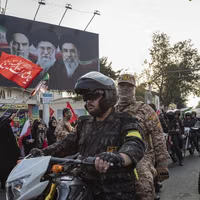
Iran’s Revolutionary Guards said they will hold a military drill on Thursday and Friday in Tehran province, warning residents they may hear loud sounds during the exercise.

Iran’s Revolutionary Guards said they will hold a military drill on Thursday and Friday in Tehran province, warning residents they may hear loud sounds during the exercise.
“Any sounds of explosions or gunfire heard during these two days will be related to the drill and will be fully controlled,” Ghorban Valizadeh said, according to Mehr news agency. He urged residents to remain calm.
Valizadeh, commander of the Sayyed al-Shohada Guards unit in Tehran province, said the exercise, known as “Beit al-Moqaddas 16,” will include staged scenarios and will be carried out by ground units.
He said the drill is held every year under the same name by ground forces of the Revolutionary Guards in different parts of the country, framing it as a standard exercise rather than a new development.
The Guards’ ground forces are tasked with homeland defense and the suppression of internal threats.
Contradictory reports on missile activity
The announcement follows contradictory reports earlier this week after an IRGC-aligned outlet reported missile tests over several Iranian cities, including Tehran, Isfahan and Mashhad. State television later denied that any missile launches had taken place, saying circulating images were not linked to a test.
Israel’s Prime Minister Benjamin Netanyahu said on Monday that Israel was aware Iran was conducting military exercises and was making preparations.
Defense analyst Farzin Nadimi told Iran International that the reported drills could be read as a signal, saying the Guards were showing they could carry out coordinated military activity across different parts of Iran.
Iranian officials have repeatedly said the country’s military activities are defensive. Earlier this week, Foreign Ministry spokesperson Esmaeil Baghaei said Iran’s defense capabilities were not open to discussion.
Iran’s Supreme National Security Council has instructed domestic media outlets to refrain from publishing what it described as biased or false reports about Venezuela, according to a directive reviewed by Iran International.
The directive, circulated to editors and media managers, warned that Western media coverage of Venezuela in recent weeks and months formed part of what it called a US-led campaign of economic and psychological pressure against the government of President Nicolas Maduro.
Without citing specific examples, the council said such reporting aimed to wage “psychological warfare” and urged Iranian media to verify information before publication and avoid highlighting narratives that could, in its words, reinforce US pressure on the Venezuelan state and population.
The Supreme National Security Council, chaired by President Masoud Pezeshkian, did not specify which reports it considered misleading or inaccurate.
Iranian authorities have repeatedly issued editorial guidance to domestic media over coverage of foreign policy issues, national security matters and relations with the United States and its allies.
Several such directives, including earlier instructions on how to report remarks by US President Donald Trump in Israel’s Knesset, have previously been obtained by Iran International.
Iran and Venezuela have maintained close political, economic and security ties for years, dating back to the presidency of Hugo Chavez. The relationship has deepened as both countries face US sanctions and diplomatic isolation.
Iran’s Supreme Leader Ayatollah Ali Khamenei recently criticized US pressure on Venezuela and condemned the seizure of a Venezuelan-linked oil tanker in the Caribbean.
President Pezeshkian also reaffirmed Tehran’s support for Caracas in a recent phone call with Maduro, describing Venezuela as a “friend and ally.”
Tehran and Caracas signed a 20-year cooperation agreement in 2022 covering sectors including energy, trade and industry. Both governments have also acknowledged cooperation in defense-related fields, though details remain limited.
Western governments and research institutions have reported that Iran has assisted Venezuela with drone technology and energy infrastructure, allegations that both countries have either denied or declined to comment on.
The United States has closely monitored Iran-Venezuela ties. US Secretary of State Marco Rubio said in recent comments that Venezuela served as a platform for Iranian influence in Latin America, remarks rejected by both Tehran and Caracas.
Iran’s foreign ministry has said it supports the Venezuelan government, which faces ongoing international disputes over electoral legitimacy. The United States, the European Union and several Latin American countries do not recognize Maduro’s current administration.

Mohammad Javad Zarif’s latest Foreign Affairs article follows a familiar pattern in his narrative: recasting Tehran’s militarization and domestic repression as reactive responses to external pressure rather than deliberate internal choices.
Zarif argues that relations between Iran and the United States have long been trapped in a cycle of “securitization,” in which each side responds defensively to the other’s actions.
The Islamic Republic, he writes, has been “forced” to prioritize military spending over development because of attacks by Iraq, Israel, and the United States.
The argument downplays Iran’s own role in shaping that trajectory.
Contrary to Zarif’s account, the theocracy’s turn toward securitization gained pace in the aftermath of the Iran–Iraq war, particularly under the late President Ali Akbar Hashemi Rafsanjani, who helped embed the military in politics and the economy as a pillar of postwar reconstruction and state survival.
But Zarif shifts responsibility for Iran’s unbalanced development outward.
Western pressure, not decisions taken by Iran’s leadership, is blamed for a system in which missile programs expanded while welfare sectors such as housing, employment, and healthcare stagnated.
The implication is that Iran’s strategic priorities were imposed rather than chosen.
Zarif further suggests that reduced pressure from Washington would lead Tehran to de-escalate. Yet this claim sits uneasily with his own account of events following the 2015 nuclear deal.
One of the achievements Zarif frequently cited was the lifting of sanctions not only on Iran’s nuclear program but also on arms-related restrictions, including sanctions on Iran Air, allowing the airline to modernize its fleet.
By Zarif’s own account, however, the easing of sanctions did not lead to restraint.
In a 2021 interview with the economist Saeed Leylaz, Zarif acknowledged that Iran Air flights were used by the Islamic Revolutionary Guard Corps to transfer weapons to Syria, with such flights increasing sharply after the nuclear deal. When Zarif raised concerns with Qassem Soleimani, the then-commander of the Quds Force, he said Soleimani replied that “Iran Air is safer.”
Zarif later described this dynamic as the “dominance of the battlefield over diplomacy,” an admission that key decisions about militarization were made within Iran’s power structure, not imposed from abroad.
Indeed, the period following the nuclear deal saw expanded investment in missile programs and a deepening of Iran’s regional proxy network, financed in part by newly available resources.
Yet in the Foreign Affairs article, Zarif presents increased uranium enrichment and the repression of domestic protest as reactions to Western pressure—once again shifting responsibility for violent crackdowns repression away from the rule in Tehran.
“The external securitization of Iran has fed into a parallel dynamic at home,” he writes, “as the state adopted a stricter approach in dealing with domestic social challenges, responding to these challenges with tighter restrictions.”
A similar pattern appears in Zarif’s account of Iran’s role in Syria.
In the same 2021 interview, he suggested that Iran’s direct military involvement followed a visit by Soleimani to Moscow, framing the escalation as the product of Russian strategy to undermine the nuclear deal rather than a decision taken by Iran’s leadership.
The role of Supreme Leader Ali Khamenei and Iran’s own security institutions is largely absent from this narrative.
The tendency to externalize responsibility extends to other areas as well.
After the nuclear deal, the release of several dual nationals and the unfreezing of Iranian assets raised expectations of de-escalation. Instead, a new wave of arrests of dual nationals followed, a pattern widely seen as deliberate leverage rather than a response to external pressure.
Zarif’s article also describes Israeli strikes in June 2025 as “unprovoked,” without reference to decades of official Iranian rhetoric calling for Israel’s destruction or the expansion of armed proxy groups along Israel’s borders.
The broader context of the current confrontation—including Hamas’s October 7, 2023 attack on Israel, praised by Iranian officials—is notably absent.
Iran has had multiple opportunities to break the cycle Zarif describes, from the early years after the revolution to the post-nuclear-deal period. Each time, its leadership made choices that reinforced militarization and repression rather than curbing them.
The question raised by Zarif’s essay is not whether external pressure mattered—but why internal agency continues to be written out of the story.

A group of UN human rights experts and more than 400 prominent women from around the world on Tuesday urged Iran to halt the execution of political prisoner Zahra Shahbaz Tabari held in Lakan Prison in Rasht.
“Ms. Tabari’s case shows a pattern of serious violations of international human rights law regarding fair trial guarantees and the inappropriate use of capital punishment for broad and ill-defined national security offences,” the UN experts said.
The statement adds that under the International Covenant on Civil and Political Rights, which Iran ratified in 1975, the death penalty must be limited to the “most serious crimes”, understood as involving intentional killing.
“This case involves no intentional killing and contains numerous procedural violations. To execute Ms. Tabari under these circumstances would constitute arbitrary execution,” the experts said.
UN human rights experts, who monitor states’ compliance with international law and regularly brief UN bodies and governments, said the case highlights a wider pattern of abuses in Iran’s use of the death penalty
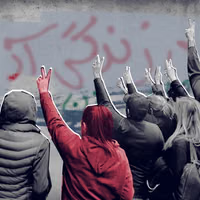
The experts said she was sentenced to death on the charges of baghi (armed rebellion) in October based on two pieces of evidence, including a piece of cloth bearing the slogan “Woman, Resistance, Freedom,” a popular slogan from the 2022 protests, and an unpublished audio message.
“What we see here is a mockery of justice that falls far short of the most basic international standards,” they said, urging Iran to halt the execution and bring its use of the death penalty in line with its international obligations.
Prominent women worldwide urge Iran to stop Tabari's execution
More than 400 prominent women from around the world also urged Iran to halt the execution of Tabari in an appeal that denounces her death sentence as the outcome of an unjust trial.
Among the signatories are prominent Iranian women in exile as well as international feminists and human rights defenders, bolstering the appeal’s call for global pressure on Tehran to stop Tabari’s execution.
Some of the most high-profile signatories include Nobel Peace Prize laureate Shirin Ebadi, Republican US Congresswoman Nancy Mace of South Carolina, and Samantha Power, the former US ambassador to the UN.
The appeal is also signed by former Ukrainian Prime Minister Yulia Tymoshenko and other senior former officials, including ex-ministers and ambassadors.
"Tabari as a 67-year-old mother and engineer who was sentenced to death in October on national security charges after a brief remote hearing held by videoconference," the statement said.
“Our colleague’s death sentence was handed down in a sham 10-minute trial, held remotely via videoconference without her chosen legal representation,” the signatories said, calling the proceedings a violation of Iran’s obligations under international law.
“For four decades, Iranian authorities have enforced brutal gender apartheid and institutionalized misogyny including through forced veiling,” the statement added.
The appeal urges the Iranian authorities to immediately quash Tabari’s death sentence and release her, warning that her hanging would amount to a further crime under international law.
“We demand Zahra’s immediate release, and we call on governments worldwide to stand with the women of Iran in their quest for democracy, equality, and freedom,” the signatories said, calling for concerted diplomatic pressure and engagement with UN mechanisms to prevent the execution.

Iran’s government on Tuesday submitted its draft budget for the year starting in March 2026 to parliament, with early indications suggesting one of the most restrictive fiscal frameworks in recent years amid persistent economic strains.
Officials familiar with the drafting process at the Planning and Budget Organization say the bill was prepared with tight spending limits.
President Masoud Pezeshkian has previously blamed budget deficits for fueling inflation, while the economy minister has said the government aims to eliminate the deficit in the coming year.
Unofficial estimates suggest the overall budget ceiling may increase by less than 5%. With inflation still running above 40%, economists say this would amount to a real contraction of around 35% in government spending power, a scale of adjustment that could weigh heavily on public services, development projects and support programs.
Wage increases draw early criticism
The draft was submitted to parliament amid immediate criticism from lawmakers, particularly over a proposed 20% rise in public-sector wages, which several MPs said lags inflation and risks further eroding household purchasing power.
The bill, state media reported, is the first budget prepared under a new format in which parliament no longer debates accompanying legal provisions, reviewing only numerical tables.
The draft, Budget chief Hamid Pourmohammadi said, was submitted after removing four zeros from the national currency, in line with recent legislation.
Inflation risks in the background
In his budget speech, Pezeshkian warned that water shortages pose an urgent national challenge, saying weak management could have lasting consequences.
The budget debate comes as gold and foreign-currency prices in Tehran have surged in recent weeks, particularly after the approval of a third gasoline price tier, developments that have reinforced expectations of higher inflation.
Lawmakers earlier on Tuesday held a closed-door session with senior ministers and central bank officials to discuss currency volatility and price controls.

Iraq’s electricity ministry said on Tuesday that Iranian gas supplies had stopped entirely, cutting between 4,000 and 4,500 megawatts from the national power grid and reducing supply hours.
“The flow of Iranian gas has stopped completely,” ministry spokesman Ahmed Mousa said, adding that some power units were shut while others were forced to cut output.
Mousa said Tehran had informed Baghdad of the halt due to “emergency conditions,” without giving further details.
He said the Iraq Electricity Ministry had switched to domestic alternative fuel in coordination with the oil ministry, and that generation remained “under control” despite the shortfall.
Iranian gas exports to Iraq had declined sharply this year after the US tightened sanctions enforcement and revoked a long-standing waiver that allowed Iraq to pay for Iranian electricity and gas imports.
Between April and August, Iranian gas exports to Iraq fell by about 40%, according to regional trade data, as Baghdad struggled to navigate sanctions while seeking alternative supplies.
Iraq’s power sector has also faced security disruptions. In November, a rocket strike forced the shutdown of the Khor Mor gas field in northern Iraq, cutting about 3,000 megawatts from regional supply.
Local Kurdish officials blamed Iran-backed armed groups for the attack, which targeted energy infrastructure critical to electricity generation.
The electricity ministry said Iraq had prepared for peak winter demand through maintenance and upgrades at power stations, and that coordination with the oil ministry would continue until Iranian gas flows resume.