Two young men sit under a large picture of Iran's first supreme leader Ruhollah Khomeini (L) and his successor Ali Khamenei at a park in Tehran, Iran, January 17, 2016.
Faced with economic crisis, social defiance and regional strain, Iran’s supreme leader Ali Khamenei continues to invoke earlier moments of “glory,” treating defeat and mismanagement as moral triumphs rather than political failures.
This approach has been a defining feature of his 36-year rule: confronting challenges not by reassessing the past but by recasting it.
That pattern was again on display in a December 15 speech, in which Khamenei returned to the state narrative forged after the 1980s war with Iraq—known officially as the “Sacred Defense.”
The Iran–Iraq war, which ended in 1988 without a clear winner, inflicted enormous human and financial losses on both countries, leaving hundreds of thousands dead.
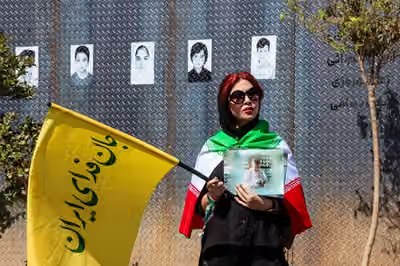
In its immediate aftermath, Iran’s theocratic rulers embedded their interpretation of the conflict into public space. Murals across the country depicted blood-stained bodies of “martyrs” alongside grieving children.
Khamenei delivered his latest speech in an event commemorating the martyrs of that war in Karaj, Iran’s fourth-largest city, just west of Tehran. He called for a “transfer of the values and motivations of the Sacred Defense era to the new generation through artistic effort and persistent follow-up.”
Rather than grappling with present-day realities, he looked backward, framing sacrifice and “martyrdom” as enduring virtues for a new generation.
No mistakes
In his speech, Khamenei acknowledged Iran’s dire condition but sought to project optimism.
“Despite all the hardships and difficulties, there exist numerous positive points and considerable readiness within the country to move toward Islam and the Revolution,” he said, adding that “these must be strengthened.”
Political analyst Jamshid Barzegar told Iran International TV that the remarks reflected a leadership unwilling to accept responsibility.
“Not only does Khamenei fail to alleviate the poverty and other problems he has imposed on the nation, he does not seem to have a plan to correct his mistakes,” Barzegar said.
He also questioned Khamenei’s assertion that society is moving “toward revolution and Islam,” noting that the supreme leader himself abandoned revolutionary and Islamic rhetoric after the 12-day war with Israel, shifting instead toward nationalist themes that emphasized Persian identity over religious ideology.
•
•
No course correction
Khamenei’s retreat into past narratives—coming shortly after the unveiling of a replica statue depicting a Roman emperor prostrating before a Persian king—has projected an image of uncertainty rather than authority.
That impression was reinforced by the handling of the Karaj speech itself. Its broadcast was delayed until the following day, apparently for security reasons, suggesting the establishment has not forgotten the shock—if not the humiliation—of the June assault and its personal aftermath for Khamenei.
The unusually brief version posted on his website also hinted at heavy editing, possibly to avoid missteps.
Economic analyst Mohammad Machinchian criticized Khamenei’s reference to “numerous positive points,” arguing that it bore little resemblance to everyday reality.
“Only in recent days nearly all Iranians suffered heavy financial losses due to unusual price hikes,” Machinchian said. “But Khamenei is captivated by the distant past and seeks to follow the same path that has led to the current impasse.”
Iran is not a war-torn country, yet four decades of Islamic Republic rule have driven mass emigration. UN data show over five million registered refugees or asylum seekers since 1980, with millions more leaving legally – about one in every 15 Iranians now living abroad.
So why have millions of Iranians chosen to endure the hardship of life far from home rather than remain under the Islamic Republic?
This report draws on official United Nations figures for Iranian refugees and asylum seekers, which begin in 1980 – about a year into the Islamic Revolution.
The UN High Commissioner for Refugees (UNHCR) published no figures for Iranian refugees or asylum seekers before 1980, although UNHCR has been collecting refugee statistics since 1951.
Before the establishment of the Islamic Republic in 1979, there were no recorded asylum cases, aside from scholarship students and legal Iranian migrants.
There are, however, personal accounts involving a small number of members of the Tudeh Party – a pro-Soviet Iranian communist party – who fled to the former Soviet Union. One such account concerns Ataollah Safavi, a former Tudeh Party member who, after fleeing to the Soviet Union, was sent to Siberian forced labor camps.
Ali Khamenei kisses the hand of Ruhollah Khomeini, the founder of the Islamic Republic, in an undated image.
First decade: War years under Khomeini’s leadership
The first wave of Iranian asylum began in 1980. Shortly after the Islamic Republic was established, Iranians could still migrate relatively easily using passports issued under the previous government.
In this period, a large number of Iranians traveled legally to the United States.
From 1980, the registration of Iranian asylum seekers began with 44 cases, marking the start of a trend that would accelerate through the decade.
The first ten years, from 1980 to 1989, coincided with the eight-year Iran–Iraq war, the presidency of Ali Khamenei, and the premiership of Mirhossein Mousavi, while Ruhollah Khomeini served as Supreme Leader.
Over that decade, more than 312,000 Iranians were registered as refugees, according to United Nations data.
The peak came in 1985, when more than 88,000 refugees were recorded in a single year – the highest annual total of the decade.
(From left) Ali Khamenei, Akbar Hashemi Rafsanjani, and Mousavi Ardebili
Second decade: Khamenei takes charge
In 1989, Ali Khamenei began his tenure as Supreme Leader of the Islamic Republic, and Akbar Hashemi Rafsanjani took office as president – ushering in what Iran’s official political language calls the “reconstruction” era, a term used for the post–Iran-Iraq war drive to rebuild state capacity and the economy.
By the end of Rafsanjani’s presidency, inflation compared to his first year was up 478%, and the record for Iran’s annual inflation is still attributed to his government at more than 49%.
Against that economic backdrop, the trend in Iranian asylum intensified.
Over the 1990–1999 period, nearly 1.06 million Iranians were registered as refugees, with the peak in 1991, when 130,000 refugees were recorded.
After 1997 – often described in Iran as the start of the “reform era” – the pace of refugee registrations eased for a time, falling to below 100,000 a year.
Former presidents Mahmoud Ahmadinejad (left) and Mohammad Khatami
Third decade: Reform and Ahmadinejad
In 1997, the election of Mohammad Khatami ushered in a period often described as Iran’s “reform” era, bringing a measure of optimism to parts of Iranian society.
During the first three years of Khatami’s presidency, the number of Iranians registered as refugees and asylum seekers declined modestly, before reversing course and rising again.
From 2000 to 2009, nearly 1.1 million Iranians were registered as refugees or asylum seekers, although some cases initially recorded as asylum claims may have been reclassified as refugee status in subsequent years.
A similar pattern emerged under Mahmoud Ahmadinejad, whose early presidency also saw a year-on-year decline in asylum registrations. That trend, however, reversed after his first two years in office.
In 2009, as protests known as the Green Movement erupted following Iran’s disputed presidential election, refugee and asylum registrations reached their highest level of the decade.
The ministers of foreign affairs of France, Germany, the European Union, Iran, the United Kingdom and the United States as well as Chinese and Russian diplomats announcing the framework for a comprehensive agreement on the Iranian nuclear program (Lausanne, April 2, 2015)
Fourth decade: Nuclear tensions and the JCPOA
In the decade spanning 2010 to 2019, Iran’s migration pressures unfolded alongside an increasingly fraught nuclear dispute and repeated economic shocks.
Unlike earlier periods, the trend in Iranian asylum did not ease after Hassan Rouhani took office in 2013, remaining on an upward path even after the JCPOA – the 2015 nuclear accord formally known as the Joint Comprehensive Plan of Action – was signed between Tehran and world powers.
After Donald Trump became US president in 2017, asylum registrations by Iranians rose sharply, reflecting the renewed strain that followed his administration’s tougher posture toward Tehran.
The same period also coincided with the rise of ISIS in Syria and Iraq, adding another layer of regional instability.
Over the decade as a whole, around 1.5 million Iranians were registered as refugees or asylum seekers.
A scene of 2019 protests in Tehran
From Bloody November 2019 to today
“Bloody Aban” is the term commonly used by Iranians to refer to the November 2019 crackdown on nationwide protests, an episode that marked a turning point in the country’s recent political and economic trajectory.
From 2020, Iran’s economic conditions deteriorated further, adding to pressures already created by sanctions and domestic mismanagement.
In the years following 2019, the overall trend in Iranian asylum and refugee registrations moved upward, with the exception of 2022, when the numbers temporarily eased.
This period was also shaped by the COVID-19 pandemic, which compounded existing strains.
In Iran, pandemic-related restrictions were imposed in 2019 and were fully lifted in 2022.
Across the six years that followed, 1,266,000 people were registered as asylum seekers or refugees.
One in every 15 Iranians lives outside Iran
United Nations data show that trends in Iranian asylum do not closely track changes of administrations in Tehran, suggesting that leaving the country has been driven more by long-term structural pressures than by shifts between governments.
There is no single, definitive figure for the total number of Iranians living abroad.
Domestic sources such as Iran’s Migration Observatory estimate the number of Iranian migrants at around two million.
Iran’s Foreign Ministry places the figure at about four million, a total that includes people born in Iran as well as a second generation born abroad.
Even so, UN data show that from 1980, when registrations of Iranian asylum seekers began, until today, 5,183,000 Iranians have been registered as asylum seekers or refugees, reflecting the scale of forced or protection-based departures over more than four decades. Of that total, nearly 4,142,000 are recorded as refugees.
Taken together with estimates that nearly two million Iranians have also left the country through legal migration, the combined figures point to a stark conclusion: roughly one in every 15 Iranians now lives outside the country.
From the outside, Iran’s migration story can appear singular. In reality, it spans legal migration and forced displacement, driven by a combination of economic pressure and political anxiety.
Many Iranians describe the same trade-off: accepting language barriers, unfamiliar cultures, and separation from family in exchange for the belief that staying offers little stability or future.
Most authoritative energy forecasts, including Iran’s own official estimates, agree that global oil demand will peak in the next decade and then enter irreversible decline, a frightening outlook for Tehran.
For an economy that still derives around 40–50% of government revenue and up to 70% of export earnings from crude, this is not a distant warning. It is an existential deadline.
Iran has, at best, one final 25-year window—and more realistically just under a decade—to execute the most expensive economic transformation in its modern history.
The cost of such a transition is conservatively estimated by analysts and think-tank scenarios at $1.8–2.4 trillion: major water-transfer systems, more than 150 gigawatts of solar and wind capacity, high-speed rail, technology manufacturing hubs, and incentives to slow the accelerating brain drain.
Iran currently lacks both the funds and, under sanctions, access to the necessary capital.
Numbers speak
Oil production capacity peaked in 2018 at roughly 4.8 million barrels per day and now struggles to remain above 3.8 million. Under widely accepted net-zero trajectories, Iran’s oil revenue in 2045 could fall to roughly a fifth of current levels.
Model estimates based on Iran’s latest development plan and historical benchmarks suggest that, to merely maintain living standards after 2040, non-oil exports would need to grow at approximately 19% annually for two decades.
It is not impossible but highly improbable—a feat achieved only by China and South Korea under very different political and institutional conditions.
But where would the money come from?
Foreign direct investment amounted to roughly $1.2 billion in the most recent recorded year—lower than Yemen and Syria.
The National Development Fund, repeatedly tapped for budget deficits, now holds less than $10 billion in liquid assets, according to its own reporting and parliamentary audits.
The Tehran Stock Exchange bleeds capital and remains dominated by quasi-state entities. Primary U.S. sanctions make international borrowing almost impossible.
‘Post-oil’
Even if every sanction were lifted tomorrow, Iran would still require more than a decade of sustained 8–10% annual GDP growth to generate the domestic savings needed for a post-oil transition—a rate it has not achieved in a single year since 2002.
Yet official planning still largely overlooks the challenge.
The Seventh National Development Plan (2023–27) mentions “post-oil” only twice and allocates less than 1% of investment to renewable energy.
A leaked 2041 energy balance from the Ministry of Energy continues to assume oil and gas will supply 82% of primary energy, a projection incompatible with any plausible global scenario.
Energy economists agree on one principle: building a new economic pillar capable of replacing oil rents takes 20–25 years. Iran’s decisive megaprojects must therefore break ground before 2030.
If the country fails to secure $250–300 billion in committed, contract-signed investment by the end of this decade, the window will effectively close.
Time running out
Iran is not starting from weakness in its fundamentals: a young and educated population, world-class engineers, strategic geography, and a diaspora that remitted an estimated $8–10 billion last year.
It possesses every advantage for a successful post-oil future except the one that matters most: a state capable of earning broad legitimacy and institutional trust.
Acknowledging the approaching post-oil cliff would require recognising that the current economic model has faced severe structural difficulties for decades.
The Islamic Republic may endure another decade or two on discounted oil sales to China and intensified domestic control. But the prospect of Iran becoming a prosperous, technologically confident middle-income nation—the future promised to every child born after 1979—becomes extremely difficult without fundamental reform.
Absent a major political rupture, that vision is likely to fade between 2030 and 2035.
“Woman, Life, Freedom” was not just about compulsory hijab. It was the first collective cry of a generation that already senses its economic future slipping away—and that time to reclaim it is running out.
Free speech. Open dialogue. People having access to one another, the ordinary ability to speak freely and exchange ideas. These might be the downfall of the system patiently built up by Supreme Leader Ali Khamenei, not foreign weapons.
A public sphere not mediated by state television or controlled narratives. People simply talking to each other, in real time, in a forum beyond the reach of power.
That is the fear.
I say this not as a theorist or a politician, but as the host of a nightly call-in program that attempts, modestly and imperfectly, to make such exchanges possible.
The experiment is simple.
There are no slogans, no marching crowds, no images calibrated for cable news. Instead, there is a microphone, a live line, and an invitation so unassuming it almost sounds apolitical: talk. Not perform. Not chant. Not rehearse ideology. Just talk, to one another, in real time, about what has gone wrong, what hurts, what frightens, and what still feels imaginable.
A society that cannot speak to itself is condemned to repeat its errors. A society that can speak cannot be governed indefinitely by myth.
Fractured by fear
Iran is among the most politicized societies in the world, yet genuine political dialogue is structurally impossible.
Families learn which subjects to avoid at the dinner table. Schools train obedience rather than inquiry. State media speaks incessantly but listens to no one.
Even social media, often romanticized as a space of resistance, is fractured by fear, surveillance, and mutual suspicion.
The result is not apathy, but exhaustion.
Questions accumulate without resolution. Why does a country rich in oil and gas fail to provide reliable electricity? Why do rivers vanish while neighboring desert states manage water abundance?
Why does each generation inherit fewer prospects than the one before it? Is war inevitable? Is collapse? Is change possible without catastrophe?
These questions never cohere into shared understanding.
Online, coordinated campaigns flood debates with distraction and distortion, contaminating the very spaces where collective reflection might otherwise take shape. Fragmentation serves power.
A society arguing with itself is a society distracted from those who govern it.
The most dangerous conflict in Iran today is not between the state and the people, but among the people themselves, along ideological, generational and emotional fault lines.
In the aftermath of the recent brief war with Israel, many Iranians found themselves at a crossroads, unsure whether the future demanded silence, rupture, or something harder and more fragile.
Dialogue, in this context, is not reconciliation with power, nor a plea for moderation as a moral posture. It is not an elite exercise in rhetoric.
Real dialogue is untidy. It requires listening to voices one distrusts. It rests on a radical premise: that no one, neither the dissident nor the conscript, neither the exile nor the factory worker, is disposable by default.
The right to speak, and to hear
On my program, I try to create space for that premise to be tested. The format is open, live, and unfiltered. Callers speak without ideological vetting. What matters is not agreement, but participation.
Recently, callers from Tehran, Rasht, Shiraz and Zahedan spoke openly about leadership, foreign intervention, a monarchy versus a republic, internet shutdowns, nonviolent resistance and the ethics of accountability if the Islamic Republic falls.
Some urged speed. Others warned against vengeance. Some placed hope in figures abroad. Others insisted that change must be rooted domestically.
At one point, a caller argued that anyone associated with the state must be punished. Another responded that a society cannot be rebuilt on the promise of mass retribution. Justice, he said, requires distinction, between those who committed crimes and those who merely survived within a coercive system.
In most democracies, such an exchange would pass unnoticed. In Iran, it is revolutionary.
It is precisely this kind of public, imperfect, unscripted reasoning that authoritarian systems fear most.
The Islamic Republic today appears brittle. Its supreme leader speaks of progress while citizens search for medicine and hard currency. Parliament performs loyalty. The judiciary enforces obedience. State media manufactures fake optimism. Yet none of these institutions command belief.
What they cannot tolerate is unity that does not require uniformity.
A national conversation produces legitimacy, among citizens. It generates shared language, moral boundaries, and, eventually, political imagination. Once people agree on what the problem is, power loses its monopoly on explanation.
Speech connects. Connection organizes.
Silence, by contrast, is a slow death. It corrodes trust. It persuades people that their doubts are solitary.
They are not. Iran does not lack courage. It lacks space.
Every Thursday night, that space opens briefly on my show, long enough to remind people that the most radical demand is not vengeance, or even freedom, but the right to speak, to be heard, and to understand one another before history forces the conversation in blood.
That, ultimately, is what terrifies Iran’s supreme leader.
Iran’s president is facing growing heat as moderate allies turn against him, arguing that his promised government of national consensus has instead lost its authority and internal cohesion.
Over the past month, three senior aides have resigned, while persistent rumors point to the possible departure of Vice President Mohammad-Reza Aref and several cabinet ministers, either voluntarily or under pressure from the hardline-dominated parliament.
The wave began last month when Fayyaz Zahed, a member of the Government Information Council (GIC), resigned, citing restrictions on expressing his views and the appointment of well-known conservatives under the banner of “national consensus.”
“Whatever this is, it is not consensus; it is distortion,” Zahed wrote on X.
A university professor and head of the Tehran Journalists’ Trade Association, Zahed had repeatedly criticized limits on free expression, judicial independence and media freedom.
More departures
Within days, Mohammad Mohajeri, another GIC member and a prominent journalist, resigned, citing similar concerns.
The third departure came last weekend, when the sociologist Mohammad-Reza Javadi-Yeganeh announced on X that he was leaving the Center for Public Communications in the president’s office and returning to academia.
“The reality is that people suffer not only from countless economic problems but also from unnecessary restrictions and interventions,” Javadi-Yeganeh wrote on X, criticizing the administration for shelving a key promise to lift internet restrictions in the face of hardline pressure.
Javadi-Yeganeh had recently shared part of a confidential survey conducted by the Iranian Students Polling Agency (ISPA) on behalf of the presidency, which some political groups said suggested public dissatisfaction approaching 92 percent.
‘Political erosion’
Many moderates in Tehran have framed the resignations as an ominous sign for the administration’s political future.
“Reformists and media outlets supporting the government will no longer pass over this issue so easily,” the news website Rouydad24 wrote in an editorial.
Another editorial, published by the moderate outlet Rooz-e No, warned of a phase of “political erosion” that it said was now visible both outside the government and within the circles close to President Masoud Pezeshkian.
Rooz-e No argued that the resignations, combined with rumors of further departures, mounting pressure from a hardline parliament and the prospect of impeaching key ministers, point to a deeper crisis.
‘Limping’ government
The political strain is unfolding against a backdrop of worsening economic conditions.
Recent government measures aimed at stabilizing the exchange rate and raising gasoline prices have driven up the cost of goods and services, including food and transportation, while shortages of some medicines have worsened.
Critics say the deteriorating economy has not translated into changes in economic leadership, particularly where such moves could carry political costs for Pezeshkian.
They point in particular to Central Bank Governor Mohammad Reza Farzin, who Pezeshkian retained from the conservative administration of Ebrahim Raisi and appears unwilling—or unable—to touch.
"Not even a word about resignation or at least an apology,” journalist Hamid Shojaei exclaimed in an article in moderate daily Arman-e Melli, arguing that it was only the reform-minded like former economy minister Nasser Hemmati and former adviser Ali Tayebnia who pay for the crisis.
“The cycle of resignations will continue,” Shojaei warned Pezeshkian on X. “Is your national consensus not limping? Where are you headed to?”
Tehran state-affiliated media are hinting that Judiciary Chief Gholamhossein Mohseni Ejei could soon be appointed by Supreme Leader Ali Khamenei to head the Guardian Council, the powerful body that vets election candidates and approves parliament’s legislation.
The strongest signal came last week from the Revolutionary Guards-linked Fars News Agency, which described the potential move as a “necessary transition in governance.”
The council’s current chairman, ultra-conservative cleric Ahmad Jannati, will turn 99 next February. He was appointed to the post more than three decades ago and has become increasingly absent from public view.
The timing has also drawn attention because Ejei—himself appointed judiciary chief by Khamenei—is approaching the end of his term.
‘Instill hope’
Beyond the passage of time, Fars floated two additional explanations: resolving tensions between Ejei and President Massoud Pezeshkian over the enforcement of compulsory hijab laws and countering what it described as efforts by “domestic and foreign actors” to depict the Islamic Republic as being in crisis.
According to the agency, these actors are amplifying signs of internal discord—pointing to the resignation of Vice President Javad Zarif last year and rumors Vice President Mohammad Reza Aref may follow suit—as evidence of an intensifying succession struggle.
The commentary ultimately stressed that the Guardian Council ranks above the Judiciary in the political hierarchy and framed Ejei’s transfer as a promotion rather than a demotion, calling for swift action to “calm the political and social atmosphere and instill hope among the nation.”
‘Hope it’s not true’
The issue has since been widely debated across Tehran’s media.
Mohammad Mohajeri, a former Kayhan editor who later became a conservative commentator, said Jannati’s departure would be “good news” after years of what he described as “questionable” candidate vetting. But he added: “I hope it is not true.”
Speaking to Fararu, Mohajeri said Ejei would “most probably improve the Guardian Council,” warning that his exit from the Judiciary could slow or reverse what he saw as modest positive changes there.
Others were more critical. Some dissidents and outspoken lawyers rejected the idea of Ejei’s “promotion,” arguing that he should instead be held accountable for his record as judiciary chief.
During his tenure, at least two senior judicial officials were tried and convicted on financial corruption charges.
Another hardliner in line?
Moderate outlets, including the Tehran daily Shargh, suggested the move was effectively settled, citing “behind-the-scenes jockeying” by hardline factions to position themselves for Ejei’s departure.
The judiciary chief’s post is traditionally reserved for figures within the Supreme Leader’s trusted inner circle, reflecting the institution’s control over the prison system and its central role in suppressing dissent.
Several media outlets have pointed to Mohammad Jafar Montazeri, the hardline head of Iran’s Supreme Court, as Ejei’s likely successor. Montazeri is known for his strict stance on hijab enforcement but has not previously been regarded as part of Khamenei’s closest circle.
Avaye Latif, a website close to the Judiciary, wrote that Montazeri’s appointment would amount to “the continuation of judicial management by someone with a long history in this institution.”