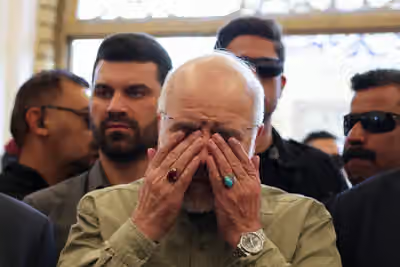
Iran's Head of Judiciary Gholamhossein Mohseni Ejei (right) talks to Supreme Leader Ali Khamenei in this undated file photo
Tehran state-affiliated media are hinting that Judiciary Chief Gholamhossein Mohseni Ejei could soon be appointed by Supreme Leader Ali Khamenei to head the Guardian Council, the powerful body that vets election candidates and approves parliament’s legislation.
The strongest signal came last week from the Revolutionary Guards-linked Fars News Agency, which described the potential move as a “necessary transition in governance.”
The council’s current chairman, ultra-conservative cleric Ahmad Jannati, will turn 99 next February. He was appointed to the post more than three decades ago and has become increasingly absent from public view.
The timing has also drawn attention because Ejei—himself appointed judiciary chief by Khamenei—is approaching the end of his term.
‘Instill hope’
Beyond the passage of time, Fars floated two additional explanations: resolving tensions between Ejei and President Massoud Pezeshkian over the enforcement of compulsory hijab laws and countering what it described as efforts by “domestic and foreign actors” to depict the Islamic Republic as being in crisis.
According to the agency, these actors are amplifying signs of internal discord—pointing to the resignation of Vice President Javad Zarif last year and rumors Vice President Mohammad Reza Aref may follow suit—as evidence of an intensifying succession struggle.
The commentary ultimately stressed that the Guardian Council ranks above the Judiciary in the political hierarchy and framed Ejei’s transfer as a promotion rather than a demotion, calling for swift action to “calm the political and social atmosphere and instill hope among the nation.”
‘Hope it’s not true’
The issue has since been widely debated across Tehran’s media.
Mohammad Mohajeri, a former Kayhan editor who later became a conservative commentator, said Jannati’s departure would be “good news” after years of what he described as “questionable” candidate vetting. But he added: “I hope it is not true.”
Speaking to Fararu, Mohajeri said Ejei would “most probably improve the Guardian Council,” warning that his exit from the Judiciary could slow or reverse what he saw as modest positive changes there.
Others were more critical. Some dissidents and outspoken lawyers rejected the idea of Ejei’s “promotion,” arguing that he should instead be held accountable for his record as judiciary chief.
During his tenure, at least two senior judicial officials were tried and convicted on financial corruption charges.
Another hardliner in line?
Moderate outlets, including the Tehran daily Shargh, suggested the move was effectively settled, citing “behind-the-scenes jockeying” by hardline factions to position themselves for Ejei’s departure.
The judiciary chief’s post is traditionally reserved for figures within the Supreme Leader’s trusted inner circle, reflecting the institution’s control over the prison system and its central role in suppressing dissent.
Several media outlets have pointed to Mohammad Jafar Montazeri, the hardline head of Iran’s Supreme Court, as Ejei’s likely successor. Montazeri is known for his strict stance on hijab enforcement but has not previously been regarded as part of Khamenei’s closest circle.
Avaye Latif, a website close to the Judiciary, wrote that Montazeri’s appointment would amount to “the continuation of judicial management by someone with a long history in this institution.”
Supreme Leader Ali Khamenei said in a speech that Iran faces a campaign by its enemies aimed at public opinion and cultural identity to bring about regime change which a US-Israeli war in June failed to achieve.
“We are in a propaganda war and a spiritual war,” Khamenei said during a meeting in Karaj on Monday which local media published the next day.
“The enemy understood that seizing this land and this country through pressure and military tools is not possible.”
Khamenei said Iran’s adversaries had shifted their focus to influencing public opinion and culture. His remarks appeared to refer to the United States and Israel.
Iran's two nemeses launched a surprise attack in June, culminating in US attacks on three key nuclear facilities. Though US President Donald Trump said the raids obliterated Tehran's capability, a dispute festers over Iran's nuclear ambitions.
Tehran denies seeking a bomb but the United States along with other Western countries and Israel deny its intentions. Trump has vowed to attack Iran again if it restarts uranium enrichment and Iran has denied a punishing response in any war.
“If they want to interfere and achieve success, they must change hearts and minds,” he said. He said pressure on Iran was ongoing in the military, economic and media realms as well as in cyberspace and the foreign press.
“All of this is focused on one point, and that point is pressure on the resistance of nations, with the Iranian nation foremost,” he said. Khamenei said the ultimate goal of such efforts was to erode Iran’s revolutionary and religious identity.
“The enemy’s objective in our country is to gradually turn people away from the revolution, its goals and its memory,” he said. He called on supporters of the Islamic Republic to recognize what he described as the adversaries’ strategy and to strengthen Iran’s cultural and media response.
The veteran theocrat, 86, has long accused Tehran's adversaries of seeking regime change by sowing the seeds of protest and discontent. Iran for over a quarter century has quashed repeated rounds of widespread unrest with deadly force.
Authorities stepped up a crackdown on dissidents and alleged spies in the wake of the June conflict even as it has relaxed enforcement of certain Islamic cultural rules in the theocracy in a move opposed by some hardliners.
Khamenei's remarks come as Iran’s Revolutionary Guards spokesman said last month that Tehran's archenemy, Israel, is in no position to launch a new war against the country, describing current rhetoric as psychological pressure rather than a genuine military threat.
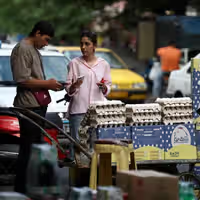
Iran faces a stark choice to address a cost of living crisis: preserve subsidized exchange rates that have failed to protect purchasing power and fueled corruption or remove it and risk triggering another wave of uncontrolled inflation.
Former Central Bank of Iran governor Mohammad-Hossein Adeli summed up the core dilemma in an editorial for Donya-ye-Eghtesad last week.
“The gap between subsidized and free-market exchange rates produces severe distortions, instability, and unjust rents—while simultaneously serving certain political and distributive goals,” he wrote.
Iran’s “preferential” currency system began in April 2018 under President Hassan Rouhani, when the exchange rate was fixed at 42,000 rials per dollar.
The rial plumbed new record lows of over 1.31 million to the dollar on Monday.
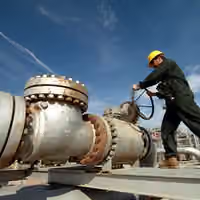
Designed to curb price shocks, protect low-income households, and guarantee access to essential goods and medicine, the subsidy was funded through oil and petroleum revenues.
But as the gap between the official and free-market rates continued to widen—and maintaining the system strained the budget—the administration of Ebrahim Raisi scrapped it as part of its so-called “economic surgery.”
Officials defended the move by pointing to massive arbitrage opportunities, rent-seeking among importers of essential goods, waste of foreign-exchange reserves, and the failure of subsidies to reach consumers.
The system, they argued, had become a costly burden on the state.
The “economic surgery” triggered Iran’s highest annual inflation since World War II and sparked widespread protests.
After several months, the government reintroduced subsidized foreign exchange at 285,000 rials—about half the free-market rate at the time.
The subsidized currency initially covered 25 categories of goods, though several items were later removed from the list.
In recent months, the government has also eliminated preferential currency from the import chain for several key commodities such as rice, vegetable oil, red meat, animal feed and medicine.
The state provided importers with roughly $18 billion at the 285,000-rial rate in 2023 and about $15 billion in 2024, and allocations are expected to fall to around $12 billion this year.
An economy distorted
Supporters of the multi-rate structure contend that it keeps essential goods and industrial inputs affordable, curbs inflation, and preserves some purchasing power.
Critics argue that while cheap currency slowed price increases temporarily at first, the widening gap with the market rate ultimately entrenched systematic corruption and prevented subsidies from reaching consumers.
Adeli, the former Central Bank governor, wrote that keeping prices artificially low through “subsidized, rent-laden exchange rates has only marginally contained prices while generating huge rents for importers who gain access to cheap currency.”
“Allocating subsidized currency in the name of supporting the final consumer ends up serving special-interest groups, diverting resources, and fueling informal markets.” Importers, he warned, often manipulate invoices to amplify profits.
Still too risky to end?
One of the starkest illustrations of the system’s failure was the Debsh Tea corruption scandal. Between 2019 and 2022, the company received an estimated $3.4–$3.7 billion in subsidized foreign currency.
Large portions were never used to import high-quality tea. Instead, part of the allocation was sold on the open market for profit, while some was used to import low-quality tea, later repackaged and marketed as premium.
The scandal became emblematic of how subsidized currency rewarded manipulation over genuine import needs, further eroding public trust.
Despite the failures, Adeli argued that Iran is not prepared for a unified exchange rate. Geopolitical tensions, intensifying sanctions, weak economic growth, the risk of inflation rising above 50%, and the possibility of a budget deficit exceeding 50% together create a fragile environment.
He therefore advises maintaining a cautious two-tier system, with essential goods and medicines supplied at a controlled rate.
Former economy Minister Ehsan Khandoozi has similarly echoed this caution, warning that abrupt unification could ignite fresh inflation and insisting on a gradual approach.
Economist Morteza Afghah told ILNA that some advocates of free-market policies act “as if they do not realize that we are in an extremely critical situation, and we cannot apply formulas designed for advanced economies under normal conditions to Iran’s current crisis.”
An annual cultural celebration of women and mothers in Iran falling on the birthday of the Prophet Muhammad's daughter Fatimah has galvanized critics of the theocracy's rights record for women even as supporters come to its defense.
After the 1979 revolution, the holiday replaced the pre-revolution tradition of observing Mother’s Day on December 15 as well as March 8, International Women’s Day.
The official website of Iran’s Supreme Leader published a message praising Fatimah as a model of “piety, justice-seeking, jihad, guidance, wifehood and motherhood.”
Across the country this year, state schools and government offices held ceremonies honoring Fatimah’s virtues and celebrating mothers and women, complete with religious speeches. The Social Security Organization also distributed a small cash gift—worth roughly $10—to women covered by retirement support programs.
But many women — and some men — responded to the government’s pageantry with sharp criticism.
'Absurd without rights'
A woman named Homa Dokht challenged the very premise of the day, pointing to Fatimah’s childhood marriage in a video posted on X.
Congratulating Mother’s Day on Fatimah’s birthday is absurd, she argued, because it is tantamount to endorsing child marriage, referring to accounts that place Fatimah’s marriage at age nine and childbirth around age ten.
“For the smallest things — like enrolling children in school, opening a bank account for them, or even getting their exam results — only the father is qualified (legally),” she said. “And if a child needs surgery, only the father’s or paternal grandfather’s signature is valid.”
For activists, the contrast between state-sanctioned celebrations and daily lived realities encapsulates a central grievance: symbolic reverence for motherhood does not translate into legal equality.
Iran mandates women wear the Islamic face veil, even as enforcement had slackened in recent year. A young woman named Mahsa Amini whose death in morality police custody stoked mass protests in 2022. The unrest was quashed with deadly force.
Iranian law, which Islamic authorities say is based on religious precepts, systematically prioritizes men in criminal, family and financial cases.
Gender equality activist Leila Forough Mohammadi wrote on X: “On a day named for women, a single woman, a divorced woman, a woman without children simply does not exist — as if she is incomplete.
"Here, the system defines the woman only as spouses, and bestows the highest status on a woman whose reproductive role serves the population policy,” she added.
Iran ranks 143 out of 146 countries in the latest World Economic Forum Global Gender Gap Report.
Amnesty International has documented systemic gender discrimination in Iran in its 2024 report, including up to 74 lashes for defying hijab rules and frequent impunity for honor killings.
Mansoureh Hosseini Yeganeh, a women’s rights activist based in the UK, wrote: “We want not just Mother’s Day, but child custody rights, the right to obtain a birth certificate for our children, the right to leave the country, government support, citizenship respect, and all the things mothers enjoy in other civilized countries. And we want gifts too!”
“What Mother’s Day?” journalist Maryam Shokrani asked: “when mothers and women in this country are deprived of their most basic rights, when you don’t even include their names on their children’s birth certificates, when they have no custody … You should be ashamed!”
Men in solidarity
A post on X by Khamenei this month highlighting income inequality between women and men in the West stoked criticism by users who pointed to the Islamic theocracy's record on women's rights.
The nearly 50-year-old system over which Khamenei presides views the veil as an emblem of Islamic identity and chastity.
Some Iranian men voiced support for the current holiday amid the criticism.
Mehrshad Ahmadian, CEO of a steel company, wrote: “Go sit with your father after you’re done congratulating Mother’s Day, ask him why your mother has no right to divorce? Why doesn’t she have custody of the child she gave birth to? Why does she need permission to obtain a passport?”
Supporters of the government’s agenda defend the official celebrations and the religious framing.
“Whenever we speak of women in the Islamic view, we speak of dignity, not a show," a user on X asserted.
"Islam defines women by the Fatimah model, not by the standards of capitalist markets. Today’s Iranian woman is an example of this great truth.”
Iranian tourism and media officials said reshaping the country’s international image, particularly after the 12-day war, has become a central challenge for the tourism sector, expressing the need for a coordinated and credible narrative to support recovery and growth.
The message emerged at a joint meeting between media and tourism officials hosted by the strategic council of Iran’s Ministry of Cultural Heritage, Tourism and Handicrafts and the media affairs department of the Ministry of Culture and Islamic Guidance, according to ISNA.
Participants said tourism increasingly depends on professional narrative-building to counter negative perceptions and present Iran’s security and cultural capacity to foreign audiences.
Officials argued that media should move beyond a passive role and become an active partner in promoting tourism and related industries.
Mohammadreza Norouzpour, deputy media affairs minister, said tourism cannot gain visibility without media engagement and that effective communication requires sustained, credible storytelling.
He said developing a participatory model between media and tourism actors was essential to reposition the sector domestically and internationally.
Speaking at the meeting, Mohsen Haji Saeid, head of the tourism working group and chairman of the national association of tour guides, said restoring Iran’s image abroad – especially following the recent conflict – was now the core issue facing the tourism industry.
He criticized traditional promotional approaches and called for a comprehensive information bank to present data on safety and tourism potential.
Other speakers emphasized the role of private-sector participation, health tourism, visual content, and the use of tour guides as cultural ambassadors.
Officials also discussed leveraging major international events, such as the World Cup, to amplify Iran’s narrative.
The meeting concluded with agreement to continue the tourism working group’s activities on a permanent, issue-driven basis, aimed at strengthening media-tourism coordination and improving perceptions of Iran among domestic and international audiences.
Iranians are increasingly discontented with how their country is run but the Islamic Republic persists because of its ability and willingness to crush dissent by force, ex-CIA analyst and National Security Council director Ken Pollack told Eye for Iran.
Pollack’s assessment comes as Iran faces overlapping crises at home and abroad.
The country is under intense economic strain, social dissent has become more visible and the Islamic Republic is recalibrating after military setbacks suffered by the June war with Israel.
Yet despite the pressure, Pollack said the system remains intact for a simple reason.
“Revolutions only succeed when regimes lose either the capacity or the willingness to use force,” he said. “The Islamic Republic learned from 1979. It is determined not to repeat the Shah’s mistake.”
“There is no question this country is in a pre-revolutionary state,” Pollack added. “They’re trying to have a revolution.”
Pollack pointed to Iran’s long cycle of unrest, tracing repeated efforts to challenge the Islamic Republic back to the 1999 student uprising.
Since then, protest waves have erupted every few years, including nationwide demonstrations and the women-led revolt that followed the death of Mahsa Amini in morality police custody.
Each time, he said, the population pushed harder, experimented with new tactics and widened the social base of dissent.
What stopped those efforts, Pollack said, was not a lack of public anger but the clerical establishment's consistent readiness to deploy force.
Pollack said episodes of unrest, such as at a public memorial service on Friday for a lawyer who died under mysterious circumstances, highlight the paradox defining Iran today: visible cracks in social control paired with an unflinching security response.
Looking ahead, Pollack identified the eventual death of Supreme Leader Ali Khamenei as the most serious potential inflection point.
At 86, the health of the veteran theocrat has become a subject of quiet speculation even inside Iran. Succession, Pollack warned, can destabilize authoritarian systems by exposing elite rivalries or paralyzing decision-making.
“Succession can just as easily lead to chaos, fragmentation or something worse,” he warned. “These systems often survive by becoming more repressive, not less.”
Pollack also criticized US policy for focusing too narrowly on Iran’s nuclear program while sidelining Iran's regional behavior and domestic repression. He warned that treating nuclear negotiations as the central problem risks missing broader forces shaping Iran’s future.
“The nuclear program is an irritant,” he said. “The real issue is the regime’s drive to dominate the region and its willingness to repress its own population to survive.”
For now, Pollack said, Iran remains suspended in a dangerous middle ground: a society actively trying to change its political fate and a state still capable of stopping it.
“These regimes can endure for a long time,” he said. “But when they finally break, it usually happens faster than anyone expects.”