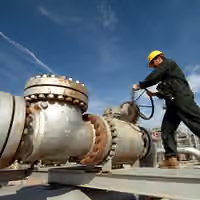
An Iranian oil worker handles barrels in this file photo.
Most authoritative energy forecasts, including Iran’s own official estimates, agree that global oil demand will peak in the next decade and then enter irreversible decline, a frightening outlook for Tehran.
For an economy that still derives around 40–50% of government revenue and up to 70% of export earnings from crude, this is not a distant warning. It is an existential deadline.
Iran has, at best, one final 25-year window—and more realistically just under a decade—to execute the most expensive economic transformation in its modern history.
The cost of such a transition is conservatively estimated by analysts and think-tank scenarios at $1.8–2.4 trillion: major water-transfer systems, more than 150 gigawatts of solar and wind capacity, high-speed rail, technology manufacturing hubs, and incentives to slow the accelerating brain drain.
Iran currently lacks both the funds and, under sanctions, access to the necessary capital.
Numbers speak
Oil production capacity peaked in 2018 at roughly 4.8 million barrels per day and now struggles to remain above 3.8 million. Under widely accepted net-zero trajectories, Iran’s oil revenue in 2045 could fall to roughly a fifth of current levels.
Model estimates based on Iran’s latest development plan and historical benchmarks suggest that, to merely maintain living standards after 2040, non-oil exports would need to grow at approximately 19% annually for two decades.
It is not impossible but highly improbable—a feat achieved only by China and South Korea under very different political and institutional conditions.
But where would the money come from?
Foreign direct investment amounted to roughly $1.2 billion in the most recent recorded year—lower than Yemen and Syria.
The National Development Fund, repeatedly tapped for budget deficits, now holds less than $10 billion in liquid assets, according to its own reporting and parliamentary audits.
The Tehran Stock Exchange bleeds capital and remains dominated by quasi-state entities. Primary U.S. sanctions make international borrowing almost impossible.
‘Post-oil’
Even if every sanction were lifted tomorrow, Iran would still require more than a decade of sustained 8–10% annual GDP growth to generate the domestic savings needed for a post-oil transition—a rate it has not achieved in a single year since 2002.
Yet official planning still largely overlooks the challenge.
The Seventh National Development Plan (2023–27) mentions “post-oil” only twice and allocates less than 1% of investment to renewable energy.
A leaked 2041 energy balance from the Ministry of Energy continues to assume oil and gas will supply 82% of primary energy, a projection incompatible with any plausible global scenario.
Energy economists agree on one principle: building a new economic pillar capable of replacing oil rents takes 20–25 years. Iran’s decisive megaprojects must therefore break ground before 2030.
If the country fails to secure $250–300 billion in committed, contract-signed investment by the end of this decade, the window will effectively close.
Time running out
Iran is not starting from weakness in its fundamentals: a young and educated population, world-class engineers, strategic geography, and a diaspora that remitted an estimated $8–10 billion last year.
It possesses every advantage for a successful post-oil future except the one that matters most: a state capable of earning broad legitimacy and institutional trust.
Acknowledging the approaching post-oil cliff would require recognising that the current economic model has faced severe structural difficulties for decades.
The Islamic Republic may endure another decade or two on discounted oil sales to China and intensified domestic control. But the prospect of Iran becoming a prosperous, technologically confident middle-income nation—the future promised to every child born after 1979—becomes extremely difficult without fundamental reform.
Absent a major political rupture, that vision is likely to fade between 2030 and 2035.
“Woman, Life, Freedom” was not just about compulsory hijab. It was the first collective cry of a generation that already senses its economic future slipping away—and that time to reclaim it is running out.
A former Iranian lawmaker, citing the fate of Iran’s claims after the fall of Syria’s Bashar al-Assad, urged Tehran to move quickly to recover what he said were more than $2 billion of assets in Venezuela, as Washington escalated pressure on Caracas.
Heshmatollah Falahatpisheh said on Tuesday that Iran should urgently clarify the legal status of more than $2 billion in claims against Venezuela, warning that experience from Syria showed how quickly assets could become unrecoverable after a sudden political collapse.
Writing on X, Falahatpisheh said lessons from Syria showed the need to settle Iran’s outstanding claims with President Nicolás Maduro’s government while conditions allow.
His remarks come against a backdrop of sharply rising tensions between Washington and Caracas.
On Tuesday, US President Donald Trump ordered what he called a “total and complete blockade” of sanctioned oil tankers entering or leaving Venezuela.
The move is part of a broader US pressure campaign targeting Maduro’s main source of revenue and follows the seizure of a sanctioned tanker off Venezuela’s coast last week.
While Falahatpisheh’s warning was framed by the experience of Syria – where the scale of Damascus’s debt to Tehran only became public after the fall of Bashar al-Assad, estimated by Syrian officials at around $30 billion – his comments coincided with Trump’s latest order on Venezuelan oil shipments.
Iran and Venezuela, both under heavy international sanctions, have built extensive but opaque economic ties over the past two decades.
Public records do not clearly show how much Iran has invested in Venezuela, the exact size of Caracas’s debt to Tehran, or the value of Iranian assets in the country, according to an article by Iranian outlet Fararu last week.
Iranian lawmakers have previously flagged specific claims. In August, MP Ahmad Bigdeli said Venezuela owed about $1 billion to Iran’s national oil company, urging Iran’s oil minister to explain why the debt had not been recovered. No official update has since been provided.
Iran has launched or participated in a range of projects in Venezuela, many of which have struggled.
A large Iranian-backed supermarket in Caracas, Megasis – opened in 2020 and linked to Iran’s Etka retail chain – has faced logistical problems due to infrequent shipping and supply disruptions, according to Iranian business figures cited by Fararu.
Joint automobile production, launched in 2006 with Iran Khodro and Saipa assembling Samand and Pride models in Venezuela, was halted in 2015 after years of losses and unpaid deliveries, Iranian media have reported. The project was revived in 2023 during a visit by former president Ebrahim Raisi, though analysts again questioned its economic viability.
Iran has also announced agricultural, housing and industrial ventures, including claims in 2021 that Venezuela had allocated up to one million hectares of farmland to Iran for overseas cultivation.
Officials have not clarified whether those plans are active or how much capital was committed.
Venezuela's President Nicolas Maduro marches in a rally against a possible escalation of US actions toward the country, in Caracas, Venezuela, November 25, 2025.
Oil, gold and sanctions pressure
Energy cooperation has been central to the relationship. Iran has supplied fuel, refinery services and technical assistance to Venezuela, while Western media and sanctions authorities have alleged barter arrangements involving oil and gold.
Bloomberg reported in 2020 that Venezuela transferred around nine tons of gold to Iran in exchange for fuel – a claim both governments have framed as legitimate barter.
Since US sanctions were imposed on Venezuela in 2019, much of its oil – including shipments involving Iranian or Russian-linked vessels – has relied on a so-called shadow fleet to evade restrictions.
Trump’s latest order has already pushed oil prices higher on expectations of reduced Venezuelan exports, Reuters said, though enforcement mechanisms remain unclear.
Analysts warned that a prolonged blockade could sharply cut Venezuelan output, with potential spillover effects for Iran, which has used Venezuela as a distant logistical and commercial partner to manage sanctions pressure.
In an analysis for Iran International, Shahram Kholdi wrote earlier this month that Venezuela has functioned as a strategic “distant flank” for Tehran, facilitating oil swaps, financial channels and political support beyond the Middle East.
But expanded US military deployments, legal actions and sanctions enforcement are tightening scrutiny on those networks.
Further allegations have added to the sensitivity. Spain’s ABC newspaper reported this month – citing leaked documents now under US review – that Venezuelan state mechanisms may have funneled billions of dollars toward Iranian entities over nearly two decades, including groups linked to Iran’s nuclear and military programs.
The claims, which Caracas and Tehran have not publicly addressed, remain unproven but are being examined by US authorities, according to the report.
“Projects and funds explicitly linked to Iran total about $4.69 billion, with an additional estimated $3.13 billion allegedly diverted indirectly from a China-Venezuela fund. The combined total about $7.82 billion – represents money that investigators say reached Iran's state ecosystem directly or indirectly through Venezuela,” read a report by The Latin Times.
US treasury fined crypto wallet firm Exodus Movement $3.1 million for violating Iran-related sanctions, saying it provided customer support to users in Iran and, in some cases, advised them to use VPNs to bypass restrictions on access to digital asset exchanges.
The Office of Foreign Assets Control said on Tuesday that the Omaha, Nebraska-based financial technology company agreed to the settlement to resolve potential civil liability for 254 apparent violations between October 2017 and January 2019, describing 12 of those cases as “egregious” and saying the conduct was not voluntarily self-disclosed.
Exodus offers a non-custodial digital asset wallet that allows users to store private keys and access third-party exchanges through its software, while generating revenue by collecting fees when customers transact through those exchange partners, OFAC said.
The regulator said Exodus’s customer service team responded to inquiries from users in Iran and enabled them to continue using the wallet or exchange services, even though the firm’s own terms of use prohibited use in US-embargoed jurisdictions.
OFAC said Exodus became aware in 2018 that at least one exchange partner was blocking Iran-based users to comply with US regulations, but staff nevertheless recommended VPNs that enabled some users to bypass location-based controls.
As part of the settlement, OFAC said Exodus agreed to invest $630,000 in additional sanctions compliance controls and cited broader remedial steps, including enhanced screening and staff training.
Iran has increasingly leaned on cryptocurrency rails to move money abroad as sanctions and banking restrictions complicate traditional transfers.
US Treasury actions in 2025 described “shadow” networks using overseas fronts and crypto transactions tied to Iranian oil revenue, portraying digital assets as one way to bypass chokepoints in the regulated financial system.
Iran’s domestic crypto ecosystem has also drawn attention from analysts and Western officials for potential sanctions-evasion uses, including allegations that some platforms help users access offshore liquidity or route funds beyond oversight.
A 2025 Reuters report on a major hack of Iran’s Nobitex said blockchain-analysis firms and US lawmakers have flagged the exchange as linked to sanction-bypassing activity, with researchers also pointing to past IRGC-linked use of crypto venues for cash-outs.
Binance has been cited in past reporting as being used by customers in Iran despite US sanctions, while large global exchanges face compliance and jurisdiction challenges when users route activity through workarounds or intermediaries.
A chronic shortage of nurses and auxiliary staff in Iran’s hospitals has quietly given rise to a new and largely unregulated job: the “patient companion.”
Across Tehran and other major cities, advertising websites, job boards and even the walls outside hospitals are plastered with notices offering such services.
The role is not filled by relatives. Instead, patient companions are hired—often informally—to care for hospitalized patients, helping with eating, hygiene and mobility.
According to the head of Iran’s Nursing Organization, the country faces a shortfall of at least 100,000 nurses. The deficit appears to have created a parallel, low-wage labor market with little oversight and frequent abuse.
A nurse working at a hospital in Tehran told Iran International that the tasks assigned to patient companions often go far beyond what their wages suggest.
“They do work that no one would normally accept for this pay,” she said, requesting anonymity. “They care for patients who cannot go to the toilet or bathe on their own.”
Exploited
A search for “patient companion” (hamrah-e bimār) on Iran’s largest classifieds website, Divar, produces dozens of listings from across the country. The companies share a familiar pitch: assurances of experience, professionalism and official registration.
One company advertises an eight-hour shift for a mobile patient who does not require personal hygiene care at 800,000 tomans (about $6 at December 16 exchange rates). Many others list prices as “negotiable.”
Alongside these firms, individuals also advertise their services directly. Many claim to have first-aid training or nursing experience and say they are willing to travel nationwide.
Yet trust remains a major barrier.
“People don’t feel comfortable hiring individuals directly,” said another nurse in Tehran, who also asked not to be named. “So they turn to companies, even though the companies take most of the money.”
According to this nurse, nursing service firms often keep close to two-thirds of what families pay, leaving companions with little compensation despite the physical and emotional demands of the work.
No better option
To avoid company fees, some companions eventually try to secure work through hospital staff. After being introduced repeatedly by agencies, they ask nurses or aides to connect them directly with families in need.
The practice is most common in public hospitals, where staff shortages are most acute.
A doctor at a Tehran hospital told Iran International that families struggling to pay medical bills sometimes plead with doctors or nurses to help a relative find work as a patient companion. “It becomes a way to cover treatment costs,” he said.
A male nurse in Tehran described hiring a companion through an agency several years ago to care for his grandmother, who had cancer.
“She was a nursing student, working to support herself while studying,” he said. “She told us the companies demand large promissory notes from workers and then take two-thirds of the family’s payment.”
For many companions, the job is a temporary lifeline rather than a chosen profession.
Home-care assignments can carry additional risks, especially for women. Reports of assault or sexual harassment are not rare, the nurse added, but few are willing to come forward, fearing that agencies may move to cash promissory notes at the first sign of dispute—effectively blacklisting workers from future employment.
That lack of regulation cuts both ways. Families often prefer companies, believing them to be safer. But, as nurses acknowledge, the skills of agency-provided companions are far from guaranteed.
“Most companions are women, many of them heads of household,” one nurse in Tehran said. “Few have formal training. Most learn on the job from hospital staff. They do this because they have no other option.”
New Google algorithms for YouTube are more accurately detecting virtual private networks which mask user locations and are reclassifying most traffic as originating from Iran where ad rates are minimal.
Prominent creators have reported revenue drops of as much as 90% in December.
Previously, RPM (revenue per 1,000 views) for Iranian content creators averaged $3-11 but has now fallen to between 20 cents and $1 for many channels, Shargh Daily reported on Tuesday.
Gaming YouTuber Aria Keoxer reported earning just $400 from a video with 400,000 views, down from thousands previously, the report said.
The changes stem from improved detection of VPN-spoofed locations, treating most views as originating from Iran, whose market advertisers rarely seek out due to stiff Western sanctions.
Users in Iran also use VPNs to sidestep broad official censorship of the internet.
While not all channels are equally affected - some report only 20% declines - the shift threatens the viability of Iranian content production, pushing creators toward sponsorships or alternative platforms.
“The income of Persian YouTube channels has practically dropped to zero," one account said on X. "Since last week, YouTube in its new update doesn't even show ads to those who connect from inside Iran using a VPN, and this means that the previous method of making money through monetization no longer works.”
“The result is that Persian channels without sponsors have practically reached the end of the line, continuing has become very difficult for them, and for some of them, continuing activities are no longer worthwhile!" it added.
An official YouTube statement on the changes in December did not mention Iran.
The country's digital marketing sector has grown modestly despite sanctions. E-commerce revenue stood at $15-16 billion in 2025 and had grown up to 12% annually, analysis site Statista reported.
Social media advertising in Iran has hit about $430 million each year driven by local platforms like Instagram and Telegram as well as apps like retail hub Digikala and ride-hailing platform Snapp.
Iran's President Masoud Pezeshkian has repeatedly promised to lift government censorship over the internet, a key pledge of his 2024 presidential campaign, but has made little headway.
Public anger intensified after revelations of so-called white SIM cards providing unfettered access to privileged insiders, which critics say contradicts government rhetoric about digital equality.
The digital and e-commerce economy in Iran faced a huge blow during a 12-day war in June with Israel, when Tehran briefly shuttered the internet entirely in what authorities called an effort to foil Israeli espionage but dissidents said aimed at free expression.
Iran’s central bank said on Tuesday it had blocked bank the accounts of over 250 people suspected of money laundering a sum amounting to $1.6 billion, as the country attempts to consolidate its financial system amid harsh sanctions.
Central bank spokesperson Mohammad Shirijian said the individuals, using around 6,000 bank accounts, recorded a combined turnover of about 2,100 trillion rials ($1.6 billion).
Shirijian said about 130 trillion rials, or around $100 million, of the total was linked to the bank accounts of a 24-year-old whom he accused of involvement in “disrupting the foreign exchange market.”
He added that the cases of 13 people suspected of "disrupting the banking system and the foreign exchange market" had been referred to the judiciary.
Separately, Revolutionary Guards-affiliated Tasnim News Agency, citing the central bank’s public relations director Mostafa Ghamari Vafa, reported that authorities had identified and blocked the accounts of three individuals, aged 24, 28 and 33, whose transactions totaled about 262 trillion rials ($201 million).
Tasnim said authorities had identified the trail of currency traders linked to the accounts and that the case remains under close surveillance.
Iran’s central bank issued a new directive in late September requiring banks to set annual transaction limits for customers based on their level of financial activity.
Under the directive, the annual transaction cap is set at 200 billion rials ($154,000) for salaried individuals, 50 billion rials ($38,400) for individuals without employment and five billion rials ($3,840) for inactive legal entities.
Shirijian's remarks come as Iran’s currency hit a fresh low on Monday of 1.312 million rials to the US dollar on the open market according to currency-tracking websites, reflecting deep economic woes in the country.
Tehran has sought to boost financial regulation and gain entry into anti-money laundering bodies in a bid to gain greater access to the global banking system as renewed international sanctions have dented its already creaky economy.
But in October the Financial Action Task Force (FATF) rejected Iran's accession, saying Tehran would remain on its list of high-risk countries for failing to fully accept the body's rules on terror financing.