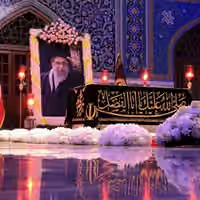
Hana Alikordi, daughter of Khosrow Alikordi, gestures at her father’s funeral service in this photo obtained from social media..
A prominent UK-based rights barrister has called for an independent investigation into the sudden death of Iranian lawyer Khosrow Alikordi this month after the case stoked outrage and rowdy protests at his memorial service.
“There should be an independent, impartial and transparent investigation into his death,” Tatyana Eatwell, an international human rights barrister at Doughty Street Chambers in London told Eye for Iran.
Eatwell has worked extensively on Iran-related cases including the detention of Nazanin Zaghari-Ratcliffe, a British-Iranian woman who was detained in Iran for six years on widely disputed charges while visiting family.
She later became one of the most high-profile cases of Iran’s detention of dual nationals, in a policy critics of Tehran have blasted as hostage diplomacy.
Alikordi’s body was discovered in his office in Mashhad on December 8, 2025.
Iranian authorities attributed his death to a cardiac arrest, citing alleged forensic evidence, even as unconfirmed reports emerged of head injuries, blood at the scene and the removal of security cameras.
Eatwell said the circumstances surrounding Alikordi’s death cannot be separated from the years of persecution he faced at the hands of Iranian authorities. He was a former political prisoner and had represented many dissidents throughout his career.
“Mr. Ali Kordi was imprisoned, he was disbarred from practice, subject to travel bans, simply for doing his job, for representing his clients without fear nor favor. This is part of our professional obligation," Eatwell told Eye for Iran.
“The first question one asks is whether in the light of allegations of state involvement, the state institutions themselves are sufficiently robust and independent to provide the family with the answers to the questions that they must have,” she said.
Alikordi was a prominent figure among Iran’s community of human rights defenders. He represented political dissidents, bereaved families and people arrested during the Women, Life, Freedom protests in 2002, including Fatemeh Sepehri, a well-known Iranian political activist and outspoken critic of Supreme Leader Ali Khamenei who has been repeatedly imprisoned for her opposition to the Islamic Republic.
A group of 81 lawyers inside Iran issued a public statement on December 9 demanding full transparency regarding the circumstances of Alikordi’s death and pledging support for his family in what they described as a necessary truth-seeking process, according to the Center for Human Rights in Iran.
Provincial officials in Razavi Khorasan in Northeastern Iran insist his death was natural, even as reports indicated a heavy security presence around the scene.
One of the lawyers who signed the statement told the Center for Human Rights in Iran that a key aim was to create a safe environment for Alikordi’s family.
A source familiar with the situation in the eastern, holy city of Mashhad said security agents warned civil and political activists arriving in the city not to give speeches at Alikordi’s funeral.
Following Alikordi’s burial, his brother, lawyer and academic Javad Alikordi said he had been summoned by the Mashhad Revolutionary Court.
Eatwell said Alikordi’s persistence in continuing to practice law despite sustained pressure stood out, saying that lawyers who defend dissidents and protesters operate in an increasingly hostile environment.
“The impact that it’s designed to have is to discourage other lawyers from practicing in this way, to discourage people from speaking out, to discourage people from asking questions,” she said.
Eatwell said Iran’s repeated failures to conduct credible investigations make it unlikely that Alikordi’s family will receive answers through domestic channels alone.
She said the international community must be prepared to act, pointing to the United Nations Human Rights Council’s International Fact-Finding Mission on Iran, established in 2022 to investigate serious human rights violations.