US envoy Barrack says Washington not pursuing Iran regime change
US Ambassador to Turkey and US special envoy for Syria Thomas Barrack speaks after meeting with Lebanese Parliament Speaker Nabih Berri in Beirut, Lebanon June 19, 2025
US Special Envoy for Syria Tom Barrack said that Washington did not seek to overthrow Iran's ruling system in a wide-ranging interview published on Friday in which he called on Tehran to restart talks over its nuclear program.
“My bosses, President Trump and Secretary Rubio, are not into regime change. They are into a regional solution left to the region itself. That issue was Israel’s. What President Trump stepped in to do in that 12-day war ending was historic. It was amazing,” Barack said.
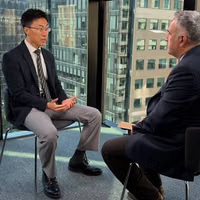
He was speaking in an interview with the UAE-based IMI Media Group, published on The National newspaper website on Friday.
The envoy, a former real estate investor of Lebanese ancestry, said the Trump administration wants Tehran to engage in a genuine dialogue on its disputed nuclear program and suggested Iran had stalled an agreement.
“I think our president has been clear. He is open to real discussions. He is not open to senselessly kicking the can down the road, and he knows the program,” Barrack added.
“If the Iranians want to listen to what this administration is saying on enrichment, on stopping funding of the proxies, it is the answer.”
Donald Trump has set three conditions for Iran to meet before starting negotiations with Washington: zero uranium enrichment, an end to backing Tehran's armed allies in the region and curbs to its missile program. Tehran sees the terms as a non-starter.
“Our president is smart enough to know that baiting him just to get a dialogue and continuing this senseless killing through surrogates is not going to happen. So I think he is 100% available to it,” Barrack said. “We have the hope that Iran is available to it. Either way, it’s the fastest road to a solution in this region.”
'No regime change'
Barrack criticized the past pro-regime change policy in the region, saying that since 1946 there have been 93 regime changes and coups, none of which succeeded, including two in Iran.
“For (Trump) then to be imputed with regime change, we had two regime changes in Iran already. Neither one worked. So I think wisely leave it to the region to solve. Why is it Israel did not finish the job? We are not at the end yet. It is chapter five, and we have five more chapters to go.”
The United States held five rounds of negotiations with Iran over its nuclear program earlier this year, for which Trump set a 60-day deadline.
When no agreement was reached by the 61st day on June 13, Israel launched a surprise military offensive, followed by US strikes on June 22 targeting key nuclear facilities in Isfahan, Natanz and Fordow.
Both Israeli and Iranian officials have vowed a devastating military effort against their foe in the event of a renewed conflict.
A briefing prepared for MPs by the UK House of Commons Library said Iranian operatives had increasingly sought to carry out kidnappings, physical attacks and assassinations against dissidents and opponents in Britain.
The House of Commons Library provides research briefings based on past government and parliamentary findings to enable members to better understand complex policy issues.
“The greatest threat currently posed by Iran in the UK was the physical threat posed to dissidents and other opponents, a change from previous years when espionage was the primary threat,” the briefing cited the Intelligence and Security Committee of Parliament (ISC) as saying in a report in July.
It described targeted individuals as “dissidents, journalists, regime opponents, Israelis, Jews, and sectors including government, travel and universities.”
Ties between Tehran and London are at a low ebb after Britain joined Germany and France in triggering the imposition of UN sanctions on Iran.
Iran has long accused its former colonial ruler of meddling in its internal affairs and seeking the downfall of its theocracy. On Friday a senior official said the United Kingdom was in league with the United Arab Emirates in regional wars.
The UK government in September submitted a statement on steps taken to confront Iranian activities including designation of the Iranian state in its entirety on the enhanced tier of its new Foreign Influence Registration Scheme (FIRS).
The move meant that anyone working for or directed by the Iranian state to conduct activities in the UK must declare those activities or face up to five years in prison.
'Persistent, unpredictable'
The ISC report also addressed cyber threat from Iran, adding it possess a “significant area of asymmetric strength” in cyber activity.
"While Iran’s cyber capability is less developed than that of China or Russia, it remains a tool for targeting journalists, analysts, and dissidents, and an Iranian cyberattack on UK infrastructure was considered unlikely,” the report said. "the threat level is persistent and unpredictable."
Iran International revealed last month the existence and structure of a secret Iranian Islamic Revolutionary Guard Corps cyber unit targeting dissidents and foreign governments, citing confidential official documents.
Department 40 of the IRGC counterintelligence unit was known as "Charming Kitten" to security experts. It had surveilled dissidents abroad, examined drone footage of the courtyard of the British embassy in Tehran and gathered information for a thwarted plot to kill Israelis in Istanbul.
The UK briefing recorded a package of government actions so far, saying that 547 individuals and entities linked to Iran had been sanctioned and that the Foreign Influence Registration Scheme had placed Iran on the enhanced tier.
“Use of a wide range of organizations means physical threat can manifest from a much broader pool of suspects, adding a further layer of unpredictability," ISC added.
The briefing concludes that the Iranian Government is “persistent and, crucially, unpredictable."
An Iranian cleric's skeptical remarks on some cherished aspects of Shi'ite Muslim religious history in a debate show have been met with insults and threats, underscoring the dangers of religious dissent in the theocracy.
The episode marks a rare public challenge to dogma in the Islamic Republic and the strength of opposition to any religious free thinking by stalwart backers of the system.
Abdolrahim Soleimani Ardestani, in a debate with fellow cleric Hamed Kashani circulated on video over social media, challenged the canonical story of the “martyrdom" of Fatemeh, a revered matriarch and the daughter of the prophet Mohammed.
A video of the discussion on YouTube had garnered 17,000 comments, among them arguments strongly for and against his remarks.
He argued that if her husband the first Shi'ite Imam, Ali, had merely watched events unfold, he would be “complicit in the killing," in an important challenge to the notion that the central figure in early Islamic history was a paragon of justice.
Ardestani went to attribute the death of the ninth Shi'ite Imam, Javad, to the jealousy of his wife and said mourning such an event for centuries was misguided.
State-appointed eulogists, who lead the faithful with chants before prayers, tore into the maverick cleric on Friday according to videos which circulated on social media.
"Damn that dishonorable Ardestani bastard with no roots, all the way till Judgment Day," said one eulogist, Hossein Sotoudeh.
Officials signal punitive response
Mohammadali Amani, secretary-general of the Islamic Coalition Party, urged legal action against Ardestani without naming him, saying on X that insulting Shi'ite sanctities was “an unforgivable sin.”
Cleric Alireza Sanjari Araki, responding to a religious query, said that denying the martyrdom of Fatemeh or the “absolute guardianship of the Ahl al-Bayt” could place a person outside Shi'ite doctrine and subject them to rulings of unbelief.
He was referring to the family of the Prophet Mohammed from whom the Fatemeh, Ali and Javad hailed. The Shi'ite tradition regards them as holy spiritual and political figures.
Tasnim News wrote that the subject was inherently “a matter of honor” for Shi'ites.
Social-media backlash widens
Pro-government users have inundated Ardestani with verbal abuse, while others condemned the attacks and defended his right to question historical narratives.
A social media user going by the name Mohammad Hossein Rajabloo said Ardestani needed to quit his neighborhood otherwise his home would be attacked.
But another user wrote that verbal violence by eulogists “goes beyond a jurisprudential dispute,” adding that divergent views are now met “not in forums for free inquiry, but with crude language from public pulpits.”
Others argued that critical reasoning threatens entrenched interests or that his questions did not warrant such escalation.
Reformist cleric Mohammadali Abtahi said former president Mohammad Khatami objected to Ardestani’s remarks in a recent meeting, arguing they harm the cause of religious reform.
The moderate Mardomsalari Party called the cleric’s comments “coarse” and contrary to Shi'ite beliefs but said violence, or attacks on his home were unacceptable and violated freedoms of expression and belief.
The confrontation underscores the Islamic Republic’s long record of harsh responses to perceived theological dissent, evoking past cases such as the decades-long targeting of author Salman Rushdie.
Rushdie was left with serious injuries including the loss of an eye when he was stabbed while giving a talk in the United States in 2022.
The attempted murder is believed to have been inspired by the fatwa issued by the Islamic Republic’s founder Ruhollah Khomeini against Rushdie for his novel The Satanic Verses.
Washington remains committed to keeping the Strait of Hormuz open and preventing “outright enemies” from dominating the Persian Gulf and its energy supplies, US President Trump said in his 2025 National Security Strategy.
The document, published late Thursday, appears to downplay the scale of the threat from Iran and offers only cursory references to Tehran.
“Iran — the region’s chief destabilizing force — has been greatly weakened by Israeli actions since October 7, 2023, and President Trump’s June 2025 Operation Midnight Hammer, which significantly degraded Iran’s nuclear program,” the document reads.
“America will always have core interests in ensuring that Gulf energy supplies do not fall into the hands of an outright enemy, and that the Strait of Hormuz remain open,” it adds.
Iran’s military chiefs have floated the threat of closing the Strait of Hormuz during past standoffs with the West—with the Army and the Revolutionary Guards conducting regular drills in the Persian Gulf.
The NSS 2025 provides almost no detail on Iran’s capabilities or intentions, or what the commitment to keep open the waterway, through which much of the world's energy export flows, would entail.
Mideast peace
The broader chapter recasts the Middle East as a region the United States no longer needs to organise its foreign policy around, arguing that two pillars of past engagement—energy dependence and superpower rivalry—have faded.
The text insists “there is today less to this problem than headlines might lead one to believe,” asserting that Iran’s weakening has reduced regional instability.
Perhaps its sharpest ideological marker is a rejection of US pressure on authoritarian partners.
Earlier efforts challenging the Arab monarchies, NSS argues, were “misguided experiment with hectoring these nations,” adding that the Trump administration will “accept the region, its leaders, and its nations as they are while working together on areas of common interest.”
The text concludes that the Middle East “is no longer the constant irritant, and potential source of imminent catastrophe, that it once was,” crediting Trump for his ability “to unite the Arab world” and allowing the United States to “finally prioritize American interests.”
Iran’s national team coach Ardeshir Amir Ghalenoei has arrived in Washington with part of the country’s football delegation ahead of Friday’s World Cup draw, FIFA said.
In a response to Iran International, FIFA said it “welcomed the arrival of the Islamic Republic of Iran Football Federation delegation to Washington, DC, including head coach Ardeshir Ghalenoei,” adding that it would continue working with Iran and US authorities to prepare for next summer’s 2026 World Cup, hosted by the United States, Canada and Mexico.
Iran had initially threatened to boycott the ceremony over visa difficulties.
The Islamic Republic of Iran Football Federation applied for nine visas, but a federation spokesman said the United States granted four, including one for Ghalenoei. Federation president Mehdi Taj was among those denied entry.
Iran qualified earlier this year through the Asian tournament and will learn their group-stage opponents at the draw later on Friday at the John F. Kennedy Center for the Performing Arts.
The team has now reached its seventh World Cup and its fourth in a row. Their arrival in the US comes against the backdrop of longstanding entry restrictions that continue to shape travel rules for Iranian nationals.
White House: team allowed, fans likely not
The White House on Wednesday said Iran’s national team will be permitted to enter the United States for the World Cup, but suggested Iranian fans will remain barred under existing travel restrictions.
“The President has, in his executive order, certainly named Iran as one of the countries whose teams will be exempt to come here,” said Andrew Giuliani, head of the White House task force on the World Cup.
Pressed on whether US immigration authorities might conduct raids at matches, Giuliani added that “the President does not rule out anything that will help make American citizens safer.”
US travel rules in the spotlight
The US has kept tight visa controls on Iranians for decades, and in June President Donald Trump signed an executive order barring entry for citizens of 12 countries, including Iran, citing security concerns. The measure is meant to exempt athletes and coaching staff attending the World Cup and the 2028 Olympics, though the visa process has remained restrictive.
The administration has also announced a separate review of green cards issued to immigrants from 19 countries, including Iran.
The review followed an incident in Washington DC in which an Afghan national — who had arrived under a special immigration program after the US withdrawal from Afghanistan — shot two National Guard troops, killing one and leaving the other gravely injured.
An Iranian water official said the volume of drinking water stored in Tehran’s five main dams has fallen to about 170 million cubic meters, roughly half the level recorded at this time last year.
Rama Habibi, a deputy at the Tehran Regional Water Company, told ISNA that the capital is experiencing its most persistent dry spell in six decades.
“For the first time in 60 years, we have had five consecutive years of drought,” he said.
Habibi added that rainfall since the start of the current water year in early October has been “very minimal.” He said Tehran recorded 48 millimeters of rain in the same period last year, compared with just 1.9 millimeters this year.
“We are facing a 96 percent reduction in rainfall compared with last year,” he said, adding that long-term averages also show a drop of nearly 98 percent.
Drought reshapes dam operations
The prolonged dry period has pushed reservoir levels across Iran to historic lows. The country’s Karkheh Dam hydroelectric plant was forced to halt power generation last week due to the shrinking water level in its reservoir.
Officials said the dam’s basin has endured years of drought, with water now flowing only through lower outlets to meet downstream needs.
Karkheh, one of the region’s largest dams, is among many facilities confronting shortages. Domestic media say reservoirs feeding Tehran’s Karaj and Latian dams have fallen sharply, and cities such as Mashhad, Kerman and Yazd are grappling with collapsing aquifers and, in some cases, water rationing.
Habibi said that in past years, rainfall returned to normal after short dry spells, but the current prolonged drought means “the outflow from the dams exceeds the inflow,” pushing storage to what he called alarmingly low levels. Long-term data indicate average storage of about 509 million cubic meters, leaving the current figure at roughly one-third of that amount, he said.
Warnings of broader strain
Authorities in several provinces warn that diminishing reserves could bring deeper disruptions if dry conditions persist. In Mashhad, officials have already moved to full rationing, while parts of Kerman report abandoned farmland due to groundwater depletion. Nationwide, rainfall has dropped to around 18 percent of normal levels, with 20 provinces reporting no measurable precipitation in recent weeks.
Water specialists quoted by local media say that if current patterns continue, significant parts of Tehran could face severe supply instability within the next decade.