• العربية
  • فارسی
Brand
  • Iran Insight
  • Politics
  • Economy
  • Analysis
  • Special Report
  • Opinion
  • Podcast
  • Iran Insight
  • Politics
  • Economy
  • Analysis
  • Special Report
  • Opinion
  • Podcast
  • Theme
  • Language
    • العربية
    • فارسی
  • Iran Insight
  • Politics
  • Economy
  • Analysis
  • Special Report
  • Opinion
  • Podcast
All rights reserved for Volant Media UK Limited
volant media logo
EXCLUSIVE

Strikes on petrochemical hubs leave Iran short of plastics

Dalga Khatinoglu
Dalga Khatinoglu

Oil, gas and Iran economic analyst

Apr 22, 2026, 02:47 GMT+1
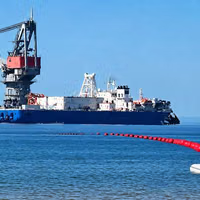
Heavy smoke rises over a petrochemical site in Mahshahr, southwest Iran, after US-Israeli strikes in late March 2026

Iran is facing severe shortages of key petrochemical products after recent strikes on its main production hubs, according to two informed sources inside the country.

Earlier this month, Israel targeted facilities in Mahshahr and Asaluyeh, Iran’s two principal petrochemical centers, which together account for roughly three-quarters of the country’s output.

According to commercial sources who spoke on condition of anonymity, several petrochemical products have become acutely scarce, particularly polymer grades used in food packaging, plastics and basic manufacturing.

The shortages have forced authorities to explore emergency import options, even as logistical and geopolitical constraints complicate procurement.

The scale of disruption is still being assessed, but industry sources say the impact on domestic supply chains has been immediate.

Najmeh Jamshidi, editor-in-chief of Energy Press, previously reported, citing senior executives at petrochemical complexes, that restoring damaged units and associated infrastructure could take anywhere from six months to two years, depending on the extent of damage.

One source said Russia declined Iran’s request to supply certain polymers, citing a sharp rise in global petrochemical prices linked to disruptions in the Strait of Hormuz. According to the source, Moscow is prioritizing domestic supply to prevent further inflationary pressure in its own market.

Ilham Shaban, head of the Caspian Oil Studies Center, said Russia itself is facing constraints, as some of its petrochemical facilities have been damaged in Ukrainian attacks. This has further limited the country’s ability to meet external demand, particularly for higher-value polymer products.

Before the recent disruptions, Iran exported about 30 million tons of petrochemical products worth roughly $15 billion annually, with polymers accounting for around 12 percent of that volume.

In response to the supply shock, Iranian authorities have moved to ban exports of several petrochemical goods in an effort to stabilize the domestic market.

Another commercial source said Iran has approached Azerbaijan as a potential supplier of polymers, but the country’s limited production capacity makes it unable to significantly offset Iran’s shortfall.

Azerbaijan is also expected to prioritize maintaining its established export markets in Europe and Turkey.

Some of Iran’s Arab neighbours have the scale to potentially offset part of the supply gap. Saudi Arabia alone has about 19 million tons of annual polymer production capacity, while the United Arab Emirates and Qatar are also major exporters.

However, given Iran’s recent attacks on these countries during the conflict, they are unlikely to assist in covering Iran’s shortages.

At the same time, disruptions affecting shipping routes through the Strait of Hormuz over the past two months have pushed global polymer prices up by about 50 percent.

The combination of domestic supply disruptions and tightening international markets has deepened shortages, raising concerns about broader impacts on downstream industries and the availability of consumer goods.

Most Viewed

Iran diplomacy wobbles as factions compete to avoid looking soft on US
1
INSIGHT

Iran diplomacy wobbles as factions compete to avoid looking soft on US

2
ANALYSIS

The politics of pink: how Iran uses cuteness to rebrand violence

3

Scam messages seek crypto for ships’ safe passage through Hormuz, firm warns

4
EXCLUSIVE

Family told missing teen was alive, then received his body 60 days later

5
INSIGHT

Is Iran entering its Gorbachev moment?

Banner
Banner

Spotlight

  • Diplomacy tolls at Hormuz as conflict returns to its doorstep
    OPINION

    Diplomacy tolls at Hormuz as conflict returns to its doorstep

  • Opposition to US talks grows in Tehran as ceasefire deadline nears
    INSIGHT

    Opposition to US talks grows in Tehran as ceasefire deadline nears

  • Tehran moderates see ‘no deal–no war’ limbo as worst outcome
    INSIGHT

    Tehran moderates see ‘no deal–no war’ limbo as worst outcome

  • The future has been switched off here
    TEHRAN INSIDER

    The future has been switched off here

  • Lights out, then gunfire: Witnesses recount Mashhad protest crackdown
    VOICES FROM IRAN

    Lights out, then gunfire: Witnesses recount Mashhad protest crackdown

  • Is Iran entering its Gorbachev moment?
    INSIGHT

    Is Iran entering its Gorbachev moment?

•
•
•

More Stories

War or economic collapse: can Iran withstand the pressure?

Apr 22, 2026, 01:05 GMT+1

Iran’s economy is likely to buckle faster than the United States or the global economy under the combined pressure of war, sanctions, a US blockade and Tehran’s disruption of the Strait of Hormuz, experts said at Iran International’s townhall in Washington DC.

The war launched by the United States and Israel against Iran began on February 28 and continued until April 7, when a two-week ceasefire was announced. The ceasefire was extended on April 21, but a US blockade of Iranian ports remained in place.

Miad Maleki, a senior fellow at the Foundation for Defense of Democracies and a former senior sanctions strategist at the US Treasury, said Iran had spent decades threatening to close the Strait of Hormuz but had never prepared its own economy for the consequences including the naval blockade.

“If we’re at the point that we have to close the Strait of Hormuz, can our own economy handle $455 million a day in trade that we have to rely on going through the Strait of Hormuz?” Maleki said, referring to his earlier estimate of Iran's daily loss during the US blockade which has been in place since April 13.

Miad Maleki
100%
Miad Maleki

He said the answer was becoming clearer as the war, blockade, currency crisis and damage to key export sectors placed Iran under pressure faster than its adversaries.

While Hormuz disruption has created serious risks for global energy markets, Maleki argued that Iran’s own economic exposure to the waterway made Tehran more vulnerable than the countries it was trying to pressure.

  • What the US naval blockade would mean for Iran’s economy

    What the US naval blockade would mean for Iran’s economy

Jason Brodsky, policy director at United Against Nuclear Iran, said Trump appeared willing to test that weakness through a strategy of coercive diplomacy backed by military force.

“He lays out the military option, prepares the theatre for US Central Command,” Brodsky said. “He then offers a diplomatic off-ramp for the Iranian regime. He lays out US terms and gives a deadline. And if the Iranian regime doesn’t play ball, he strikes.”

Who blinks first?

The discussion repeatedly returned to the question of who would break first: Iran, the United States, or the global economy. The blockade, imposed on April 13, has added to the pressure on Iranian trade, while Tehran’s disruption of Hormuz has turned the confrontation into a test of economic endurance for Iran, Washington and major Asian energy consumers.

Bozorgmehr Sharafedin, head of digital at Iran International and moderator of the townhall, said Iran’s disruption of Hormuz amounted to Tehran “putting sanctions on the world,” while the US blockade showed Washington using military power to enforce sanctions.

Bozorgmehr Sharafedin
100%
Bozorgmehr Sharafedin

Maleki said Asian economies would be the first major external victims of a prolonged Hormuz crisis because of their heavy dependence on energy flows through the strait. But he said the global impact did not change the basic balance of vulnerability.

“Asia is the first,” Maleki said, referring to economies dependent on energy flows through Hormuz. “North Korea, Japan, China and India, 89, 90 percent of their petroleum, 75 percent of their natural gas comes through the Strait of Hormuz. We’re not here in the US the main target of the economic ramifications of the Strait of Hormuz, but what’s happening in those countries will affect our economy.”

Still, he said, Iran had far less time to absorb the shock.

“The clock is much faster on Iran’s economy side than it is on our own side,” Maleki said. “But we know historically that the Iranian regime doesn’t really care to the extent that Iranians are starved or dealing with major economic issues.”

Brodsky said Trump was also likely willing to sustain pressure longer than many expected because he was in his second term and focused on legacy.

He argued that Washington had achieved through force what diplomacy alone had failed to achieve, including pushing Tehran to reportedly consider a one-year suspension of uranium enrichment.

Jason Brodsky
100%
Jason Brodsky

“President Trump is willing to go at this for longer than most people expect,” Brodsky said. “He is willing to take that risk because he is in legacy-building mode at the moment.”

Iran’s postwar economy

Mohammad Machine-Chian, a senior journalist covering economic affairs at Iran International and former head of market research at EcoIran, said Iran’s stock market had been closed for eight weeks, an unprecedented development in the history of the Tehran Stock Exchange.

He said the closure allowed policymakers to pretend prices had remained normal, while in reality the war had changed the value of companies, assets and investor expectations. The market, he said, was already in crisis before the war, even though nominal gains had masked the impact of inflation above 70 percent.

Mohammad Machine-Chian
100%
Mohammad Machine-Chian

Machine-Chian said banking was “in shambles,” the auto industry was deep in trouble, and the market had been relying heavily on export-oriented sectors such as petrochemicals, steel, oil and gas-related companies. Many of those sectors, he said, had been damaged or disrupted by the war.

“Even if they reopen the market, there’s no petrochemical, there’s no steel,” Machine-Chian said. “They have to rely on the banks, car manufacturers and other industries that rely on basically petrochemicals to begin with in the supply chain.”

He said a crash was likely if trading resumed, even with official limits preventing shares from falling by more than five percent a day.

“It doesn’t make any sense,” Machine-Chian said of those limits. “Nonetheless, that’s the way they’re managing it, but even in that scenario, I don’t think they can afford to open the markets.”

Machine-Chian said the economic crisis had reached a point where inflation should be discussed monthly rather than annually. In a best-case scenario involving a comprehensive agreement, he estimated inflation could still average at least five percent a month for the rest of 2026.

“I’m talking about inflation in months, no longer in years, and that is the reality we’re dealing with,” he said.

He said that in a “no war, no peace” scenario, prices could triple over the year. In the event of another conflict, he warned monthly inflation could exceed 20 percent, pushing annual price increases toward 500 percent.

Sanctions relief would not be quick

Maleki said even a diplomatic agreement would not quickly revive Iran’s economy because the sanctions regime is complex and private banks and companies remain deeply reluctant to handle Iran-related business.

He said the experience of the 2015 nuclear deal showed the limits of formal sanctions relief. Even when the US government tried to facilitate limited access to funds, he said, banks refused to touch Iranian money.

“They couldn’t find one single bank,” Maleki said. “Not just US banks, but little, tiny banks without any corresponding relationship with US banks to actually touch the money. At the end of the day they had to put the funds on a pallet and send them in cash.”

Maleki said Iran’s sanctions architecture was more layered than Syria’s and could take months or years to unwind. He added that even regime change would not automatically solve the immediate fiscal crisis.

“If we have a democratic government today, a transitional government established in Iran today, and the Islamic Republic is gone, that transitional government probably is not going to be able to pay government salaries for more than a week or two,” he said.

The warning underscored one of the main themes of the townhall: Iran’s economy is not merely under wartime pressure, but faces deeper structural damage that may outlast the fighting and any short-term diplomatic arrangement.

No access to cash

In the Q&A section, an audience member asked whether cash or access to frozen funds could allow the Islamic Republic to recover and rebuild its capabilities after the war.

Brodsky said that would be the worst possible move, arguing that Tehran would use any financial relief to rebuild the same military and security structures targeted during the conflict.

100%

“The worst thing that we could do right now is to flush the regime with cash,” Brodsky said. “It’s going to use that to rebuild its missile program, its nuclear program, its drone program, and all of its repression architecture.”

Maleki said direct cash transfers were unlikely because of legal restrictions, but access to restricted funds or sanctions relief for metals and petrochemicals could still provide Tehran with a lifeline.

He said those details would determine whether Iran’s weakened economy remains under pressure or gains enough room to recover.

Diplomacy tolls at Hormuz as conflict returns to its doorstep

Apr 21, 2026, 20:43 GMT+1
•
Shahram Kholdi

The fragile truce between Tehran and Washington expires on April 22. With it ends restraint. Conflict will return, though its scale remains uncertain.

For two decades, the United States sought a durable nuclear settlement with Iran. Each failure strengthened the Islamic Republic. It deepened ties with Russia and China, expanded proxies from Iraq to the Red Sea, and built a missile and drone arsenal while burying key infrastructure underground—beyond inspection and reach.

The revelation of the Pickaxe Mountain facility in June 2025 ended ambiguity. In Washington and Jerusalem, red lines hardened into a single demand: effective surrender of Iran’s military-nuclear-industrial complex.

For all intents and purposes, the Khamenei–IRGC refusal of American–Israeli demands precipitated the February 28–April 8, 2026 conflict—the 40-day war. To outsiders, Tehran’s refusal appeared reckless. The regime, however, believed too much had been invested—in blood and treasure—to retreat without resistance.

With President Trump’s April 8 ceasefire declaration, a new round of diplomacy began in Islamabad (April 11–12, 2026). It lasted twenty-one hours and yielded nothing. Vice President Vance stated plainly that Iran had rejected American terms.

Reports indicated that senior IRGC figures, including Vahidi and Zolghadr, vetoed any concession. Authority was fractured; Ghalibaf’s delegation could not bind the state. The collapse exposed internal divisions and set the pattern ahead.

Tehran signalled its readiness to escalate—threatening to close the Strait of Hormuz, recover concealed arsenals, with strikes on Gulf monarchies’ energy infrastructure.

Trump ordered a naval blockade of Iranian ports. As both sides manoeuvred behind the scenes, Tehran’s April 17 declaration that the strait remained open was swiftly overtaken, as Washington seized upon it as evidence of capitulation while maintaining the blockade. Trump nevertheless indicated that talks would continue.

Yet Vice President Vance’s planned return to Islamabad has now been placed on hold after Tehran failed to respond to American negotiating positions. The diplomatic track is no longer merely fragile—it is suspended.

Even if revived at short notice, the underlying reality remains unchanged: any Iranian delegation would face the same internal veto, and any concession would deepen recent humiliations—the decapitation of senior leadership and the degradation of strategic infrastructure.

It is at sea that the confrontation sharpens.

Washington maintains that its blockade is a lawful belligerent measure under the law of armed conflict at sea, subject to effectiveness, proportionality, and notification as reflected in customary law and articulated in the San Remo Manual (1994).

Tehran, by contrast, operates under narrower constraints. Though not party to the UN Convention on the Law of the Sea (1982), it remains bound by customary international law.

Transit passage through the Strait of Hormuz—Articles 37–44 of UNCLOS—cannot be suspended, even in armed conflict, as affirmed in the Corfu Channel case (1949) and reflected in the 1958 Territorial Sea Convention. Any attempt to mine or disrupt the strait would violate both the law of the sea and the law of armed conflict at sea and fail the tests of necessity and proportionality under Article 51.

What once served Tehran as deterrence now operates as constraint. Geography, turned against it, has become Washington’s leverage.

That leverage is already being applied through calibrated force. The recent strike on the Toska vessel, confined to the engine room, demonstrated how force may be applied with precision and restraint at once. Restraint, therefore, has been calculation, not limitation. This is not indiscriminate destruction but controlled degradation.

During the 40-day war, US–Israeli strikes targeted steel, gas, and petrochemical hubs with precision. They may resort to that practice again.

There is precedent. During Operation Allied Force in Kosovo in 1999, NATO struck power plants, depriving Serbia of over seventy per cent of its electricity. The logic was calibrated escalation in the service of coercion.

Should negotiations fail, the next rungs are visible: precision strikes on power grids, bridges, and transport arteries. The Kosovo template may yet be reprised in the Persian Gulf.

Over the past year—across Ukraine, Gaza, and in dealings with China—President Trump has demonstrated a consistent posture: he neither retreats nor entertains settlements that suggest humiliation.

Lest we forget the chorus that once insisted President Trump would refrain from a prolonged conflict—that oil shocks would stay his hand, that he would restrain Israel, or that he would contrive accommodation with Tehran.

Events have ruthlessly overtaken these assumptions, leaving in their place a single, unambiguous note: the President now declares that the blockade “is absolutely destroying Iran” and will not be lifted until there is a “deal”—one he insists will be “far better” than the JCPOA.

Across the divide, Ghalibaf answers in a discordant key, rejecting negotiations “under the shadow of threats” while signalling preparation for escalation.

Trump is dividing and conquering on two fronts. He drives a lethal wedge between Ghalibaf’s faction—seeking a face-saving accommodation—and hardliners such as Vahidi and Zolghadr who command the instruments of force.

If Ghalibaf prevails, Trump imposes his terms and claims victory. If the hardliners purge him, they will be branded irredeemable extremists, and what remains of the regime will be subjected to decisive force. In either outcome, the structure of pressure favours Washington.

This is coercive diplomacy in its classical form. It draws from Thomas Schelling’s The Strategy of Conflict and Arms and Influence, fused with what Jeffrey Sonnenfeld describes as Trump’s “divide and conquer” doctrine—his so-called Ten Commandments.

A public commitment device raises audience costs and forces a stark binary: agreement or refusal. The “threat that leaves something to chance”—brinkmanship—is fully engaged. Each rung narrows retreat and magnifies miscalculation.

Contrary to prevailing punditry, the 40-day war has turned Tehran and Washington into adversaries locked in a contest of endurance. Attacks on regional energy infrastructure have eroded tolerance, while American resilience has diminished Iran’s deterrent card. What once compelled caution now invites pressure.

Vice President Vance’s journey to Islamabad has now been halted. If no credible Iranian response emerges, detonation will follow—not in metaphor, but in action. The United States and Israel may then treat the remaining IRGC leadership as beyond restraint—men whose decisions invite elimination rather than negotiation.

The outcome now narrows to a single choice: acceptance—or detonation.

Top condom maker plans price hikes of up to 30% amid US-Iran war impact

Apr 21, 2026, 14:19 GMT+1

Malaysia’s Karex Bhd, the world’s largest condom producer, plans to raise prices by 20% to 30% and possibly more if supply chain disruptions linked to the Iran war persist, its chief executive told Reuters.

CEO Goh Miah Kiat said rising costs across petrochemical-based inputs, including synthetic rubber, nitrile and packaging materials, were forcing the company to pass on higher prices to customers. “We have no choice but to transfer the costs right now,” he said.

Karex is also seeing demand rise by about 30% this year as shipping delays and higher freight costs leave customers with lower stockpiles.

Shipments to Europe and the United States are now taking close to two months to arrive, compared with about a month previously, the company said.

The company produces more than 5 billion condoms annually and supplies major brands including Durex and Trojan, as well as public health systems such as Britain’s NHS and UN-backed aid programs.

Karex said it has enough supplies for the coming months and is looking to boost output, but warned that ongoing disruptions to energy and petrochemical flows from the Middle East are tightening global supply chains.

Family told missing teen was alive, then received his body 60 days later

Apr 21, 2026, 12:33 GMT+1
•
Farnoosh Faraji

A 14-year-old student disappeared during protests near Tehran on January 8, only for his family to receive his body 60 days later with a gunshot wound to the temple, Iran International has learned.

Amir-Mohammad Shahkarami, an eighth-grade student, vanished as security forces suppressed demonstrations in Shahre Qods, located west of Tehran. For two months, his family faced a series of conflicting reports from Iranian authorities regarding his safety.

On January 10, two days after he went missing, the boy's mobile phone was turned on. Government agents used the device to contact the family and tell them he was alive. Officials at the local judiciary later supported this account, telling the parents that the teenager was in custody and that a court had already issued a sentence against him.

The family also tried to find information through the Department of Education, but officials there labeled his file as "confidential" and refused to speak.

A 'finish-off' shot

After 60 days of silence, forensic officials finally called the family to identify a body. The body of the 14-year-old was delivered to the family.

When the family examined the body, they found a gunshot wound to the temple, a type of injury often described by rights groups as a "finish-off" shot. Large bruises also covered his chest and side.

Patterns of deception

The teenager’s death highlights the uncertainty facing many families of young detainees who disappeared during the January protests. Despite the assurances given to his parents in the weeks following his disappearance, the physical evidence on his body pointed to a violent death.

Rights groups have documented cases where Iranian authorities provide families with false information about the health or legal status of detained relatives to delay public reporting or to manage the fallout of deaths in custody.

The Iranian government has not explained why various state agencies told the family the boy was alive and sentenced while he was either already dead or facing terminal abuse in custody.

Scam messages seek crypto for ships’ safe passage through Hormuz, firm warns

Apr 21, 2026, 08:52 GMT+1

Fraudulent messages offering ships safe passage through the Strait of Hormuz in exchange for cryptocurrency have been sent to some shipping companies, Reuters reported on Tuesday, citing a maritime security firm.

Greek risk management firm MARISKS said unknown actors posing as Iranian authorities had contacted companies whose vessels are stuck west of the strategic waterway, asking for transit fees in Bitcoin or Tether in return for “clearance.”

"These specific messages are a scam," the firm said in an alert, adding the communications did not originate from Iranian authorities.

The warning comes as the United States continues a blockade of Iranian ports, while Iran has imposed restrictions on the Strait of Hormuz, a key chokepoint through which about a fifth of global oil and liquefied natural gas once passed before conflict disrupted flows.

Amid ceasefire talks, Tehran has suggested collecting tolls from vessels seeking safe transit, contributing to uncertainty among shipowners.

  • Why the $100 billion Hormuz toll revenue is a myth

    Why the $100 billion Hormuz toll revenue is a myth

  • Iran floats Hormuz transit tolls as Persian Gulf states warn of military response

    Iran floats Hormuz transit tolls as Persian Gulf states warn of military response

Hundreds of vessels and roughly 20,000 seafarers remain stranded in the Persian Gulf due to the disruptions, according to the firm.

On April 18, when Iran briefly allowed limited passage subject to inspections, several ships attempted to transit, but at least two vessels, including a tanker, reported that Iranian boats fired shots, forcing them to turn back.

MARISKS said it believed at least one ship that came under fire while trying to leave the strait on Saturday may have been affected by the fraudulent scheme.

The messages cited by the firm said vessels would need to submit documents for review by Iranian security services, after which a cryptocurrency fee would be set before transit at a pre-arranged time.