Iranian cleric stokes backlash after casting doubt on some Shi'ite dogma
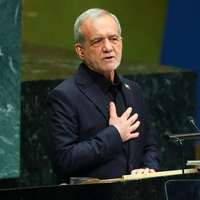
Abdolrahim Soleimani Ardestani (right) in a debate with fellow cleric Hamed Kashani, recorded in Tehran and live-streamed on YouTube, November 30, 2025
An Iranian cleric's skeptical remarks on some cherished aspects of Shi'ite Muslim religious history in a debate show have been met with insults and threats, underscoring the dangers of religious dissent in the theocracy.
The episode marks a rare public challenge to dogma in the Islamic Republic and the strength of opposition to any religious free thinking by stalwart backers of the system.
Abdolrahim Soleimani Ardestani, in a debate with fellow cleric Hamed Kashani circulated on video over social media, challenged the canonical story of the “martyrdom" of Fatemeh, a revered matriarch and the daughter of the prophet Mohammed.
A video of the discussion on YouTube had garnered 17,000 comments, among them arguments strongly for and against his remarks.
He argued that if her husband the first Shi'ite Imam, Ali, had merely watched events unfold, he would be “complicit in the killing," in an important challenge to the notion that the central figure in early Islamic history was a paragon of justice.
Ardestani went to attribute the death of the ninth Shi'ite Imam, Javad, to the jealousy of his wife and said mourning such an event for centuries was misguided.
State-appointed eulogists, who lead the faithful with chants before prayers, tore into the maverick cleric on Friday according to videos which circulated on social media.
"Damn that dishonorable Ardestani bastard with no roots, all the way till Judgment Day," said one eulogist, Hossein Sotoudeh.
Officials signal punitive response
Mohammadali Amani, secretary-general of the Islamic Coalition Party, urged legal action against Ardestani without naming him, saying on X that insulting Shi'ite sanctities was “an unforgivable sin.”
Cleric Alireza Sanjari Araki, responding to a religious query, said that denying the martyrdom of Fatemeh or the “absolute guardianship of the Ahl al-Bayt” could place a person outside Shi'ite doctrine and subject them to rulings of unbelief.
He was referring to the family of the Prophet Mohammed from whom the Fatemeh, Ali and Javad hailed. The Shi'ite tradition regards them as holy spiritual and political figures.
Tasnim News wrote that the subject was inherently “a matter of honor” for Shi'ites.
Social-media backlash widens
Pro-government users have inundated Ardestani with verbal abuse, while others condemned the attacks and defended his right to question historical narratives.
A social media user going by the name Mohammad Hossein Rajabloo said Ardestani needed to quit his neighborhood otherwise his home would be attacked.
But another user wrote that verbal violence by eulogists “goes beyond a jurisprudential dispute,” adding that divergent views are now met “not in forums for free inquiry, but with crude language from public pulpits.”
Others argued that critical reasoning threatens entrenched interests or that his questions did not warrant such escalation.
Reformist cleric Mohammadali Abtahi said former president Mohammad Khatami objected to Ardestani’s remarks in a recent meeting, arguing they harm the cause of religious reform.
The moderate Mardomsalari Party called the cleric’s comments “coarse” and contrary to Shi'ite beliefs but said violence, or attacks on his home were unacceptable and violated freedoms of expression and belief.
The confrontation underscores the Islamic Republic’s long record of harsh responses to perceived theological dissent, evoking past cases such as the decades-long targeting of author Salman Rushdie.
Rushdie was left with serious injuries including the loss of an eye when he was stabbed while giving a talk in the United States in 2022.
The attempted murder is believed to have been inspired by the fatwa issued by the Islamic Republic’s founder Ruhollah Khomeini against Rushdie for his novel The Satanic Verses.
Tehran’s move to sharply limit a man’s liability for paying his wife mehriyeh—a gift of value promised at marriage—has triggered a fierce social debate, with critics warning that it tilts the legal balance further away from women.
On Wednesday, Iran’s parliament voted to cut the threshold for criminal enforcement from the long-standing ceiling of 110 gold coins, introduced in 2013, to just 14.
The measure passed as part of a broader bill to curb the criminalization of debt.
Legal scholar Mohsen Borhani was among the first to sound the alarm when the proposal surfaced earlier this year.
“Once again, a misogynistic bill is moving toward approval,” he posted on X, arguing that mehriyeh remains one of the few practical tools women have in a system where laws and practices heavily favor men.
Lawmakers, he wrote, should revise “all the reciprocal rights of spouses, not tilt the law to one side, and certainly not in a way that harms women.”
Mehriyeh, the inverse of dowry in Western traditions, is negotiated before marriage and legally treated as a debt. It becomes payable at divorce, on demand, or from the husband’s estate if he dies.
While it can take the form of money, property, or symbolic items, government-minted gold coins have become standard over the past few decades; amounts routinely reach hundreds of coins, each worth around $1,000.
Some conservatives inside parliament echoed that concern this week.
Lawmaker Sara Fallahi said the decision would alienate the public from religion “because it limits women’s rights in the name of Sharia.”
Supporters, including Mehrdad Lahouti, counter that more than 25,000 men have been jailed over unpaid mehriyeh and insist the reform will reduce imprisonment for debt.
For decades, criminal enforcement has been central to the function of mehriyeh: it gave women a swift and powerful remedy when husbands refused payment and acted as one of the few bargaining tools available in divorce or marital disputes.
Ankle monitor
Under the new rule, a man unable to pay more than 14 coins could be fitted with an electronic ankle monitor rather than jailed while the remaining debt is pursued.
The legislation still requires approval by the Guardian Council. If finalized, only claims up to 14 coins could trigger criminal sanctions; everything above that would fall into slow and often uncertain civil litigation.
Many families choose 14 coins in reference to the 12 Shi’a Imams plus Prophet Mohammad and his daughter, Fatima.
In many divorces, women surrender part or all of their mehriyeh in exchange for custody or simply for the husband’s consent to dissolve the marriage—another reason reform critics view mehriyeh as a crucial form of leverage in a system already tilted toward men.
Iran’s Sharia-based legal framework contains numerous provisions that disadvantage women, particularly in family and inheritance law.
Men can divorce without proving fault, bar their wives from working or traveling abroad, and legally marry multiple wives. Women must establish serious grounds to obtain a divorce and often rely on mehriyeh as the only enforceable financial safeguard available to them.
Critics fear that without the threat of criminal consequences, many wives—especially those without independent income—will be left to pursue claims through years of civil litigation with little guarantee of recovery.
“Such an approach will easily widen the gender gap and undermine public trust in the process of reforming family laws,” the conservative Farhikhtegan daily warned.
Iran’s national team coach Ardeshir Amir Ghalenoei has arrived in Washington with part of the country’s football delegation ahead of Friday’s World Cup draw, FIFA said.
In a response to Iran International, FIFA said it “welcomed the arrival of the Islamic Republic of Iran Football Federation delegation to Washington, DC, including head coach Ardeshir Ghalenoei,” adding that it would continue working with Iran and US authorities to prepare for next summer’s 2026 World Cup, hosted by the United States, Canada and Mexico.
Iran had initially threatened to boycott the ceremony over visa difficulties.
The Islamic Republic of Iran Football Federation applied for nine visas, but a federation spokesman said the United States granted four, including one for Ghalenoei. Federation president Mehdi Taj was among those denied entry.
Iran qualified earlier this year through the Asian tournament and will learn their group-stage opponents at the draw later on Friday at the John F. Kennedy Center for the Performing Arts.
The team has now reached its seventh World Cup and its fourth in a row. Their arrival in the US comes against the backdrop of longstanding entry restrictions that continue to shape travel rules for Iranian nationals.
White House: team allowed, fans likely not
The White House on Wednesday said Iran’s national team will be permitted to enter the United States for the World Cup, but suggested Iranian fans will remain barred under existing travel restrictions.
“The President has, in his executive order, certainly named Iran as one of the countries whose teams will be exempt to come here,” said Andrew Giuliani, head of the White House task force on the World Cup.
Pressed on whether US immigration authorities might conduct raids at matches, Giuliani added that “the President does not rule out anything that will help make American citizens safer.”
US travel rules in the spotlight
The US has kept tight visa controls on Iranians for decades, and in June President Donald Trump signed an executive order barring entry for citizens of 12 countries, including Iran, citing security concerns. The measure is meant to exempt athletes and coaching staff attending the World Cup and the 2028 Olympics, though the visa process has remained restrictive.
The administration has also announced a separate review of green cards issued to immigrants from 19 countries, including Iran.
The review followed an incident in Washington DC in which an Afghan national — who had arrived under a special immigration program after the US withdrawal from Afghanistan — shot two National Guard troops, killing one and leaving the other gravely injured.
An Iranian water official said the volume of drinking water stored in Tehran’s five main dams has fallen to about 170 million cubic meters, roughly half the level recorded at this time last year.
Rama Habibi, a deputy at the Tehran Regional Water Company, told ISNA that the capital is experiencing its most persistent dry spell in six decades.
“For the first time in 60 years, we have had five consecutive years of drought,” he said.
Habibi added that rainfall since the start of the current water year in early October has been “very minimal.” He said Tehran recorded 48 millimeters of rain in the same period last year, compared with just 1.9 millimeters this year.
“We are facing a 96 percent reduction in rainfall compared with last year,” he said, adding that long-term averages also show a drop of nearly 98 percent.
Drought reshapes dam operations
The prolonged dry period has pushed reservoir levels across Iran to historic lows. The country’s Karkheh Dam hydroelectric plant was forced to halt power generation last week due to the shrinking water level in its reservoir.
Officials said the dam’s basin has endured years of drought, with water now flowing only through lower outlets to meet downstream needs.
Karkheh, one of the region’s largest dams, is among many facilities confronting shortages. Domestic media say reservoirs feeding Tehran’s Karaj and Latian dams have fallen sharply, and cities such as Mashhad, Kerman and Yazd are grappling with collapsing aquifers and, in some cases, water rationing.
Habibi said that in past years, rainfall returned to normal after short dry spells, but the current prolonged drought means “the outflow from the dams exceeds the inflow,” pushing storage to what he called alarmingly low levels. Long-term data indicate average storage of about 509 million cubic meters, leaving the current figure at roughly one-third of that amount, he said.
Warnings of broader strain
Authorities in several provinces warn that diminishing reserves could bring deeper disruptions if dry conditions persist. In Mashhad, officials have already moved to full rationing, while parts of Kerman report abandoned farmland due to groundwater depletion. Nationwide, rainfall has dropped to around 18 percent of normal levels, with 20 provinces reporting no measurable precipitation in recent weeks.
Water specialists quoted by local media say that if current patterns continue, significant parts of Tehran could face severe supply instability within the next decade.
Iran’s Revolutionary Guards began the second phase of a naval drill with volleys of ballistic and cruise missiles aimed at targets in the Oman Sea, state media reported on Friday.
Qadr 110, Qadr 380 and Qadir cruise missiles, along with the 303 ballistic missile, were fired from locations inside Iran and struck preselected targets at sea, according to the state media. Drone units also carried out attacks on simulated enemy bases, and naval air defense systems practiced responses to aerial threats against fast boats and coastal positions.
The exercise is taking place in the Persian Gulf, the Strait of Hormuz and around Iran’s southern islands, waters where Iranian officials have at times said traffic could be restricted during periods of tension.
The IRGC Navy has said the drill is named after Mohammad Nazeri, a commander and founder of the force’s special operations unit who was killed in 2016. Earlier this week, the navy announced the exercise would run for two days and extend across the Persian Gulf, the Strait of Hormuz, the Oman Sea and nearby islands.
Officials say the drill includes testing combat systems, electronic warfare defenses and operations in simulated wartime conditions.
The naval drill follows Sahand 2025, a five day counter terrorism exercise led by IRGC Ground Forces in East Azarbaijan province under the Shanghai Cooperation Organization framework. That drill was designed with support from Iran’s foreign ministry and the SCO’s Regional Anti Terrorist Structure and focuses on what the bloc calls terrorism, separatism and extremism.
Iranian lawmaker Fada-Hossein Maleki said on Friday that the United States has sent messages indicating interest in negotiations, but Tehran has no plans to engage.
He told the outlet Didban Iran that “the remarks of the Supreme Leader about negotiations with the US are the final word,” adding that “we tried every path, but in the end it led to war and the wall of distrust only grew higher.”
Maleki said messages had arrived “through different channels,” but insisted Iran does not view Washington as a reliable counterpart. “The Americans want to dictate their positions. We want negotiations that secure our rights, not talks that follow their script,” he said.
Preconditions at the heart of the standoff
Maleki said one key reason for Iran’s rejection of talks is Washington’s insistence on sweeping concessions, including halting uranium enrichment. “Zero enrichment is something Iran will never accept,” he said, describing the demand as outside international norms. He added that “no IAEA member state accepts such limits on its own soil.”
Iran International reported last month that President Donald Trump reiterated three preconditions for talks via Saudi Crown Prince Mohammed bin Salman: an end to enrichment, curbs on Iran’s missile program, and halting support for armed allies in the region. Tehran rejects all three as non-starters.
Supreme Leader Ali Khamenei last week denied that Iran had asked Saudi Arabia to mediate, calling reports of outreach “pure lies.” Maleki said lawmakers and Foreign Minister Abbas Araghchi have agreed that Iran should stay aligned with Khamenei’s guidance.
Araghchi had said earlier that Iran remains open to negotiation “when it is real,” but added that Washington is currently “dictating, not negotiating.”
Regional risks and warnings
Maleki said there is a possibility of US or Israeli attacks on armed groups aligned with Iran in Lebanon, Iraq and Yemen, describing Washington and Tel Aviv as increasingly isolated. “They are cornered, and they may act out of desperation,” he said.
He argued that some Arab governments no longer view US guarantees as dependable. “Many in the region see that the American rope is rotten, and those who cling to it will fall to the bottom of the well,” he said.
Maleki said Iran is ready for any escalation. “We are far more prepared than before,” he said, adding that although Iran suffered losses in the opening hours of the recent twelve-day conflict, “the enemy knows our readiness now.”
He said Tehran’s position remains unchanged: “Whenever the Americans enter real negotiations — give and take — and prove good faith, we have no problem. But imposing preconditions will never be acceptable.”