• العربية
  • فارسی
Brand
  • Iran Insight
  • Politics
  • Economy
  • Analysis
  • Special Report
  • Opinion
  • Podcast
  • Iran Insight
  • Politics
  • Economy
  • Analysis
  • Special Report
  • Opinion
  • Podcast
  • Theme
  • Language
    • العربية
    • فارسی
  • Iran Insight
  • Politics
  • Economy
  • Analysis
  • Special Report
  • Opinion
  • Podcast
All rights reserved for Volant Media UK Limited
volant media logo

US pressure after Iran-tied strikes on oilfields restarts Iraq–Turkey pipeline - Reuters

Dec 4, 2025, 12:47 GMT+0
Smoke rises after a drone attack targeted oil facilities in the Zakho area of Iraq's Kurdistan region, Iraq July 16, 2025.

Drone attacks on US-run oilfields in Iraqi Kurdistan – blamed by local authorities on Iran-aligned militia – prompted a US pressure campaign that helped restart the Kirkuk–Ceyhan export pipeline, a move Washington views as curbing funding for Iran-backed groups, Reuters reported.

The July strikes – described by Reuters as retaliation for US action against Iranian nuclear sites weeks earlier – hit the Sarsang field operated by HKN Energy and another run by Dallas-based Hunt Oil, disrupting output across the region.

By the end of four days of attacks, nearly half of Kurdistan’s production was offline, Reuters said.

In the following weeks, US officials delivered what one administration source called “extremely intensive” messages to Baghdad, pressing for a restart of the pipeline to Türkiye’s Ceyhan port.

Washington has argued that the line’s closure diverted crude into southern routes and informal channels that enriched Iran-aligned networks.

A preliminary restart deal was reached in mid-July, and exports resumed late in September after a 30-month halt, helping normalize flows of Kurdish crude.

Iraqi officials have not named the group behind the strikes, and no group has claimed responsibility for the attack, but Iraqi Kurdistan security sources said that initial investigations suggested that the drone came from areas under the control of Iran-backed militias.

Most Viewed

Ghalibaf defends Iran-US talks amid hardline backlash
1
INSIGHT

Ghalibaf defends Iran-US talks amid hardline backlash

2
INSIGHT

Iran diplomacy wobbles as factions compete to avoid looking soft on US

3
VOICES FROM IRAN

Bread shortages, soaring prices strain households in Iran, residents say

4
ANALYSIS

The politics of pink: how Iran uses cuteness to rebrand violence

5

Scam messages seek crypto for ships’ safe passage through Hormuz, firm warns

Banner
Banner

Spotlight

  • Opposition to US talks grows in Tehran as ceasefire deadline nears
    INSIGHT

    Opposition to US talks grows in Tehran as ceasefire deadline nears

  • Tehran moderates see ‘no deal–no war’ limbo as worst outcome
    INSIGHT

    Tehran moderates see ‘no deal–no war’ limbo as worst outcome

  • The future has been switched off here
    TEHRAN INSIDER

    The future has been switched off here

  • Lights out, then gunfire: Witnesses recount Mashhad protest crackdown
    VOICES FROM IRAN

    Lights out, then gunfire: Witnesses recount Mashhad protest crackdown

  • Family told missing teen was alive, then received his body 60 days later
    EXCLUSIVE

    Family told missing teen was alive, then received his body 60 days later

  • Is Iran entering its Gorbachev moment?
    INSIGHT

    Is Iran entering its Gorbachev moment?

  • Local Iraqi officials blame gas field rocket strike on Iran-backed groups

    Local Iraqi officials blame gas field rocket strike on Iran-backed groups

  • Trump says Iraq more friendly after US attacks on Iran

    Trump says Iraq more friendly after US attacks on Iran

•
•
•

More Stories

Iranian government pins inflation on unbacked money printing

Dec 4, 2025, 10:50 GMT+0

Iran’s government said inflation stems from unfunded promises financed by unbacked money printing and bank credit, adding it has capped budget growth at about 2% and halted most other outlays in a bid to curb price pressures.

“The moment we print money without backing, inflation rises and people pay the price,” President Masoud Pezeshkian said during a visit to the southwestern city of Yasuj.

Monetary expansion driven by unfunded pledges, he said, “takes money from people’s pockets” and intensifies existing pressures.

Economists widely link Iran’s continued inflation and the collapse of the rial to persistent reliance on money creation.

The government’s use of bank borrowing and indirect central bank financing expands the monetary base without matching growth in real output, entrenching price instability.

Iran’s rial continued to weaken on Wednesday in a sign of flagging confidence in the country's troubled economy, with the US dollar trading at an all-time high above 1.2 million rials according to local exchange-rate websites.

  • Iran’s Central Bank ordered to slash four zeros from national currency

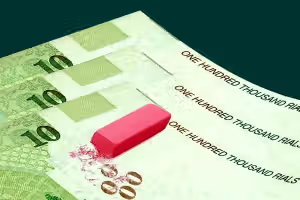
    Iran’s Central Bank ordered to slash four zeros from national currency

  • Iran Printing Huge Sums Of Money Amid Rising Inflation

    Iran Printing Huge Sums Of Money Amid Rising Inflation

Rapid liquidity growth

Iran's broad money doubled during the 2.5-year presidency of Ebrahim Raisi, according to statistics from the country’s Central Bank (CBI).

Broad money, the total money supply within an economy, is the primary cause of rampant inflation in Iran.

Over the past years, Iran’s Central Bank has ceased publishing government budget reports.

Local media tracking shows that in the past year, food prices in Iran have risen by an average of more than 66%.

According to the Supreme Audit Court of Iran, however, it is estimated that since 2018 – when the US withdrew from the Joint Comprehensive Plan of Action (JCPOA) and imposed sanctions on Iran’s oil exports – the government's annual budget deficit has consistently exceeded 30%.

The Iranian government has been compensating the budget deficit by borrowing money, in particular, from the banking system.

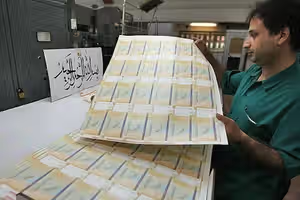
A worker inspects freshly printed Iranian banknotes (undated)
100%
A worker inspects freshly printed Iranian banknotes

Budget capped

Pezeshkian said his administration set an unprecedented ceiling on expenditure. “For the first time, we have kept budget growth to around two percent and cut the rest,” he said.

Some recipients, he added, had protested reduced allocations but argued that expanding spending without resources would heighten inflation rather than solve shortages.

He added that the government could not “spend from people’s pockets” for short-term gains and warned that raising expectations without funding would deepen internal disputes.

“If we think the situation is fine, that the government has money and is not giving it, or if we only raise our own expectations, we will increase disagreements and conflicts.”

Iraq to correct official record, delete Hezbollah and Houthis from sanctions list

Dec 4, 2025, 09:17 GMT+0

Iraq will remove Lebanon’s Hezbollah and Yemen’s Houthis from an asset-freeze list after the Iran-aligned groups were included in an official publication, officials said on Thursday.

The Justice Ministry’s gazette carried a committee decision freezing funds of designated entities and, in error, named Hezbollah and the Houthis, according to Reuters.

A letter from the acting deputy governor of the Central Bank asked the Committee for the Freezing of Terrorists’ Funds to delete the clause, two bank sources was cited by the outlet.

Tasnim, an outlet close to Iran’s IRGC, framed Baghdad’s correction as a climbdown under intense public and political pressure, saying Iraq’s Central Bank “backed off” after outrage over the Gazette notice.

Prime Minister Mohammed Shia’ al-Sudani said Iraq had approved freezing only the assets of entities and individuals linked to Islamic State and al Qaeda, in line with UN Security Council Resolution 1373 and following a request from Malaysia.

He ordered an urgent investigation “to hold accountable those responsible” for the mistake and stressed Baghdad’s stance on Lebanon and the Palestinians was “principled and not subject to exaggeration.”

The clarification followed publication in issue No. 4848 of the Iraqi Gazette of Decision No. 61 by the Committee for the Freezing of Terrorists’ Assets, which named 24 entities and ordered their funds frozen.

The committee is chaired by Central Bank Governor Ali Mohsen al-Alaq, with members from the anti-money-laundering office and the ministries of finance, interior, foreign affairs, justice, trade, communications, and science and technology, as well as the integrity, intelligence and counter-terrorism bodies.

The committee said on Thursday that the publication was meant to cover ISIS- and al-Qaeda-related listings only and that unrelated groups appeared because the list was released before final revisions were completed. It said a corrected version will be printed in the official gazette.

Publication of the committee’s decision in the Justice Ministry’s gazette led some outlets to report that Hezbollah and the Houthis had been designated terrorist entities, prompting denunciations from politicians aligned with Iran-backed factions.

Hussain Mouanes, a lawmaker from a bloc affiliated with Kataeb Hezbollah, called the government’s conduct “irresponsible” and accused it of failing to defend Iraq’s sovereignty.

Lawmaker Mustafa Sanad, who shared the gazette and is aligned with Popular Mobilization Forces-linked blocs, condemned the designations on social media.

  • Trump says Iraq more friendly after US attacks on Iran

    Trump says Iraq more friendly after US attacks on Iran

  • Iran-backed militias’ election gains may expand Tehran’s sway in Iraq - FT

    Iran-backed militias’ election gains may expand Tehran’s sway in Iraq - FT

Iraq has balanced relations with both the United States and Iran, but faces mounting risks to its financial system if it falls foul of global sanctions regimes.

Hezbollah and the Houthis are key members of a broader network of Iran-backed groups across the region.

Iran views Iraq as a strategic economic and political partner amid Western sanctions, while Baghdad remains wary of being drawn into US efforts to squeeze Tehran and its regional allies.

Israel arrests Ashkelon man on suspicion of spying for Iran

Dec 4, 2025, 08:46 GMT+0

Israeli police and the Shin Bet said they arrested an Ashkelon resident, 37-year-old Amir Malka, on suspicion of spying for Iran over several months, allegedly earning several thousand dollars.

He was detained last month in a joint probe by Jerusalem District detectives and the Shin Bet; police did not detail the alleged espionage.

Malka is to be indicted in the Beersheba District Court.

The agencies said they are intensifying efforts to deter Israelis from spying for Iran following the 12-day war in June, with the Shin Bet working with municipalities.

Bat Yam Mayor Tzvika Brot this week urged residents who contacted Iranian agents to come forward, implying leniency.

Iran boosts gas exports to Turkey despite deepening domestic shortages

Dec 3, 2025, 21:41 GMT+0
•
Dalga Khatinoglu

Despite facing a growing domestic gas deficit and widespread use of highly polluting fuel oil, Iran’s gas deliveries to Turkey have continued to surge according to official Turkish energy statistics.

Newly released data from Turkey’s Energy Market Regulatory Authority (EMRA), affiliated with the Ministry of Energy show that Iran supplied more than 5.5 billion cubic meters of gas to Turkey during the first nine months of 2025—17% more than in the same period last year and 45% higher compared to 2023.

Buffeted by stiff Western and international sanctions, Tehran appears to be seeking revenue from abroad even as it faces severe gas shortages at home.

A confidential Oil Ministry document obtained by Iran International in mid-2025 showed an annual jump by nearly half in fuel oil, or mazut, consumption last year.

This is despite its being one of the most polluting forms of fossil fuel on earth.

It is not yet clear how much mazut consumption has risen this year, but the deputy oil minister says Iran is expected to face a daily gas deficit of 300 million cubic meters during this winter’s peak demand. Last year, the shortfall was 250 million cubic meters; in 2023, it was about 200 million.

Bleak outlook

With the onset of cold weather and rising household gas demand across large parts of the country, industries and power plants have increasingly switched to burning mazut, causing dangerous air pollution in major cities including the capital Tehran.

A recent report by Iran’s Department of Environment on the mazut and diesel supplied to Tehran-area power plants shows sulfur content 10 to 100 times higher than international standards.

Had Iran halted its gas shipments to Turkey, the statistics show it could have reduced domestic fuel oil consumption by roughly 20 million liters per day, given that natural gas is the cleanest fossil fuel alternative.

Yet the Islamic Republic insists on maintaining its gas exports to Turkey and supplies roughly the same amount to Iraq.

Last year, Iran exported 15 billion cubic meters of gas, equivalent to 15 billion liters of mazut in energy content. If exports had been suspended, not only would Iran have avoided burning mazut domestically, it would have also saved 7 million liters of diesel per day.

Why does Iran have a gas shortage?

Part of Iran’s gas deficit stems from the slowdown in the development of gas production projects due to the government’s financial constraints and the limited technological capabilities of domestic oil companies.

Stiff Western and international sanctions have made updating the country's already creaky energy infrastructure yet more difficult.

For example, between 2010 and 2020, Iran’s gas output grew at an average annual rate of 5.2%, but growth has dropped to 1–2% in recent years, according to BP statistics.

Another critical factor is the decline in pressure at Iran’s section of the South Pars gas field, shared with Qatar—a decline that began in 2024. South Pars supplies over two-thirds of Iran's gas.

Years ago, Qatar collaborated with major Western energy companies to install 20,000-ton platforms—15 times heavier than Iran’s current offshore platforms—along with huge compressors in the Qatari section (the North Field).

But neither Iran nor its Chinese partners possess the technical capacity to manufacture such large-scale equipment.

Declining pressure

About nine months ago, Iran’s Oil Ministry signed a $17 billion contract with four domestic firms to implement pressure-boosting operations at South Pars. However, instead of installing 20,000-ton platforms, the plan calls for 4,000-ton structures, and for using weaker compressors instead of the massive units required.

An Iranian-British oil and gas engineer—designer of a BP mega-platform in Azerbaijan’s Caspian waters and currently working on the Qatari side of South Pars—told Iran International that the specifications of platforms and compressors outlined in the Iranian contract are inadequate to resolve the field’s pressure decline.

The engineer, who requested anonymity, added that restoring pressure on the Iranian side requires much larger platforms capable of hosting a full power plant, giant compressors and facilities for separating various gas streams and condensates.

The pressure in Iran’s section of South Pars was about 120 bar until two years ago, but has since been dropping by 6 bar per year, significantly reducing gas output.

Mohammad Oliya, CEO of MAPNA—one of the four companies awarded the $17 billion contract—said earlier this month that “no funding has yet been allocated” for the pressure-boosting project.

At the same time, the Revolutionary Guards-linked Tasnim news agency reported that although the contract was signed in March, no action beyond a series of study meetings and initial assessments has occurred.

How Iran's theocratic rule takes hits but persists

Dec 3, 2025, 18:04 GMT+0
•
Ata Mohamed Tabriz

A lopsided war with Israel and the United States in June rattled Iran’s political order, but it survives through smarter coercion and the disarray of forces that might otherwise bring it down.

Internal contestation is harsher than at any time in recent memory, with competing factions trying to preserve or redefine their place in a system that has lost the capacity for reform or institutional expansion.

Yet Iran's nearly 50-year-old theocracy persists, compensating for poor governance with stiff security control and the careful redistribution of shrinking resources.

Just as authorities have slackened enforcement of Islamic social rules, allowing unveiled women and open-air concerts in public, it has stepped up a crackdown on political dissent and alleged spies.

Opposing this order are three forces whose interaction with the securitized state produces neither fundamental change nor imminent collapse, but something closer to endurance through erosion.

Those are: people inside Iran fighting localized economic and professional battles without organized networks, an exiled opposition adept at narrative and symbolism but detached from lived realities inside Iran and foreign actors committed to curbing Tehran’s nuclear and regional strength but not to toppling it.

One system, many channels

The Islamic Republic is structured around the Supreme Leader, whose authority ultimately resolves all major decisions. Around this axis sits an intricate constellation of parallel institutions, security councils, loyalty networks and overlapping hierarchies.

Policymaking is multi-layered. But decision-making is ultimately his sole prerogative.

President Masoud Pezeshkian recently issued a telling statement that unmanageable infighting would ensure should Ali Khamenei somehow exit the scene. It underscores a basic fear: without the Leader’s centrality, the power networks would drift apart.

Nothing illustrates this better than the way “system” is used interchangeably for both the political order and the leader himself.

Khamenei functions less as the manager of a unified apparatus than as the referee of internal conflicts. The state bureaucracy is not the engine of governance but one node among political, security and economic bodies each pursuing their own interests.

The 12-day war intensified these fissures. The removal of influential IRGC figures disrupted long-standing balances and sharpened factional sensitivities.

The Babak Zanjani affair illuminates the power politics at play.

Sprung with little explanation from a death sentence for corruption, the disgraced tycoon now not only walks free but weighs in regularly on politics, even appearing to threaten former President Hassan Rouhani with death in a tweet this week.

Such a rapid rehabilitation could not occur without powerful establishment backing.

Unorganized discontent

The war’s economic toll—passed on to society through inflationary policies—has deepened hardship and widened discontent. Iran’s society today is in ferment but unorganized: protests erupt across workplaces and cities, but without intermediary institutions they remain local and short-lived.

A recent nurses’ strike in Mashhad, much like the truck drivers’ strike before it this spring, showed the pattern clearly: strong anger, weak connective tissue.

The labor market’s collapse into unstable, platform-based work illustrates a society living in permanent emergency. Eight million rideshare drivers do not prove total collapse, but they reveal a mass shift toward insecure livelihoods.

Economic stress drains the psychological capacity for sustained organization; survival overrides solidarity.

Provincial centers skew toward economic protests, while peripheral regions experience conflict mainly through security confrontation.

The recurring demolition of homes in Baluchistan in southeastern Iran is one example of a strategy that provokes local resistance but rarely ratchets up because no networks link periphery grievances to central demands.

Inside Iran, opposition forces function like isolated islands. Outside, the opposition produces abundant media output but struggles to translate daily grievances into a shared political language.

The gap between “voice” abroad and “life” inside has produced an opposition that amplifies frustrations but does not alter the balance of power.

Survival on the edge

The Islamic Republic continues not as an effective state but as a mechanism that defers crises day by day. Security has replaced policy; the cost of maintaining power rises constantly as the quality of governance decays.

The system persists because no countervailing power with organizational depth has yet emerged.

European-triggered international sanctions and intermittent threats from the United States and Israel show that containment—not internal transformation—may be the ultimate priority from outside powers.

External pressure accelerates economic and infrastructural decay but cannot substitute for domestic political change.

For the West, Iran remains a security file, not a political project.

Foreign actors may accelerate or intensify pressure, but the indispensable condition for change is alignment between internal and external forces around a shared language and objective.

Until such convergence forms, the Islamic Republic will remain in a state of endurance through erosion—able to enforce the status quo even as it becomes less capable of maintaining stability or basic services.