• العربية
  • فارسی
Brand
  • Iran Insight
  • Politics
  • Economy
  • Analysis
  • Special Report
  • Opinion
  • Podcast
  • Iran Insight
  • Politics
  • Economy
  • Analysis
  • Special Report
  • Opinion
  • Podcast
  • Theme
  • Language
    • العربية
    • فارسی
  • Iran Insight
  • Politics
  • Economy
  • Analysis
  • Special Report
  • Opinion
  • Podcast
All rights reserved for Volant Media UK Limited
volant media logo

Iran foreign ministry pushes back on claims of US outreach via Saudi Arabia

Nov 24, 2025, 11:07 GMT+0
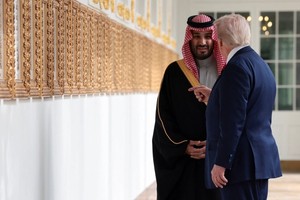
Crown Prince and Prime Minister Mohammed bin Salman of Saudi Arabia attends the US-Saudi Investment Forum in Washington, DC, November 19, 2025.

Iran’s foreign ministry rejected reports about President Masoud Pezeshkian’s letter to Saudi crown prince, saying it was a routine bilateral message focused solely on Hajj coordination and contained nothing related to negotiations with the United States.

Foreign ministry spokesman Esmail Baghaei said the correspondence was “a completely normal letter exclusively about the Hajj” and that “there was no content in it related to negotiation issues,” according to state news agency IRNA.

He criticized what he called persistent “baseless speculation” about the letter’s purpose, adding that insisting on publishing claims already denied by officials “does nothing to advance national interests.”

Baghaei’s comments follow a rising domestic debate over whether Tehran is exploring indirect channels to Washington after a former lawmaker, Mostafa Kavakebian, said Pezeshkian had sent a message to US President Donald Trump through Mohammed bin Salman offering talks without preconditions.

Reuters reported last week, citing two sources familiar with the exchange, that Pezeshkian had urged the Saudi crown prince to help revive stalled nuclear diplomacy, while Saudi media confirmed only that bin Salman received a letter from the Iranian president.

Iran has repeatedly denied seeking Saudi mediation, saying there is currently no negotiation process with the United States

Most Viewed

Iran negotiators ordered to return after internal rift over Islamabad talks
1
EXCLUSIVE

Iran negotiators ordered to return after internal rift over Islamabad talks

2
ANALYSIS

US blockade enters murky phase as tankers spoof signals and buyers hesitate

3
ANALYSIS

Why the $100 billion Hormuz toll revenue is a myth

4

US tightens financial squeeze on Iran, warns banks over oil money flows

5
ANALYSIS

US blockade targets Iran oil boom amid regional disruption

Banner
Banner

Spotlight

  • Hardliners push Hormuz ‘red line’ as US blockade tests Iran’s leverage
    INSIGHT

    Hardliners push Hormuz ‘red line’ as US blockade tests Iran’s leverage

  • Ideology may be fading in Iran, but not in Kashmir's ‘Mini Iran'
    INSIGHT

    Ideology may be fading in Iran, but not in Kashmir's ‘Mini Iran'

  • War damage amounts to $3,000 per Iranian, with blockade set to add to losses
    INSIGHT

    War damage amounts to $3,000 per Iranian, with blockade set to add to losses

  • Why the $100 billion Hormuz toll revenue is a myth
    ANALYSIS

    Why the $100 billion Hormuz toll revenue is a myth

  • US blockade targets Iran oil boom amid regional disruption
    ANALYSIS

    US blockade targets Iran oil boom amid regional disruption

  • Iran's digital economy battered by prolonged blackout
    INSIGHT

    Iran's digital economy battered by prolonged blackout

  • Khamenei authorized Pezeshkian’s letter to Trump, former lawmaker says

    Khamenei authorized Pezeshkian’s letter to Trump, former lawmaker says

  • Iran says president’s letter to Saudi crown prince not about US mediation

    Iran says president’s letter to Saudi crown prince not about US mediation

•
•
•

More Stories

Khamenei authorized Pezeshkian’s letter to Trump, former lawmaker says

Nov 23, 2025, 18:43 GMT+0

President Masoud Pezeshkian sent a letter via Saudi Crown Prince Mohammed bin Salman to President Donald Trump with the permission of Supreme Leader Ali Khamenei offering to revive nuclear talks, a former Iranian lawmaker said after Tehran denied seeking Riyadh’s mediation.

Mostafa Kavakebian, a former member of the Iranian parliament, told the Tehran-based Asr Iran news website on Sunday that bin Salman carried Pezeshkian’s message during his recent trip to Washington and meeting with Trump on November 18.

He said Pezeshkian wrote in the letter that Iran was ready to negotiate with the United States without preconditions or diktats.

"The content of the message was that we are willing to sit down and talk together—not a conversation that comes from a position of surrender, nor one where you dictate what should or should not be. Instead, we will sit down, open the door to dialogue, discuss the issues together, and this was conveyed," Kavakebian said.

"This was conveyed during this recent trip by bin Salman. It was also done with the Leader’s permission," he added.

Kavakebian said he believed the message aligned with Trump’s comments earlier this week, when the US president said Tehran was eager to reach an agreement.

“I think sending this message had an effect, and Trump immediately said that we will at last plan for negotiations,” Kavakebian said, referring to Trump’s remarks at a joint appearance with bin Salman in the White House on Tuesday.

Trump said the United States was talking to Tehran, which he said "very badly” wanted a deal with Washington.

"Iran does want to make a deal. I think they very badly want to make a deal. I am totally open to it, and we're talking to them, and we start a process," Trump had said.

Kavakebian's remarks come hours after after Iran's ministry spokesman denied that Pezeshkian’s letter to bin Salman was aimed at securing Saudi mediation with Washington, calling it a standard bilateral note tied to Hajj coordination.

“The issue of a mediator is not on the table,” Esmail Baghaei said.

Reuters reported on Thursday, citing two sources familiar with the exchange, that Pezeshkian had urged the crown prince to help persuade US President Donald Trump to revive nuclear talks.

Earlier on Monday, Saudi state news agency SPA reported that bin Salman received a letter from Pezeshkian, a day before the crown prince traveled to the United States for talks with Trump.

SPA did not provide any further details about the letter.

US talks with Tehran over its disputed nuclear program began earlier this year with a 60-day ultimatum. On the 61st day, June 13, Israel launched a surprise military campaign which was capped with US strikes on June 22 targeting key nuclear sites in Esfahan, Natanz and Fordow.

Iran denies seeking nuclear weapons and has called the attacks illegal.

The United States has demanded Iran renounce domestic uranium enrichment while Tehran maintains its nuclear program is an international right.

Iran says president’s letter to Saudi crown prince not about US mediation

Nov 23, 2025, 08:37 GMT+0

Iran on Sunday denied that President Masoud Pezeshkian’s letter to Saudi Crown Prince Mohammed bin Salman was aimed at securing Saudi mediation with Washington, calling it a standard bilateral note tied to Hajj coordination.

“The issue of a mediator is not on the table,” foreign ministry spokesman Esmail Baghaei said at a weekly briefing.

“This letter was simply a routine correspondence exchanged within the framework of Iran-Saudi discussions on organizing the Hajj. It contains the Islamic Republic of Iran’s message of appreciation to Saudi Arabia for the services it provided during last year's Hajj.”

Reuters reported on Thursday, citing two sources familiar with the exchange, that Pezeshkian had urged the crown prince to help persuade US President Donald Trump to revive nuclear talks.

Pezeshkian, the outlet reported, wrote that Iran “does not seek confrontation,” wants deeper regional cooperation, and remains ready for nuclear diplomacy if its rights are guaranteed.

Saudi state news agency SPA said that Saudi Crown Prince Mohammed bin Salman received a letter from Pezeshkian, a day before the crown prince traveled to the United States for talks with Trump.

foreign ministry spokesman Esmail Baghaei (file photo)
100%
Iran's foreign ministry spokesman Esmail Baghaei

The Reuters report came after Trump said last week that he seeks a deal with Iran and believes Tehran does too, speaking alongside Saudi Crown Prince Mohammed bin Salman who said he would try to help Tehran and Washington reach a deal.

Talks between Iran and the United States stalled after the 12-day war and the US and Israeli strikes on Iranian nuclear sites, a period during which the UN snapback mechanism of the 2015 nuclear deal was also triggered reimposing sanctions on Tehran.

Tehran challenges IAEA stance

Baghaei also addressed Iran’s cooperation with the International Atomic Energy Agency (IAEA), saying Iran’s membership eliminates any need for mediation efforts.

“We are a member of the IAEA and we do not need a mediator,” he said.

The United States and Israel, Baghaei added, must answer for actions he said disrupted cooperation, adding the agency “should not constantly complain” about Iran’s posture.

He urged the IAEA leadership to uphold its professional obligations, saying impediments to cooperation were created by Israel, the United States and the three European parties to the now-defunct nuclear deal.

“Regarding the problems in our cooperation with the International Atomic Energy Agency, it is Israel and the United States – who attacked us – that must be held accountable, and the agency should stop constantly complaining about our lack of cooperation.”

'Cairo accord is dead'

Baghaei said the Cairo agreement reached in September between Foreign Minister Abbas Araghchi and IAEA Director General Rafael Grossi “has no practical applicability and lacks validity” following last week’s Board of Governors vote adopting a resolution advanced by the United States, France, Britain, and Germany.

Araghchi said after the vote that “the Cairo agreement had been killed.”

On Iran’s next steps, Baghaei said decisions on the nuclear file are made “at the macro level” and details will be shared once decisions are reached.

The IAEA said last week that it needs more Iranian cooperation to restore full inspections at sites hit in June’s strikes, warning that verification of enriched uranium stocks is “long overdue.”

US says Iran's theocracy has taken air out of people's lungs

Nov 22, 2025, 20:40 GMT+0

The US State Department on Saturday blamed Iran’s government for tens of thousands of pollution-related deaths last year, calling it another burden on Iranian citizens already facing water shortages, economic collapse and arbitrary arrests.

"The Iranian regime not only represses its own people, it has also taken the air out of their lungs," the State Department said in a post on its Persian-language X account.

Air pollution caused about 58,975 deaths in Iran in the Iranian calendar year starting in March 2024, equivalent to 161 deaths per day and around seven every hour, the country’s deputy health minister said earlier this month.

"For citizens already struggling with water shortages, economic collapse and the constant fear of arbitrary arrest, air pollution adds yet another deadly threat to their lives," the State Department said.

"This is the price of the failure of those who are supposed to protect their own people."

Tehran’s air reached the unhealthy for sensitive groups range on Friday as pollutant concentrations climbed and meteorologists issued an orange alert for six major cities, warning that stagnant conditions could drive indices toward the dangerous threshold in the coming days.

Calls to ban old vehicles, invest in cleaner energy, and empower a central environmental authority have so far gone unanswered. Critics warn that without systemic change, major cities including Tehran will continue to suffer both in air quality and human lives.

President Masoud Pezeshkian said on Thursday Iran’s capital must be moved because the country “no longer has a choice,” warning that severe ecological strain has made Tehran impossible to sustain.

He said the pressure on water, land and infrastructure had left the government with “no option” but to act. “When we said we must move the capital, we did not even have enough budget. If we had, maybe it would have been done. The reality is that we no longer have a choice; it is an obligation."

Iran weighs NPT withdrawal after IAEA censure

Nov 22, 2025, 11:00 GMT+0

Tehran is considering suspending or withdrawing from the Nuclear Non-Proliferation Treaty (NPT) following a Western-backed resolution passed by the UN atomic watchdog this week, a member of Iran’s parliament said on Saturday.

Amir Hayat-Moghaddam, a member of parliament’s National Security and Foreign Policy Committee, told Rokna news agency that the option is “on the table” and under expert review. “Several meetings have been held since the IAEA Board of Governors adopted its anti-Iran resolution,” he said. “Withdrawal from the NPT is one of the preliminary options, but no final decision has been made. The review of all dimensions and possible consequences is still underway.”

He said a final decision could be announced by Tuesday, adding that any such move would be coordinated between parliament and the Supreme National Security Council. “There is no structural conflict between these institutions. Issues related to national interests are decided jointly,” he said. “Legally, however, withdrawal from international treaties falls within parliament’s authority.”

Separately, the spokesman for the National Security and Foreign Policy Committee said on Saturday that Iran’s parliament has begun drafting a bill on countermeasures in response to the recent International Atomic Energy Agency resolution.

Ebrahim Rezaei said the proposal aims to boost “nuclear and sanctions-related deterrence” and strengthen Iran’s defensive and legal capabilities. “A six-article draft has been prepared covering nuclear and sanctions counteractions as well as strategic, defense and judicial measures,” he told reporters.

Backdrop of renewed nuclear tensions

The discussions come days after the IAEA’s 35-member Board of Governors adopted a resolution urging Iran to provide full access to its nuclear sites and enriched uranium stockpiles. The measure, submitted by the United States, Britain, France and Germany, passed with 19 votes in favor, three against and 12 abstentions.

Iran condemned the vote as “illegal and unjustified” and said it has nullified the inspection accord reached in Cairo in September with IAEA chief Rafael Grossi and Egyptian mediation. Foreign Minister Abbas Araghchi said the resolution “killed” the Cairo accord and reflected a pattern of Western escalation.

“The US and the E3 attacked diplomacy just as they attacked our nuclear facilities,” Araghchi wrote on X on Thursday. “Iran is not the party seeking another crisis.”

Tehran says its cooperation with the agency remains within the framework of the NPT but insists that access to bombed facilities cannot resume until safety and legal questions are resolved.

Iran’s long-held position on the NPT

Iran has been a party to the NPT since 1970 and has repeatedly said it does not seek nuclear weapons. Officials in Tehran have described NPT membership as a sign of Iran’s commitment to peaceful nuclear energy, but they have also warned that continued political pressure could force a policy review.

  • West ‘killed’ Cairo nuclear accord, Iran foreign minister says

    West ‘killed’ Cairo nuclear accord, Iran foreign minister says

  • Iran says it will answer what it calls political IAEA move

    Iran says it will answer what it calls political IAEA move

  • IAEA urges Iran to restore full access to nuclear sites hit in June strikes

    IAEA urges Iran to restore full access to nuclear sites hit in June strikes

Foreign Ministry spokesperson Esmail Baghaei said on Friday that Western powers were “misusing an international body” and that their actions “undermine the credibility and independence of the Agency.”

In Vienna, Russia’s envoy Mikhail Ulyanov said the situation had reached a “complete deadlock,” blaming the Western sponsors of the resolution for “stalling diplomacy.”

Israel’s attacks on Iran changed everything — or did they?

Nov 21, 2025, 19:14 GMT+0
•
Negar Mojtahedi

Iran’s nuclear strategy has entered an ambiguous new phase, said veteran non-proliferation expert Mark Fitzpatrick, and Israel’s attacks in June could have left intact Tehran's ability to pivot toward a bomb if it so chose.

"It’s all about ambiguity. Nuclear hedging is all about the other side not knowing exactly what we have or exactly what our intentions are," Fitzpatrick, an associate fellow with The International Institute for Strategic Studies (IISS), told Eye for Iran.

Fitzpatrick, the author of “The Iranian Nuclear Crisis" and former US Deputy Assistant Secretary for Non-Proliferation, spoke after Iran this week rejected a new International Atomic Energy Agency resolution demanding access to its bombed nuclear sites.

US strikes capped off a surprise military campaign against Iran in June and targeted the Natanz, Esfahan and Fordow nuclear sites. Iranian authorities have barred international inspection of the stricken facilities in the months since.

A leaked report from the UN nuclear watchdog says it has lost continuity of knowledge on Iran’s 60 percent enriched uranium stockpile, which had grown to roughly 400 kilograms before the attacks.

Rafael Grossi, head of the agency warned this week that monitoring gaps have become a serious proliferation risk. Iran’s ambassador to the IAEA, Reza Najafi, responded by saying the resolution voided an earlier deal with the nuclear body.

What has actually changed?

Fitzpatrick says none of these developments signal a shift in Iran’s doctrine and that ambiguity may be a deliberate part of Iran's strategy.

“I don’t see any evidence that they’ve given up the desire to have a nuclear option for the future.” He argued Iran remains committed to so-called nuclear hedging, a strategy designed to maintain the capability to produce a weapon quickly while avoiding the political cost of crossing the threshold.

What has changed is Iran’s capacity, as Iran's foreign minister said this week that no enrichment had occurred since the attacks. “We’re not enriching for now because we can’t,” Abbas Araghchi said this week.

Araghchi told The Economist in an interview published on Thursday that Tehran is open to talks with the United States but not on Washington’s terms. “Zero enrichment is impossible ... zero (nuclear) weapons is possible.”

Fitzpatrick believes Iran is now stuck between possible inclination to revive its nuclear capability and desire to avoid renewed attack.

If Tehran tries to recover the buried canisters of 60 percent material or construction accelerates at the sensitive sites, he says Israel will likely strike again. The current drift, Fitzpatrick added, may be a sign of Iran making a bid for time, or "temporizing."

Despite the damage, Fitzpatrick believes the strikes may have strengthened the internal argument for a bomb.

“It probably steels a determination to have an option.”

Regional dynamics add further risk

In Saudi Arabia’s Crown Prince Mohammed bin Salman was in Washington this week he inked a Civil Nuclear Cooperation Agreement with Washington, which “builds the legal foundation for a decades-long, multi-billion-dollar nuclear energy partnership."

It positions the United States as Saudi Arabia’s “civil nuclear cooperation partner of choice," according to a release by the White House.

White House officials said the partnership would not entail Saudi enrichment, though it adds another nuclear element to the tense Persian Gulf region.

“If Saudi Arabia has an enrichment capability, then not just Iran, but other states in the region will say well we should have it too.”

You can watch the full episode of Eye for Iran on YouTube or listen on any podcast platform of your choosing.