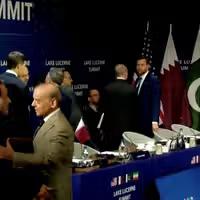
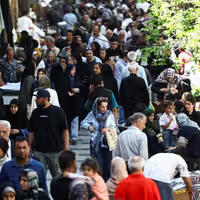
Iran’s foreign ministry condemned a joint statement by the G7 countries the previous day saying they would enforce new UN sanctions against Iran and blaming Tehran for a diplomatic impasse over its nuclear program.
Foreign ministry spokesman Esmail Baghaei called the statement “hypocritical and a distortion of reality.”
“These seven countries, because of their hypocritical and irresponsible actions regarding the rule of law, peace, and international security, lack any moral authority to lecture others,” Baghaei added.

Washington is seeking to overthrow Iran’s ruling system after rejecting Tehran’s proposal for direct talks, the Revolutionary Guards-affiliated Javan newspaper said, accusing the United States of trying to achieve its goals through economic pressure and fueling domestic unrest instead of military action.
“The US goal is to overthrow the system in Iran. Since it does not see war as a suitable method, it wants to achieve this through soft measures such as sanctions and creating public discontent,” the paper said.
The newspaper also called US President Donald Trump’s Middle East envoy, Steve Witkoff, a “fraud,” adding that those who believed negotiations could solve Iran’s economic problems should now recognise that Washington never intended to engage in a way that benefits Tehran, and the country must find an alternative path.
Iran's Foreign Minister Abbas Araghchi told his Pakistani counterpart in a phone call on Thursday that UN Security Council Resolution 2231 which authorized a 2015 nuclear deal is set to end on October 18, 2025 and rejected the snapback of international sanctions triggered by the UK, France and Germany which went into effect on September 28.

Iran’s rial weakened on Thursday to about 1,180,000 per US dollar on Tehran’s unofficial market, roughly a week after the United Nations reimposed snapback sanctions, as President Masoud Pezeshkian urged cost-cutting and efficiency to shield households.
Traders also quoted the euro around 1,386,500 rials and the pound at about 1,591,200.
The UN measures, restored over Iran’s nuclear program, have added pressure to an economy already struggling with high inflation and repeated supply strains. Iran denies seeking nuclear weapons.
Visiting Bandar Abbas on Thursday, Pezeshkian said savings and better management could soften the blow.
“We can organize livelihoods, living conditions and housing by saving 10% in costs, which is equivalent to $16–18 billion a year,” he said.
“They say with snapback, they will sanction you, while we have sanctioned ourselves,” he added, arguing that curbing waste and relying less on oil and gas would blunt external pressure.
“They scare us with snapback because we tied our life to oil and gas,” he said. “I think of a day when we have neither oil nor gas. Should we die?”
The president called for practical conservation across government. He said employees and managers could work in smaller offices and avoid unnecessary energy use, recalling that at the United Nations “the corridor was partitioned and managers worked there in 2-by-3 rooms, next to the Secretary-General’s office. In Iran, everyone has a room, and the secretary has a room. You can avoid keeping all the lights on.”
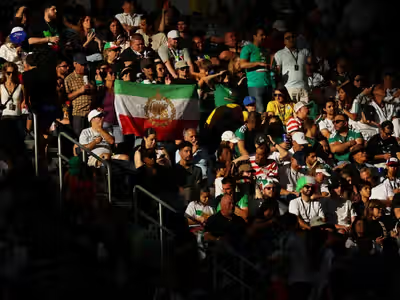
The Iranian rial plunged further on Thursday as the US dollar crossed 1.18 million rials in Tehran’s open market, continuing its climb following the activation of the snapback mechanism.
The rate had already risen by over ten thousand rials Wednesday evening, hitting 1.164 million rials.

The Wall Street Journal reported that a senior Arab government official close to the Trump administration has urged Washington to avoid further military confrontation with Iran, warning that renewed conflict with Israel could destabilize the region and that de-escalation should be the priority.
“The region today cannot go through the same Iranian-Israeli war or the other wars of the last two years. The cost is too high,” the official said, adding that he is advising US counterparts that de-escalation is the only alternative.
He said Iran’s weakened state is a reason for caution and argued that fresh strikes risk triggering instability reminiscent of post-Saddam Iraq.
“Diplomacy has to be the way forward,” the official said, according to the WSJ.