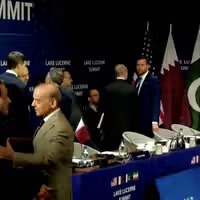
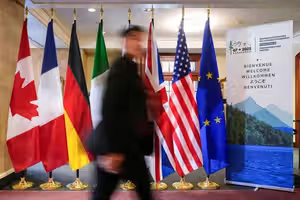
The commander of the Revolutionary Guards’ ground forces urged resilience against adversaries, saying Iran should not be deterred by advanced foreign weapons and must rely on the Quran to drive technological progress.
“The false front has come with all its power and tools, so we must also stand firm,” Mohammad Karami said on Thursday.
“If we see some advanced equipment from the enemy, we should not retreat,” Karami said.

Any future aggression would draw heavier, more precise and deadlier retaliation, marking a new, costlier phase of confrontation, said Iran's Revolutionary Guards on the anniversary of Tehran’s second direct operation against Israel.
“The era of cost-free threats and regret-inducing responses by the enemy has ended,” the IRGC said in a Thursday statement.
“Any new mistake or possible aggression from the enemy’s camp will receive a heavier, more precise and deadly response, a response that will be capable of bringing Israel closer to the promised hell,” the Guards added.

Wasteful spending and mismanagement have damaged the country more than any threat of renewed international sanctions, said Iran's President Masoud Pezeshkian on Thursday.
He said cutting state costs could free billions for social needs.
“We have these resources, yet we are hungry,” Pezeshkian said during his visit to Hormozgan province.
The president added that a ten percent reduction in government expenses could amount to 16 to 18 billion dollars annually, enough to improve housing and livelihoods.


Turkey has frozen the assets of dozens of individuals and entities tied to Iran’s uranium enrichment and nuclear activities, moving in lockstep with the latest UN sanctions against Tehran.
The decision, signed by President Recep Tayyip Erdogan, extends to organizations across Iran’s energy, shipping, banking, and research sectors.
The Atomic Energy Organization of Iran, Bank Sepah and several firms involved in nuclear fuel production and uranium conversion are among the most significant entities blacklisted by Ankara.
Other sanctioned entities include Isfahan Nuclear Fuel Research and Production Center (NFRPC), Isfahan Nuclear Technology Center (ENTC), First East Export Bank, Irano Hind Shipping Company, IRISL Benelux NV, Jaber Ibn Hayyan, Karaj Nuclear Research Center, Kavoshyar Company, Mesbah Energy Company, Modern Industries Technique Company, Novin Energy Company, Agriculture and Medical Nuclear Research Center, Pars Trash Company, Pishgam Energy Industries, South Shipping Line Iran and Tamas Company.
The decision was made official on Wednesday when it was published in Turkey’s Official Gazette — the government’s legal record of new laws and decrees.
The measure updates earlier Turkish actions from 2006, 2015, and 2021 that implemented United Nations Security Council resolutions on Iran.
The latest decree underscores Ankara’s alignment with a renewed global pressure campaign targeting Tehran’s nuclear ambitions.
The coordinated steps follow the United Nations’ recent reimposition of sanctions against Tehran through the so-called snapback mechanism.
The sanctions had been lifted under the 2015 nuclear deal, but European powers triggered the mechanism citing Tehran’s failure to comply with its obligations.
Turkey’s decision to free Iran’s assets signaled its support for the broader international effort to contain Iran’s nuclear and military programs, even as Ankara maintains complex trade and diplomatic ties with its eastern neighbor.

Iran’s Supreme Leader Ali Khamenei blocked any potential signal of compromise before President Masoud Pezeshkian even landed in New York—a move some saw as a reckless gamble but in fact a calculated strategy rooted in decades of survival.
By calling negotiations with the United States “pointless” and “harmful,” the 86-year-old theocrat closed the door in advance, after which Pezeshkian delivered one of the harshest speeches of his career on the UN rostrum.
The choreography left no doubt: foreign policy remains Khamenei’s domain, and presidents, however reform-minded are confined to carrying out his script.
Since taking power in 1989, Khamenei has built a structure designed to withstand shocks. He has consolidated control over the military, judiciary and intelligence services, silenced dissent before it could spread, and constructed a security state that has absorbed everything from economic collapse to mass protest.
Khamenei’s doctrine is simple: so long as no foreign power places “boots on the ground” in Tehran, the Islamic Republic can survive.
Regimes in neighboring Iraq and Afghanistan collapsed only when foreign armies physically invaded. Iran’s ruler wagers that Israel lacks the capacity — and Washington the will — to do the same in Iran.
Weapon of time
Airstrikes, sabotage and cyberattacks may wound the system, but the Islamic Republic has bunkers intelligence tools designed to outlast them. This is the logic of endurance: time, not compromise, is Tehran’s strongest weapon.
Yet the June war with Israel revealed how fragile that calculation may be. Precision strikes and AI-driven targeting allowed Israel to decapitate Iranian command structures in hours.
For the first time, senior officers rather than foot soldiers became the primary casualties, along with hundreds of civilians. In such a war, no bunker guarantees safety.
Khamenei’s confidence is shaped not only by military assumptions but also by diplomacy.
One formative lesson came in 1997, when a German court found Iran responsible for the assassinations of three dissidents in a Berlin restaurant. European states briefly withdrew their ambassadors in protest, only to quietly return them months later.
For Khamenei, this was proof that Europe’s resolve is fleeting, its economic and political interests overriding its outrage. He has leaned on that lesson ever since.
Sanctions, what sanctions?
Even now, as the snapback mechanism is reactivated, he assumes enforcement will fray. He expects Europe’s divisions and Washington’s caution to leave loopholes that allow Iran to keep exporting oil, especially to China and India, at discounted rates.
Sanctions, in the octogenarian’s view, are never airtight. They are survivable obstacles, not existential threats.
Khamenei’s rhetoric serves multiple aims: it projects deterrence abroad by drawing red lines; reassures loyalists at home by projecting strength; frames any Western retreat as weakness; and, above all, buys time.
The longer Iran resists, the thinking goes, the more likely international resolve will weaken—as it has before.
But the strategy is not without risk.
Internal unrest can erupt faster and wider this time. Sanctions may dig deeper into the economy, hollowing out the state’s support base. Warfare itself has changed in ways that undercut the assumption that endurance alone ensures survival.
Khamenei continues to rely on the playbook that has carried him through three decades: repression at home, resilience abroad and a conviction that the West will ultimately step back.
The gamble is that history will repeat itself. The danger is that this time, it may not.
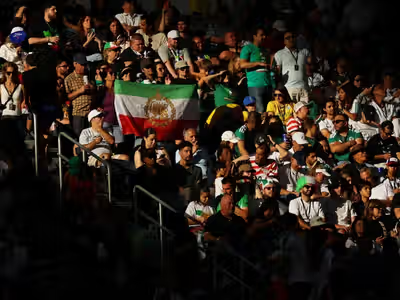

The G7 grouping of wealthy democracies plus the European Union on Wednesday blamed Iran for newly-imposed international sanctions and urged Tehran to resume talks with Washington and allow inspections of its nuclear sites.
Meanwhile, Russia, itself heavily sanctioned by the West announced it would flout the new UN sanctions it unsuccessfully opposed at the UN Security Council last week.
“The E3 and the United States have repeatedly offered diplomatic avenues in good faith to Iran to avoid the snapback and reach a durable and comprehensive negotiated resolution,” the G7 said in a joint statement.
It was signed by the foreign ministers of Canada, France, Germany, Italy, Japan, the United Kingdom, and the United States, along with the EU High Representative.
'Diplomacy essential'
The statement referred to the European troika of Britain, Germany and France which invoked the return of UN sanctions citing what they called Iran’s lack of transparency on its nuclear program.
“Diplomacy remains essential now that the UNSC process has led to the reimposition of sanctions. We call on Iran to refrain from any escalatory action, immediately engage in direct talks with the United States, and make demonstrable progress toward fully meeting its nuclear non-proliferation obligations,” the ministers said.
They urged Iran to fully cooperate with the International Atomic Energy Agency (IAEA) without delay, including by implementing its Comprehensive Safeguards Agreement under the Nuclear Non-Proliferation Treaty (NPT).
“This includes allowing IAEA inspections to resume in all nuclear facilities and accounting for all nuclear material it holds,” the statement said.
Iran denies seeking a nuclear weapon and has called the sanctions a violation of international law and its sovereignty.
Russia set to defy sanctions
Russia announced on Wednesday it will not recognize or implement the reinstated UN sanctions on Iran.
“We’ll be living in two parallel realities, because for some snapback happened, for us it didn’t,” Moscow’s UN envoy Vassily Nebenzia told reporters.
Russia’s UN envoy also claimed the move could serve as a pretext for another round of military strikes on Iran, referencing the 12-day war during which Israel and the United States targeted major nuclear sites.
“This development is fraught with the risk of major escalation around Iran, because it opens the door for those countries who want to finish off Iran’s nuclear program,” Nebenzia added.
Iran, as a signatory to the NPT, is obligated to host IAEA inspections of its nuclear facilities.
Tehran has warned the return of UN sanctions threatens its collaboration with the IAEA, and the diplomatic impasse over Iran's disputed nuclear program appears to have no end in sight.