Iran’s rial hits record low after UN snapback sanctions
Iran’s currency fell to a record low in Tehran’s unofficial market on Wednesday, days after the reimposition of UN snapback sanctions, trading at about 1,151,000 rials per US dollar.
The euro stood at 1,352,200 rials and the pound at 1,548,300, according to local exchange rates.
The American flag and other flags are displayed on a sign at a currency exchange in Tehran, Iran, September 27, 2025.
Iran’s government will approve a response plan on Sunday to the reimposition of UN snapback sanctions, state media quoted spokesperson Fatemeh Mohajerani as saying.
She told reporters after Wednesday’s cabinet meeting that the plan assigns specific tasks to each ministry “to minimize pressure on people’s lives.”
Mohajerani said Tehran had sought to avert the measure through diplomacy, including a last-minute proposal to delay the sanctions by 45 days, but the effort was blocked by what she described as lobbying pressure on European powers.
She added that Tehran had expressed readiness to hold a meeting in New York with Britain, France, Germany, the International Atomic Energy Agency (IAEA) and US Middle East envoy Steve Witkoff, but that “the proposal was not accepted or the counterparts did not attend.”
She added that Foreign Minister Abbas Araghchi briefed the cabinet on his New York visit, saying Iran’s push to scrap or delay the snapback failed after Western rejection of its proposals.
At least 26 students have died in 13 accidents involving university buses across Iran over the past decade, the daily Ham-Mihan reported on Wednesday, reviving concerns about road safety and vehicle standards.
The paper said the latest crash occurred on the Semnan–Sorkheh road when a minibus carrying paramedical students overturned, killing two and injuring 11, three of whom remain in intensive care. Police blamed driver negligence and failure to yield by a truck driver.
Experts told the paper many of the vehicles used by universities are city buses not designed for intercity travel, and often operate without permits.
Fatal accidents in recent years include a 2018 bus crash at Islamic Azad University’s Science and Research branch in Tehran that killed nine, and a 2024 accident in Gilan province.
According to official figures, more than 19,000 people died in traffic accidents in Iran last year, with half of the fatalities recorded in just seven provinces. Health authorities say up to 800,000 people are injured annually, most under the age of 30.
Officials and transport safety experts have pointed to poorly maintained roads, broken speed cameras, low-quality vehicles and lack of oversight as key causes. “Road accidents happen every day, but when the victims are students, society takes notice,” Ham-Mihan quoted safety specialist Hormoz Zakari as saying.
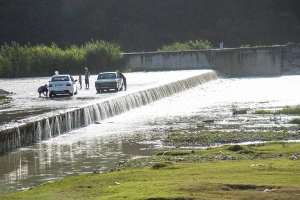
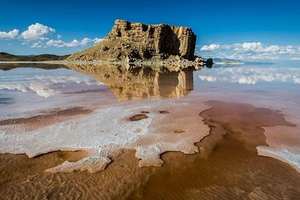
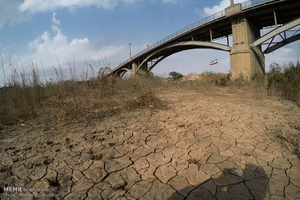
Iran’s deepening water emergency is straining both cities and rural communities, with one of Tehran’s key reservoirs taken offline and the once-vast Lake Urmia reduced to a salt desert, forcing migration and sparking deadly disputes over dwindling supplies.
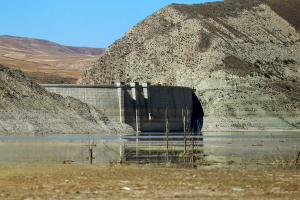
Authorities confirmed this week that the MamlouDam, one of five major reservoirs supplying the capital, has fallen below usable levels.
Only 8% of its 250 million cubic meter capacity remains, with storage at 19 million cubic meters -- below the “dead volume” threshold of 28 million.
The facility, built in 2007 east of Tehran, is officially out of operation for the first time, leaving the capital more reliant on other reservoirs already at historic lows.
The crisis extends far beyond Tehran. In northwestern Iran, Lake Urmia, once the Middle East’s largest saltwater lake, has lost more than 90% of its volume and surface area.
Environmental experts warned on Wednesday that “salt storms” from the dried lakebed are beginning to hit surrounding provinces, damaging crops, raising health risks, and prompting what officials describe as the early stages of forced relocations from nearby towns and villages.
People walk across the dried basin of Lake Urmia.
Lawmakers acknowledge that years of mismanaged agriculture, unchecked groundwater pumping and weak enforcement of water-use reforms have accelerated the decline.
“The lake is like a critical patient in intensive care,” said Reza Hajikarim, head of Iran’s Water Industry Federation, warning that existing plans were not implemented to save the lake. He urged rapid cuts in water-intensive farming and enforcement of ecological water rights, saying “we do not need new solutions, only execution of the old ones.”
“Salt storms from Lake Urmia have now begun, and evacuations are starting in provinces surrounding the lake. The salt storms and rising temperatures caused by the sun’s reflection are among the consequences of Urmia’s desiccation, undermining life and habitability in the region. This is only the beginning,” he added.
Social strains are mounting. In recent weeks, a violent clash over irrigation rights near Urmia left one dead and 13 injured, highlighting how scarcity is fueling local disputes.
Similar unrest erupted earlier this year in central Iran, where farmers damaged a pipeline transferring water from Isfahan to Yazd. Rights groups say protests over blackouts and dry taps in cities such as Sabzevar were also met with arrests and tear gas.
Experts stress the problems are largely man-made. Climatologist Nasser Karami has described the situation as an “engineered drought,” arguing that mismanagement, subsidies for water-intensive crops, and expansion of militarized agriculture -- not climate alone -- lie at the root.
Agriculture consumes over 85% of Iran’s water while contributing less than 12% of GDP, and exports such as pistachios and melons remain state priorities despite groundwater depletion.
Other ecosystems are also under threat. Officials warn that Anzali Wetland on the Caspian coast faces collapse without $300 million in restoration funds, after decades of sewage, sediment and pollution inflows.
Iran’s Meteorological Organization says the country has endured two decades of near-continuous drought, but specialists argue that structural reforms -- diverting water from agriculture to households, modernizing irrigation, reducing waste, and enforcing groundwater limits -- could stabilize supplies.
Airmen inspect a Massive Ordnance Penetrator bomb at Whiteman Air Base in Missouri in a photo released by the US Air Force.
Boeing is set to receive a contract worth up to $123 million to replace the 14 massive bunker-buster bombs expended during June’s US strikes on Iran’s nuclear facilities, Bloomberg reported on Tuesday,citing a Pentagon budget document and three people familiar with the matter.
The weapon, known as the GBU-57 Massive Ordnance Penetrator (MOP), weighs 30,000 pounds (13,600 kg), measures six meters (20 feet) in length, and is considered the world’s largest precision-guided conventional bomb. It can penetrate up to 200 feet underground before detonating, according to the US Air Force.
The Pentagon disclosed in an August budget document that it had reallocated $123 million from operations and maintenance accounts to Air Force munitions procurement, saying the funds were needed to replace munitions used in “Operation Midnight Hammer,” the code name for the strikes.
The document described the operation as being conducted “in support of Israel.”
During the June raid, US B-2 bombers deployed 12 of the MOPs against the Fordow nuclear enrichment facility, with President Donald Trump telling a gathering of military leaders outside Washington that the weapons achieved “total obliteration,” and that “every single one of them hit its target.”
On June 22, Trump ordered airstrikes on nuclear sites at Isfahan, Natanz, and Fordow two days before brokering a ceasefire to a 12-day war in June between Iran and Israel.
The bombs are manufactured with components from several facilities. The bomb bodies are forged at the McAlester Army Ammunition Plant in Oklahoma, where the Army has been expanding production capacity to triple monthly output.
Personnel there fill casings with explosives and assemble the warhead and fuse. Boeing supplies the tail kit, which provides navigation and guidance systems, and has integrated the bomb for use with the B-2 stealth bomber.
The Air Force has disclosed few details about the program but acknowledged in 2015 that it had contracted 20 units with Boeing.
The new replacement contract is separate from an agreement the service awarded in late August to Applied Research Associates Inc. and Boeing to design and prototype the next generation of the weapon.
A senior commander at Iran’s Khatam al-Anbiya central headquarters on Wednesday said Tehran would increase the range of its missiles “to wherever necessary” and stressed the country was prepared to defend itself.
Mohammad Jafar Asadi, deputy for inspections at the Khatam al-Anbiya command, was quoted by Fars news agency as saying “with the resources we have, we are 100% ready; however we will not be the first to start a war, but if anyone invades our country we will respond decisively.”
Responding to European calls to restrict Iran’s missile program, he said: “I can only say they were wrong to make such claims.”
The Khatam al-Anbiya headquarters is the top operational command that plans and coordinates Iran’s armed forces.
Asadi said Iran’s missile deterrent had been decisive in past confrontations and would be extended as needed in response to perceived threats, Fars added.
Iranian missiles have a maximum range of 2,000 km, which officials have previously said is sufficient for the country’s defense, as it covers the distance to Israel.