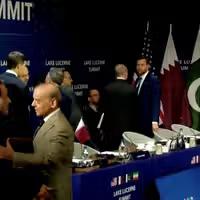
The G7 grouping of wealthy democracies on Wednesday said it backed new European-triggered international sanctions on Iran and urged Tehran to negotiate with the United States and open up its nuclear sites to inspections.
“The E3 and the United States have repeatedly offered diplomatic avenues in good faith to Iran to avoid the snapback and reach a durable and comprehensive negotiated resolution," the G7 said in a joint statement.
It referred to the European troika of Britain, Germany and France which invoked the return of UN sanctions citing Iran's alleged lack of transparency on its nuclear program.
"Diplomacy remains essential now that the UNSC process has led to the reimposition of sanctions. We call on Iran to refrain from any escalatory action, immediately engage in direct talks with the United States and make demonstrable progress towards fully meeting its nuclear non-proliferation obligations."
“Iran must fully cooperate with the IAEA without any further delay and fully implement its obligations under its NPT-required Comprehensive Safeguards Agreement. This includes allowing for IAEA inspections to resume in all its nuclear facilities and accounting for all of the nuclear material it holds," it added.
Iran is a signatory of the nuclear non-proliferation treaty (NPT) and is obligated to host inspections of its nuclear sites by the International Atomic Energy Agency (IAEA).

The majority of disinformation circulated across global digital platforms during the Israel-Iran war in June served Iran's narrative, a new report by the Israel Internet Association (IIA) found.
The study, titled "Ballistic Fakes: Disinformation and Fact-Checking Efforts during the Israel-Iran War", analyzed the work of fact-checking organizations in 23 countries.
Among the most active were Misbar in Jordan, AFP in France, Newschecker in India and Teyit in Turkey — each contributing a significant volume of war-related fact-checks.
In assessing the motivations behind the spread of false information, the IIA asked which party might gain from the dissemination of misinformation and coded each answer.
It found that in 72% of cases, the content was likely to serve Iranian strategic narratives, while 24% appeared to support the Israeli side. The remaining 4% could not be clearly classified, the research said.
Video content accounted for 85% of all disinformation reviewed. Of this, 82% was found to be outdated, 68% misattributed geographically, and 77% presented with false contextual framing. 17% of video content was generated using artificial intelligence, and 12% was entirely fabricated.
“A large proportion of the fact-checks (71%) concerned false connections and decontextualized content,” the report said. “In these instances, genuine material was accompanied by misleading captions or narrative framing, producing an effect contrary to the original meaning.”
One example cited was a demonstration in San Diego during the war. While the event was accurately located and timed, it was misrepresented online as a protest related to the Israel–Iran conflict. It was images from a domestic protest known as "No Kings" against US President Donald Trump's domestic policies.
Other examples included an image of a hotel fire in China from 2009 portrayed as the aftermath of an Iranian missile strike in Israel as well as footage of an Israeli strike in Lebanon circulated as evidence of Iranian attacks.
Generative AI
In total, the report found that a fifth of fact-checked items were created using generative AI, primarily fabricated images and videos. These included depictions of destroyed Israeli infrastructure, the downing of Israeli aircraft, an Israeli soldier allegedly surrendering and fabricated scenes of domestic anti-war protests.
Fabricated claims, entirely invented events, actions or quotes, made up 15% of the sample. These included false reports of Israeli aircraft crashes in Iran, captured Israeli pilots, and nuclear attacks by both sides.
An additional 2% of items involved impersonation. These included a forged resignation letter from Iran’s president and a deepfake video purporting to show Russian President Vladimir Putin declaring support for Iran.
The most common theme in disinformation content concerned physical damage to infrastructure, featuring in 44% of the items reviewed.
False reports included alleged Iranian missile strikes on Tel Aviv’s Azrieli Towers and Israeli attacks on Tehran’s airport.
Many items focused on explosions, often accompanied by misattributed images or video clips. One widely circulated example included a fabricated report of an attack on the Fordow nuclear site, while another falsely described an explosion in Haifa Bay.

The US Treasury on Wednesday imposed sanctions on 38 individuals and companies from Iran and China it accused of advancing Iran’s military procurement including surface-to-air missiles and US-manufactured helicopter parts.
The sanctions, the Treasury said in a statement, focus on networks that facilitate the transfer of sensitive goods and technology to Iran’s Ministry of Defense and Armed Forces Logistics (MODAFL).
“Under President Trump’s leadership, we will deny the regime weapons it would use to further its malign objectives,” Treasury Secretary Scott Bessent said in a statement.
The Treasury also reminded UN member states that UN sanctions on Iran were reimposed as of September 28 and must be enforced.
These measures include restrictions on Iran’s nuclear, missile and arms programs, embargoes, export controls, travel bans, asset freezes and prohibitions on entities like banks involved in Iran’s weapons activities.
Sanctioned Iranian entities include Abzar-e Daghigh-e Taha Company, Beh Joule Pars Commercial Engineering Company and Business United Unipessoal Lda, which is tied to Pasargad Helicopter Company.
Several Chinese-based firms such as Westcom Technology Co Limited, UIY Inc, Rocket PCB Solution Ltd, and Rayming Technology were also designated.
The list further names Iranian individuals such as Mehdi Shirazi Shayesteh and Mehdi Nili Ahmadabadi, along with Chinese nationals Liu Baojuan and Sun Zhaola.
The new designations come as part of Washington’s broader effort to enforce the return of UN sanctions reactivated by European powers in response to what they say is Tehran's defiance of negotiations and nuclear inspections.
Iran denies seeking a nuclear bomb and has rejected sanctions and curbs on its conventional weapons as illegal violations of its sovereignty.
US officials argue that tightening sanctions is essential to block Tehran from acquiring advanced technologies that could bolster both its firepower and potential nuclear capabilities.

Iran’s Expediency Council has agreed to conditionally join a United Nations convention aimed at preventing and criminalizing the financing of terrorism, the body’s spokesperson said on Wednesday.
“After holding four public sessions and joint commission meetings, the Expediency Council agreed in today’s session for Iran to join the CFT convention on a conditional basis,” Mohsen Dehnavi wrote on X.
The International Convention for the Suppression of the Financing of Terrorism (CFT), adopted by the United Nations in 1999, is designed to prevent and criminalize the financing of terrorist activities worldwide.
Iran's Expediency Council, overseen by Supreme Leader Ali Khamenei, mediates disputes between parliament and the Guardian Council, a hard-line body that vets laws and candidates.
The move comes just days after UN sanctions on Iran were reinstated on September 28.
In April, over 150 hardline lawmakers urged the Council to reject the convention.
In a letter to Expediency Council chairman Sadegh Amoli Larijani, they argued that any approval—conditional or not—should wait until the risk of the reimposition of UN triggered by the snapback mechanism is entirely eliminated.
In May, the Council conditionally approved the country’s accession to the Palermo Convention, one of the two key legislative items tied to the Financial Action Task Force (FATF) standards aimed at addressing money laundering and terrorism financing.
An annual US State Department report last December, called Iran the world's leading state sponsor of terrorism for the 39th year running, accusing Tehran of using its allied armed groups to destabilize the Middle East.
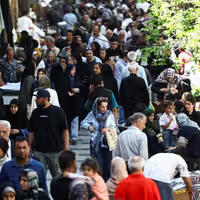
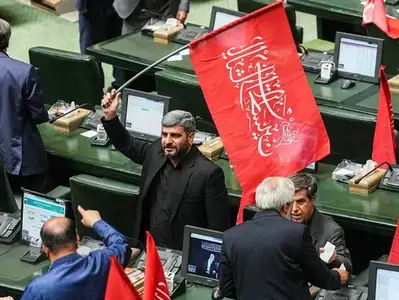
Iranian lawmaker Jabbar Kouchaki-Nejad dismissed the return of UN sanctions on the country as “psychological warfare,” saying Tehran is “managing the situation through domestic measures,” without elaborating.
The United States on Wednesday issued new Iran-related sanctions on several individuals and entities from Iran and China it accuses of advancing Tehran's military weaponry, the Treasury Department said.
“In support of the United Nations Security Council snapback of Iran sanctions, Treasury is targeting Iranian weapons procurement networks that help maintain its ballistic missile and military aircraft programs,” Treasury Secretary Scott Bessent said in a statement.
“The Iranian regime’s backing of terrorist proxies and its pursuit of nuclear weapons threatens the security of the Middle East, the United States, and our allies around the world,” Bessent added.
Bessent said that under President Donald Trump’s leadership, Washington “will deny the regime weapons it would use to further its malign objectives.”