Ali Saeedi, head of Supreme Leader Ali Khamenei’s political-ideological office, said on Wednesday that there were differing views on whether Israel might launch another attack on Iran.
“Some say the enemy may commit another madness, while others believe Israel’s internal turmoil prevents it from taking action,” he told ILNA.
Saeedi added that while “the armed forces must be 100% ready,” ordinary people should “continue with their lives and not be agitated.”
He said Iran had seen “no signs of an enemy attack” at present.


Jailed Georgian opposition leaders have accused the ruling Georgian Dream party of forging closer ties with Iran and urged Britain to expand sanctions on its allies, the Guardian reported on Wednesday.
In a letter to UK Foreign Secretary Yvette Cooper from prisons in Rustavi, south-east of Tbilisi, seven politicians warned of what they called an “unprecedented expansion” of Iranian influence in Georgia.
They wrote: “We … respectfully urge you to consider extending sanctions to these individuals, their entities, and their family members, to ensure they can no longer enjoy the benefits of the UK’s democratic society while working to erode it.”
As evidence, the letter cited solidarity expressed by Deputy Foreign Minister Aleksandre Khvtisiashvili at Iran’s embassy after US strikes on nuclear facilities, and Prime Minister Irakli Kobakhidze’s recent visit to Tehran, where, they said, he “stood alongside leaders of Hamas and Hezbollah as chants of ‘Death to America’ echoed.”
The politicians -- including Zurab Japaridze, leader of the pro-EU Girchi–More Freedom party -- also accused Georgian Dream and its founder, billionaire Bidzina Ivanishvili, of “full state capture” and compared conditions to Russia, alleging more than 60 political prisoners and violent crackdowns on protests.
“More than 500 peaceful demonstrators … were brutally beaten, including many who suffered broken facial bones,” they wrote.
Imedi TV, Georgia’s most-watched broadcaster owned by London-based Hunnewell Partners and named in the letter, rejected the claims as “unfounded,” saying it was independent and allowed vigorous debate.
“Being sympathetic to Georgian Dream is not a crime,” a spokesperson said. “We strongly reject the allegation that Imedi TV is a propaganda outlet.”
Georgian Dream, which says it is pro-European, has been accused by critics of realigning the country with Moscow’s interests and eroding democratic standards.
The UK has previously sanctioned Georgian judges and politicians, as well as media figure Levan Vasadze for spreading pro-Russian disinformation. The opposition leaders said London’s measures had “real impact” but called for wider action against Ivanishvili’s network.
In July, US-based defense policy think tank Jamestown Foundation wrote of the growing ties between Tbilisi and Tehran, with trade and commerce a key incentive to the former Soviet state.
“Georgia’s Deputy Foreign Minister Alexander Khvtisiashvili expressed solidarity with Iran following the Israeli airstrikes, sparking outrage from the Israeli Embassy and raising domestic accusations of Georgian Dream acting as a regional proxy for Tehran," its author, Beka Chedia, wrote.
“Russia is intensifying efforts to pull Georgia into strategic regional frameworks, positioning Iran as a key partner, which aligns with Georgian Dream’s pivot away from the West. Iran’s connectivity and economic presence in Georgia has been rapidly growing under Georgian Dream, marked by a surge in Iranian companies, residents, and trade.”
Data from the National Statistics Office of Georgia says that over the past 10 years, 10,000 Iranian citizens have arrived in Georgia for permanent residence and following the rise to power of Georgian Dream, the number of private companies established in Georgia by Iranian citizens has increased significantly.
Jamestown Foundation research says that in 2010 there were only 84 Iranian companies registered in Georgia but between 2013 and 2024, 9,300 were registered, including 125 new companies registered in 2025.
In the wake of US sanctions against Iran, Georgia has also become a key market for Iranian goods such as food, plastic products and construction materials. Of the total trade turnover of $322 million between Georgia and Iran in 2024, $285 million was imported products from Iran to Georgia.
Georgian NGO Civic IDEA reported earlier this year that “as diplomatic ties between the Georgian Dream government and Iran have grown closer, several Georgian-registered companies have emerged with direct links to Iran’s Ministry of Defense and the Armed Forces Logistics Agency.”
The NGO said: “Iranian businessmen are using Georgia as a strategic transit point to evade international sanctions and channel funds back to the Islamic Republic of Iran.”

Iran’s currency fell to a record low in Tehran’s unofficial market on Wednesday, days after the reimposition of UN snapback sanctions, trading at about 1,151,000 rials per US dollar.
The euro stood at 1,352,200 rials and the pound at 1,548,300, according to local exchange rates.

Iran’s government will approve a response plan on Sunday to the reimposition of UN snapback sanctions, state media quoted spokesperson Fatemeh Mohajerani as saying.
She told reporters after Wednesday’s cabinet meeting that the plan assigns specific tasks to each ministry “to minimize pressure on people’s lives.”
Mohajerani said Tehran had sought to avert the measure through diplomacy, including a last-minute proposal to delay the sanctions by 45 days, but the effort was blocked by what she described as lobbying pressure on European powers.
She added that Tehran had expressed readiness to hold a meeting in New York with Britain, France, Germany, the International Atomic Energy Agency (IAEA) and US Middle East envoy Steve Witkoff, but that “the proposal was not accepted or the counterparts did not attend.”
She added that Foreign Minister Abbas Araghchi briefed the cabinet on his New York visit, saying Iran’s push to scrap or delay the snapback failed after Western rejection of its proposals.


At least 26 students have died in 13 accidents involving university buses across Iran over the past decade, the daily Ham-Mihan reported on Wednesday, reviving concerns about road safety and vehicle standards.
The paper said the latest crash occurred on the Semnan–Sorkheh road when a minibus carrying paramedical students overturned, killing two and injuring 11, three of whom remain in intensive care. Police blamed driver negligence and failure to yield by a truck driver.
Experts told the paper many of the vehicles used by universities are city buses not designed for intercity travel, and often operate without permits.
Fatal accidents in recent years include a 2018 bus crash at Islamic Azad University’s Science and Research branch in Tehran that killed nine, and a 2024 accident in Gilan province.
According to official figures, more than 19,000 people died in traffic accidents in Iran last year, with half of the fatalities recorded in just seven provinces. Health authorities say up to 800,000 people are injured annually, most under the age of 30.
Officials and transport safety experts have pointed to poorly maintained roads, broken speed cameras, low-quality vehicles and lack of oversight as key causes. “Road accidents happen every day, but when the victims are students, society takes notice,” Ham-Mihan quoted safety specialist Hormoz Zakari as saying.

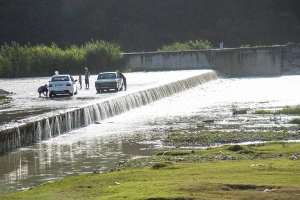
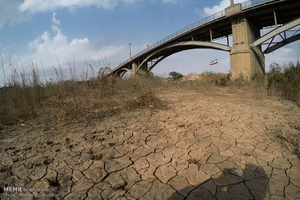
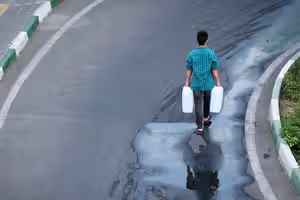
Iran’s deepening water emergency is straining both cities and rural communities, with one of Tehran’s key reservoirs taken offline and the once-vast Lake Urmia reduced to a salt desert, forcing migration and sparking deadly disputes over dwindling supplies.
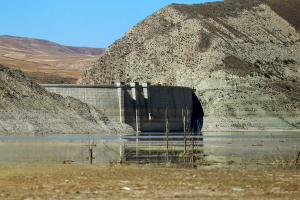
Authorities confirmed this week that the MamlouDam, one of five major reservoirs supplying the capital, has fallen below usable levels.
Only 8% of its 250 million cubic meter capacity remains, with storage at 19 million cubic meters -- below the “dead volume” threshold of 28 million.
The facility, built in 2007 east of Tehran, is officially out of operation for the first time, leaving the capital more reliant on other reservoirs already at historic lows.


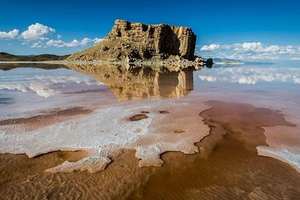
The crisis extends far beyond Tehran. In northwestern Iran, Lake Urmia, once the Middle East’s largest saltwater lake, has lost more than 90% of its volume and surface area.
Environmental experts warned on Wednesday that “salt storms” from the dried lakebed are beginning to hit surrounding provinces, damaging crops, raising health risks, and prompting what officials describe as the early stages of forced relocations from nearby towns and villages.

Lawmakers acknowledge that years of mismanaged agriculture, unchecked groundwater pumping and weak enforcement of water-use reforms have accelerated the decline.
“The lake is like a critical patient in intensive care,” said Reza Hajikarim, head of Iran’s Water Industry Federation, warning that existing plans were not implemented to save the lake. He urged rapid cuts in water-intensive farming and enforcement of ecological water rights, saying “we do not need new solutions, only execution of the old ones.”
“Salt storms from Lake Urmia have now begun, and evacuations are starting in provinces surrounding the lake. The salt storms and rising temperatures caused by the sun’s reflection are among the consequences of Urmia’s desiccation, undermining life and habitability in the region. This is only the beginning,” he added.


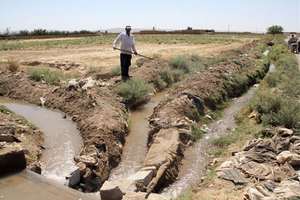
Social strains are mounting. In recent weeks, a violent clash over irrigation rights near Urmia left one dead and 13 injured, highlighting how scarcity is fueling local disputes.
Similar unrest erupted earlier this year in central Iran, where farmers damaged a pipeline transferring water from Isfahan to Yazd. Rights groups say protests over blackouts and dry taps in cities such as Sabzevar were also met with arrests and tear gas.
Experts stress the problems are largely man-made. Climatologist Nasser Karami has described the situation as an “engineered drought,” arguing that mismanagement, subsidies for water-intensive crops, and expansion of militarized agriculture -- not climate alone -- lie at the root.


Agriculture consumes over 85% of Iran’s water while contributing less than 12% of GDP, and exports such as pistachios and melons remain state priorities despite groundwater depletion.
Other ecosystems are also under threat. Officials warn that Anzali Wetland on the Caspian coast faces collapse without $300 million in restoration funds, after decades of sewage, sediment and pollution inflows.
Iran’s Meteorological Organization says the country has endured two decades of near-continuous drought, but specialists argue that structural reforms -- diverting water from agriculture to households, modernizing irrigation, reducing waste, and enforcing groundwater limits -- could stabilize supplies.