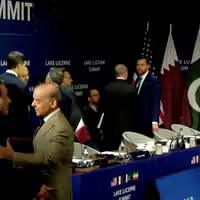
An Iranian foreign ministry official denied claims that the European Union has frozen the Central Bank of Iran’s assets, saying the accounts concerned were inactive and held little or no funds.
“The claims about the Central Bank’s assets being frozen are not true,” Hamid Ghanbari, deputy for economic diplomacy at the foreign ministry, told the official Islamic Republic News Agency (IRNA).
“These accounts were practically unused and have now simply been added to the sanctions list.”
Ghanbari said the reimposition of UN sanctions is not expected to have a major immediate impact, as most European companies have already complied with US measures since Washington’s withdrawal from the 2018 nuclear deal.

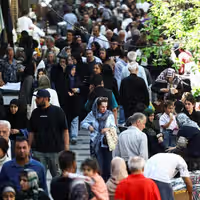
Pop concerts and late summer parties are spreading across Iran as music, as dance and fashion become battlegrounds testing the limits of state control.
Videos on social media show unveiled women dancing and singing freely at these events, some of them open to the public. In Tehran’s Grand Bazaar, models recently walked a red-carpet fashion show with no hijab in sight.
Just a few years ago, such scenes brought swift arrests. Most seem to meet no retaliation, and the fashion show earned only a limp judicial summons.
Some view these as proof of state retreat under social pressure. Others say it’s not real change but fleeting gestures to distract from economic hardship and the anniversary of the 2022–23 Woman, Life, Freedom protests in which hundreds were killed.
Hardliners fight on
Hardliners denounce hijab-free events as a betrayal of revolutionary values, warning that such openings erode ideological control and deepen rifts inside the establishment.
“It’s as if all the cultural officials of the country have perished together,” one conservative commentator posted online.
“Why did we have a revolution, sacrifice our loved ones to the enemy’s blade, and create a cemetery of martyrs? Only to become so like Westerners and allow a civilization … detached from Sharia to dominate us?”
At the Shah’s palace
The clash was visible at a September concert by pop star Sirvan Khosravi on the grounds of the Shah’s former palace, now run by Tehran Municipality. Clips of unveiled women singing and dancing went viral.
Only a year earlier, women were detained at another Khosravi concert for Islamic dress code violations. This time, police stood back. Some described the atmosphere as euphoric.
“Sirvan Khosravi’s concert was more than just a performance; it was walls breaking down,” said Nazanin, a 21-year-old student. “The compulsory hijab has nearly collapsed, and women are reclaiming cultural freedoms one by one.”
On X, a user named Mostafa used the hashtag #retreat: “Did anyone notice? The attendees sang ‘I love my life’ with no interference from enforcers … or police? The Mayor and City Council paid the costs, and police chief (Ahmadreza) Radan was busy protecting the dancers!”
Both officials had long promoted and enforced Islamic dress codes.
Opening or survival instinct?
Some among Tehran’s opposition accuse both artists and fans of playing into the establishment’s hands, saying that such events coincide with families mourning the third anniversary of Mahsa Amini’s killing.
“When certain groups in the government stage free street concerts during the protests’ anniversary, a wise person shouldn’t play on its turf,” one user posted on X. “Whatever the mullahs say and do, the opposite is right.”
Some see this tolerance as a survival tactic rather than real liberalization. Others believe it signals cracks in the Islamic Republic’s cultural order.
Music journalist Bahman Babazadeh argued: “The system has learned its lesson. It has moved beyond the stupidity of canceling concerts. It’s no big deal if a few reactionary zealots get angry by these images. For survival, the system has adapted.”
Filmmaker and academic Ali Azhari suggested the state tolerates “safe” cultural expressions while clamping down on those with social impact.
“The regime has concluded, more or less, that cultural mediocrity is harmless,” he wrote.
“Pop beats, commercial comedies with a few sexual jokes … don’t really pose a threat to the system. But when culture drives real social mobilization, there is no compromise.”

“All military, security, and defense forces are naturally on full alert, but logic says that Israel is not in a position to go to war with Iran and lacks the capability to launch an attack,” senior adviser to Iran’s Revolutionary Guards commander-in-chief Hamidreza Moghadamfar told IRGC-affiliated Tasnim news agency on Monday.
"One of Israel’s main psychological and media tactics after the 12-day war was to keep 'the shadow of war' hanging over Iran to paralyze its economy and politics," he added.
“Withdrawing from the NPT (Nuclear Non-Proliferation Treaty) has not been ruled out and is being considered as a legal and diplomatic tool,” Iranian lawmaker, Hashem Khanafereh, said on Monday.
“The Islamic Republic seeks the complete elimination of sedition and the eradication of Israel from history, and therefore war and jihad will continue until sedition is eradicated from the world,” Tehran’s Friday prayer leader Ahmad Khatami said.
Khatami also criticized those calling for a halt or suspension of uranium enrichment, saying such an approach amounts to surrender.

UN experts expressed alarm on Monday at what they called an “unprecedented” surge in executions after over 1,000 people were put to death so far this year, warning they likely violated international law.
“The sheer scale of executions in Iran is staggering and represents a grave violation of the right to life,” human rights experts appointed by the United Nations Human Rights Council, including Special Rapporteur on the situation of human rights in Iran, Mai Sato, said in a statement.
“With an average of more than nine hangings per day in recent weeks, Iran appears to be conducting executions at an industrial scale that defies all accepted standards of human rights protection.”
At least 1,000 executions have been documented since January. Most were for drug-related offences and murder, followed by security-related charges and rape. Among those executed were at least 58 Afghans, including 57 men and one woman.
“The extensive use of the death penalty for drug-related offences is particularly alarming,” the experts said, adding that 499 people were executed for such crimes this year—far higher than the 24 to 30 executions annually recorded between 2018 and 2020.
They said the 2017 amendment to Iran’s anti-drug law, initially seen as progress for limiting the death penalty, has been effectively reversed, with executions surging again after 2021.
International law restricts capital punishment to the “most serious crimes,” interpreted as intentional murder, they added, stressing that drug offences do not meet that threshold.
Executions disproportionately impact marginalised communities from ethnic minority backgrounds, many of whom face confiscation of homes and farmland.
Most executions are not publicly announced, and trials are often held behind closed doors.
11 executed in 2025 on alleged espionage charges
In a post on X, Mai Sato, the UN Special Rapporteur on the situation of human rights in Iran, said 11 individuals have been executed on espionage charges, with nine carried out after Israel's military strikes on Iran on June 13.
The statement came as Iran executed the 11th man for allegedly spying for Israel’s Mossad intelligence service.
"A new espionage bill introduced after the military escalation significantly expands the scope of conduct considered espionage to include activities linked to dissemination of information and media work, such as contact with foreign and diaspora media outlets," the experts said.
“The international community cannot remain silent in the face of such systematic violations of the right to life,” the experts said. “States must take concrete diplomatic action to pressure Iran to halt this execution spree.”