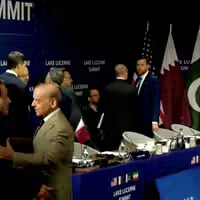
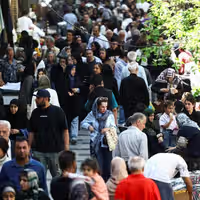
Withdrawing from the Nuclear Non-Proliferation Treaty (NPT) would not benefit Iran, former deputy head of Iran’s Atomic Energy Organization said on Monday.
“Perhaps it is better for us to maintain our commitment and goodwill today, unless the Islamic Republic’s interests dictate otherwise,” Pezhman Shirmardi said speaking to the semi-official Student News Network (SNN).
Shirmardi also criticized IAEA chief Rafael Grossi, calling him “weak” and “completely dependent on Israel and the United States,” and accused him of politicizing the agency’s work.

The American Geophysical Union (AGU) has awarded its highest honor, the William Bowie Medal, to Iranian-American scientist Soroosh Sorooshian for 2025.
The award, established more than 85 years ago, is the AGU’s most prestigious distinction, given annually to a researcher for outstanding contributions to fundamental geophysics and for unselfish cooperation in science.
The AGU cited Sorooshian’s “exceptional contributions to water science and practice, and vision in developing a global precipitation product serving millions of people worldwide.”
Sorooshian, 76, is a distinguished professor of civil and environmental engineering at the University of California, Irvine, and director of the university’s Center for Hydrometeorology and Remote Sensing.
Born in Kerman, Iran, he moved to the United States in 1966 and earned his PhD at UCLA.
Kaveh Madani, head of the UN University Institute for Water, Environment and Health, congratulated Sorooshian in a social media post, calling him “the first Iranian to receive the William Bowie Medal” and praising his decades of support for younger researchers.
The AGU, founded in 1919, is the world’s largest Earth and space science society with more than 62,000 members from 144 countries. Its annual prizes are announced in September and presented at the December meeting attended by over 25,000 participants.
The hydrologist has previously received the Robert E. Horton Medal, NASA’s Distinguished Public Service Medal, and the UNESCO Great Man-Made River Water Prize. He is a member of the US National Academy of Engineering and several international scientific academies.
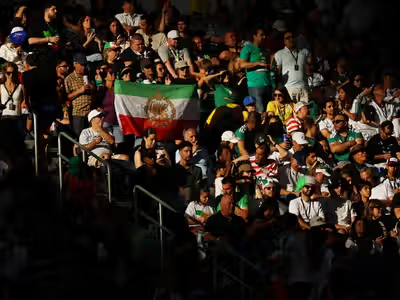
The recent 12-day conflict was a mix of missile, aerial, and ground battles that began with US approval and ended with Washington’s direct involvement, said Revolutionary Guards spokesman Ali-Mohammad Naeini.
“The enemy, even with advanced air defense and air force technology, could not withstand the power and resilience of the Islamic Republic,” Naeini said Monday.
The confrontation highlighted Iran’s endurance against external pressure, he added.

Iran’s anti-narcotics authority warned on Monday that poppy cultivation would face severe punishment, including fines, prison and land confiscation for repeat offenders.
Tarahomi, head of legal affairs at the Anti-Narcotics Headquarters, told state media that speculation about legalizing poppy cultivation was misplaced. “What is under consideration is licensing controlled cultivation of certain poppy species such as Papaver bracteatum -- also known as the Iranian poppy -- for medical use, not opium poppy,” he said.
He explained that Iran had voluntarily halted poppy farming after the 1979 revolution, meeting pharmaceutical needs through seizures and imports. But declining production in Afghanistan has forced Tehran to consider limited licensed cultivation for morphine and related medicines under international conventions.
Tarahomi said licensed crops would be grown only on enclosed land with state purchase and factory processing, leaving no possibility of diversion. By contrast, he warned, illegal growers would face escalating penalties: “The first time a fine, the second time a fine and prison, and from the third time onward, fine, prison and confiscation of agricultural land.”
Officials have previously reported a sharp fall in opium seizures and rising concerns over illegal cultivation in some provinces, with authorities destroying thousands of hectares of illicit fields.
A new wave of cryptocurrency speculation has swept through Iranian online markets, with high demand for Tether driving billion-rial trades on unlicensed domestic exchanges, wrote the IRGC-linked outlet Tasnim on Monday.
The agency cautioned that behind the excitement lies a severe risk of financial damage.
“The digital currency market these days is full of real stories of heavy losses,” Tasnim wrote, citing cases of blocked accounts, frozen assets and steep declines in value.
Tasnim quoted experts as saying that in Iran’s economic climate, “we are facing a market with no official oversight, no licensed exchanges, and no recourse if problems arise.”
Recent sanctions pressures and global compliance rules on Tether make Iranian traders especially vulnerable to sudden freezes, with little chance of recovery, added the report.

Adversaries of the Islamic Republic acted on flawed assumptions that led to their defeat, Ali Fadavi, the deputy commander of the Revolutionary Guards said on Monday.
“The enemies of the revolution acted based on flawed calculations and in many cases made misjudgments that resulted in their defeat,” he said.