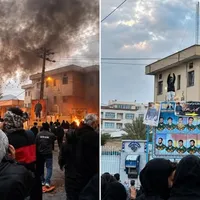
The Iranian parliament will debate withdrawal from the Nuclear Non-Proliferation Treaty on Sunday and decide on it, a senior lawmaker said.
"The issue of building a nuclear bomb will be considered separately at a later stage, and we can place it on the agenda," the IRGC general-turned-lawmaker Esmail Kowsari told the state-run YJC.


Iran has imposed new limits on stablecoin transactions, capping annual purchases at $5,000 per person and total holdings at $10,000, authorities announced on Saturday, as the rial plunged to a record low on the eve of the return of UN sanctions.
The decision, adopted during the Central Bank’s High Council session this week, applies to all traders and users on licensed digital platforms and must be implemented within a one-month transition period, according to Asghar Abolhasani, secretary of the High Council.
“From now on, the ceiling for purchasing stablecoins is set at $5,000 per user annually, and holdings cannot exceed $10,000,” Abolhasani told Iran's state TV.
He said those already holding stablecoins will have only a brief period to comply.
“The important point is that in regard to stablecoins currently in possession, a maximum one-month transition period has been set, during which the authorized ceiling for holdings must be observed.”
Stablecoins are digital tokens pegged to traditional currencies, with Tether (US dollar) being the most widely used.
In Iran, Tether has become a lifeline for households and traders seeking to protect savings from inflation or to move money abroad, offering the stability of the US dollar without the barriers of the formal banking system.
The new restrictions come as the rial continues to collapse, hitting an all-time low of 1,136,500 per US dollar on Saturday. The national currency is likely to lose further value amid the looming renewal of UN sanctions and worsening public confidence in government controls.
Stablecoins such as Tether have surged in popularity among Iranians since the war with Israel and US earlier this year. For many, converting rials into digital dollars has been the only way to preserve value.
The new cap is expected to affect thousands of small traders who have been making a living in crypto and could now face penalties for exceeding the legal ceiling.
The Central Bank’s move mirrors past efforts to curb demand for foreign currency during sharp market downturns. In earlier crises, authorities restricted access to dollars and gold in hopes of stabilizing the rial, but the measures had little long-term impact and often pushed transactions into black markets.
Iran’s currency has steadily depreciated over the past decade, battered by sanctions, inflation, and mismanagement.
"The three European countries and the United States expected Iran to give up all its nuclear material or hand it over to them, in exchange for delaying the activation of the snapback mechanism by three or six months, Iran's foreign minister said on Saturday.
"This is the height of a “brazen” approach toward us, and we will not submit to such humiliation," Abbas Araghchi told Iran's state TV.
"Iran will not accept the humiliating pressure over snapback. The European countries and the United States tried to extort concessions from Iran by creating fear of activating the snapback mechanism," he said.
"We have no doubt about the peaceful nature of our nuclear program, and we are ready to build trust, provided that the Iranian people’s inalienable right to enrich uranium is respected," the Iranian foreign minister said.
Legal battle at Security Council
Iran's foreign minister said Tehran will start a legal battle at the UN Security Council next month as it believes the snapback mechanism has not been activated and once Resolution 2231 expires on Oct. 18, all sanctions will be terminated.
"China and Russia also believe that the activation of the snapback is illegal, and on October 18 all sanctions on Iran will end as per UNSC Resolution 2231," Araghchi said.
"Since Iran clearly does not comply with its obligations under the Joint Comprehensive Plan of Action agreed to in 2015, we had no choice but to trigger the snapback of sanctions," German Foreign Minister Johann Wadephul said Saturday.
"Following a clear vote by the Security Council yesterday, sanctions will be effective later today," he told the UN General Assembly.
"But let me emphasize that we remain open to negotiations on a new agreement. Diplomacy can and should continue."

Russia's foreign minister told the UN General Assembly that the West's rejection of "a rational proposal by China and Russia to extend the 2015 Iran deal in order to allow time for diplomacy.. finally exposed the West's policy of sabotaging the pursuit of constructive solutions."
It also exposed the West's "desire to extract unilateral concessions from Tehran through blackmail and pressure," Sergei Lavrov said.
"We consider such a policy to be unacceptable and consider all manipulations to restore anti-Iranian UN sanctions as well as the sanctions themselves to be illegal."


A documentary released by Iran’s Intelligence Ministry claiming infiltration into Israel has drawn ridicule from both opposition groups and hardline loyalists of the Islamic Republic who criticized it for relying on public images and exaggerating its claims.
The documentary, The Spider’s Hideout, aired on state television on September 24, presenting alleged intelligence on Israeli nuclear sites, including Dimona.
Intelligence Minister Esmaeil Khatib described it as "a major infiltration yielding a treasure of top-secret intelligence," seemingly in response to criticism of his ministry’s failures during Israel’s June campaign.
Independent reviews, however, revealed that most images were publicly available online. Critics noted some visuals depicted Israel’s nuclear research collaboration rather than weapons programs, and the individuals named were publicly known Israeli Atomic Energy officials.
The incident has raised concerns about the inefficiency of Iran's intelligence apparatus and its propaganda methods.
Mehdi Kharratian, head of an Iranian think tank close to power circles, wrote: "Superiority must be shown not in the media but in the field—by raising levels of deterrence and increasing the costs to any enemy that acts against the country's security."
He also urged the establishment of a fact-finding committee to address inefficiencies and security gaps within the intelligence apparatus.
Guards-linked outlets admit use of online photos
Fars News Agency, affiliated with the Revolutionary Guards (IRGC), acknowledged using archival images, describing the choice as “poor judgment” that allowed critics to call the documentary “fabricated.”
It confirmed that all images, including archived ones, were labeled as “exclusive photos.”
Mashregh News, also linked to the IRGC, claimed the documents came from human sources inside Israel and were used in targeting sites during the 12-day war.
While admitting some images were available online, it alleged Israel had waged a Persian-language social media campaign to discredit the documentary.
Social media reactions
Iranian media largely avoided direct criticism of the intelligence ministry probably due to fear of prosecution, but X users from opposition and Islamic Republic loyalists were scathing:
“The Islamic Republic’s problem is that it thinks it is ruling over people aged 5 to 10… This is how the clerics have driven a great country into ruin," one user said on X.
"Calling (the documentary) a media stunt would be generous — it was more like a media toy; like a rattle handed to a child to distract them," reads another post.
Ghasem Mohammadi, a supporter of the Green Movement leader Mir-Hossein Mousavi, lamented wasted resources, writing: “Once again the people’s money has been squandered.”
“It is truly upsetting to see the state of the country’s intelligence apparatus like this! Some things are a matter of dignity.”
“Believe me, if the enemy wanted to ruin an institution’s reputation with a media operation, they couldn’t have done better.”
Why are ultra-hardliners criticizing the ministry?
Some ultra-hardliners’ criticism may reflect a structural conflict between Iran’s Intelligence Ministry and the IRGC’s parallel intelligence network, which aligns more with hardline factions.
Although appointed with the Supreme Leader's approval, the Intelligence Minister formally reports to the president and is intended to serve as the country’s main civilian intelligence body, while the IRGC’s intelligence organization reports directly to the Supreme Leader and the Guards’ command.
This dual structure creates overlapping responsibilities and frequent rivalries, with the IRGC often acting independently of—or even in opposition to—the ministry’s priorities.
The ministry has supported President Masoud Pezeshkian’s push for social and cultural relaxation, including resisting the enforcement of the new Hijab law. These changes, now increasingly irreversible, are seen as undermining hardline influence.