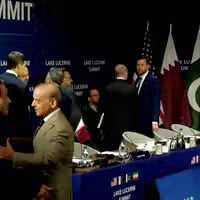
Negotiations cannot be one-sided, Iranian President Masoud Pezeshkian said in a meeting with anti-war activists in New York on Thursday, adding that Iran has abided by its nuclear commitments while others have not.
“What kind of negotiation is it where we must honor our commitments while they do not uphold any of theirs?” he said.

International pressure surrounds the snapback mechanism and sanctions on financial institutions in recent months have exceeded it several times over, Masoumeh Aqapour, an adviser to Iran's President Masoud Pezeshkian, said on Thursday.
“There is international pressure regarding the snapback mechanism. Sanctions imposed on financial institutions over the past six months have been several times greater than those under the snapback mechanism,” she said.
“Psychologically it can have a large impact on the country’s economy. We must pursue both long-term and short-term programs to minimise the effects of the snapback mechanism,” she added.

“We should use the capacity of India and China to supply essential goods.”
EU Council President António Costa said he met Iranian President Masoud Pezeshkian in New York to raise concerns over Iran’s nuclear program, detainees, and military support for Russia.
“We agreed that continued dialogue remains essential to address and resolve these issues,” Costa said in a post on X. “I urged President Pezeshkian to take — even at this late stage — concrete steps towards full cooperation with the IAEA.”
US statements about willingness for diplomacy are “nothing but deception and an obvious contradiction,” Iranian Foreign Ministry Spokesman Esmail Baghaei said on Thursday.
“It is impossible to bomb a country while holding diplomatic talks and then speak of diplomacy,” he added.

The US dollar rose to a record 1,084,000 rials on Thursday, deepening pressure on Iran’s currency as the deadline for the UN snapback sanctions mechanism approaches.
On Tuesday, Iran’s central bank governor Mohammadreza Farzin sought to reassure business leaders that the country’s foreign exchange and gold reserves remain secure.
On Wednesday, Oil Minister Mohsen Paknejad said that reimposition of UN sanctions will not add "new burdensome restrictions" on the country’s oil sales.

China has sharply increased crude imports declared from Indonesia in recent months, an unusual surge that points to possible new workarounds for Iranian oil exports, Bloomberg reported on Wednesday.
Customs data show 2.7 million tons of Indonesian crude -- around 630,000 barrels per day -- arrived in August, far exceeding Indonesia’s average output of 580,000 bpd in 2024, most of which was consumed domestically. The flows followed a sharp jump in July.
China, the biggest buyer of Iranian oil, officially reported no imports from Tehran since mid-2022. In the meantime, it buys more oil from Malaysia than the country produces. In the past two months, shipments from Malaysia -- often used for ship-to-ship transfers and rebranded cargoes -- have dropped more than 30%.
Analysts say operators are now shifting tactics.
“This is just part of a continuing evolution of the operators’ tactics, hiding what they’re doing,” said Charlie Brown, a senior adviser at United Against Nuclear Iran. “They’re still doing ship-to-ship transfers in the same area off Malaysia; the basic trade pattern remains the same.”
Vessel-tracking data show tankers including the Aquaris, Yuhan, Pola and Pix signaled calls at Indonesia’s Kabil port near Singapore -- a hub not connected to crude exports but close to established transfer zones off Malaysia. These tankers later discharged cargoes in Chinese ports such as Qingdao, Rizhao and Dalian.


Bloomberg cited the Aquaris as receiving Iranian crude from the sanctioned Sorion tanker before unloading in Qingdao in June. The Yuhan and Pola followed similar patterns, according to data from Vortexa and Kpler.
Queries to Indonesia’s energy ministry, Pertamina, Kabil port, and China’s foreign ministry went unanswered, Bloomberg reported.
China’s reliance on Iranian oil has provided Tehran with a crucial economic lifeline as US sanctions continue to target the trade.
The looming return of UN sanctions on Iran is unlikely to curb its oil exports but could boost China’s refiners, who already take nearly 80% of Tehran’s 1.6 million barrels per day at steep discounts, Reuters reported on Wednesday.