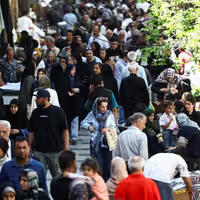
Dollar rate in Iran kept rising on Thursday, hitting a new record of 1,084,000 rials, figures showed.
The surge comes as the deadline for the snapback mechanism draws closer, fueling pressure on the local currency.


Iranian political prisoner Somayeh Rashidi died after several days in hospital following her transfer from Qarchak prison, the judiciary's Mizan news agency reported on Thursday.
Mizan said Rashidi, who was arrested in 2022 and 2023 for alleged ties with the exiled opposition group Mujahideen-e-Khalq (MEK), had previously been released under what it called “Islamic clemency” but later resumed contact with the group. It accused her of receiving money to carry out sabotage missions, including arson.
Rights groups and opposition outlets had earlier reported that Rashidi, 43, was repeatedly denied urgent medical treatment despite a serious condition.
Iran International reported earlier in the month that her level of consciousness had dropped and doctors had little hope of saving her.
Family members had voiced concern after Rashidi suffered several seizures and was moved to Mofatteh Hospital in Varamin in recent days.
According to sources who talked to Iran International on condition of anonymity, security officials attempted to pressure the family to describe her hospitalization as the result of a suicide attempt.
Rashidi, born in 1983, was detained in April while writing slogans in Tehran’s Javadieh district and initially held in Evin prison before being transferred to Qarchak after an Israeli strike on the facility in July. She was reportedly beaten during her arrest.
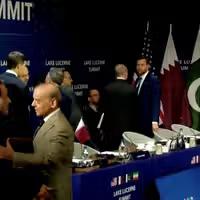
Iranian Foreign Minister Abbas Araghchi met French Foreign Minister Jean-Noël Barrot on the sidelines of the UN General Assembly in New York, the Islamic Republic’s foreign ministry said on Thursday.
Talks focused on Iran’s nuclear issue and diplomatic initiatives to prevent the return of UN Security Council resolutions, according to the ministry.
Earlier, Iranian President Masoud Pezeshkian met French President Emmanuel Macron.


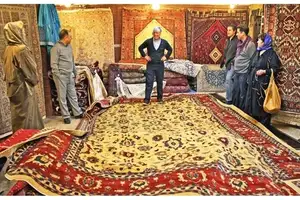
Iran’s centuries-old carpet industry, once a symbol of cultural prestige and a $2 billion export powerhouse, is unraveling under US sanctions, shifting consumer tastes and rising competition, industry officials and traders say.
Exports of handmade rugs, which stood at more than $400 million in 2017, fell to just $41.7 million in the year to March 2025, according to customs data -- a drop of over 95% from their peak in the early 1990s, AFPreported.
The collapse followed Washington’s 2018 reimposition of sanctions, cutting off the US market that once bought more than 70% of Iranian carpets.
“During the unkind and cruel US sanctions, we lost our biggest buyer,” said Zahra Kamani, head of Iran’s National Carpet Center.
Germany, the UAE, Japan and China are now Iran’s top destinations, but volumes remain a fraction of past levels.
Rivals including India, China, Nepal, Turkey and Pakistan have captured global market share, with some rugs even imported back into Iran, traders said.


At least two million Iranians, many of them rural women, depend on carpet-weaving but earn only a few dollars a day. “We are losing even part of our domestic market due to imports,” Tehran trader Hamed Nabizadeh told AFP.
With tourism also in decline, fewer foreign visitors buy rugs, and even those who do are deterred by price tags of $30,000 or more for silk carpets.
Officials insist revival is possible. Trade Minister Mohammad Atabak said in June that new trade and currency policies could help resuscitate exports.
Analysts argue adapting designs to modern décor trends, using social media for sales and branding carpets more effectively may be key.
But with Iran’s currency plunging, many families at home are turning to cheaper factory-made rugs, and a centuries-old craft risks fading into a relic of the past.

Sanctions were never lifted to be restored by the snapback mechanism, since they have always been imposed on the Islamic Republic, parliament’s economic committee member Fathollah Tavassoli said Thursday.
“Sanctions were never gone to be brought back with the snapback mechanism, they have been there from the beginning and for many years imposed on the Islamic Republic,” Tavassoli said.
A definitive solution is within reach if both sides’ interests are met, Iranian President Masoud Pezeshkian said on Thursday, following his meeting with French President Emmanuel Macron.
“Today I had a frank and detailed discussion with Emmanuel Macron in which we exchanged views, and a solution ensuring Europe’s concerns and safeguarding Iran’s interests was clearly expressed,” Pezeshkian wrote on X.
“In case of commitment to fairness and the fulfillment of mutual interests, a definitive solution is within reach,” he added. He also said the two leaders agreed to address the issue of detainees on both sides.