An Iranian lawmaker warned that the country has reached a critical juncture between advancing its nuclear program or risking war, urging officials to forge a new version of the 2015 nuclear deal to end economic and political uncertainty.
Mostafa Pourdehghan, a member of parliament’s Industries and Mines Committee, said activation of the United Nations “snapback” sanctions mechanism had already cast a psychological shadow over Iran’s fragile economy.
“Whether or not the mechanism is enforced next week, both possibilities carry negative effects for markets,” he said, adding that “if the atmosphere of uncertainty continues, the country faces an even bleaker economic outlook.”
The lawmaker criticized past leaders for downplaying sanctions as “scraps of paper,” arguing that such populist positions left Iran isolated. “We have now reached the crossroads of nuclear and war,” he said. “We must either end this ambiguity or resolve fundamental issues with the international community while preserving national rights.”
Pourdehghan said Iran’s 2015 agreement with world powers created an opportunity, but internal divisions undermined its benefits and ultimately gave Washington space to exit the accord in 2018. He argued that only a new arrangement -- “a JCPOA 2 with updated structures and timelines” -- could help Tehran navigate sanctions and avert deeper crisis.


Iran’s central bank governor Mohammadreza Farzin sought to reassure business leaders on Tuesday that the country’s foreign exchange and gold reserves remain secure as UN snapback sanctions loom later this month.
Speaking at a meeting with the National Entrepreneurs Assembly, Farzin said the Central Bank of Iran (CBI) has “full security and access” to reserves held abroad and is preparing special measures to support exporters, ease access to hard currency and expand financing channels.
He announced plans for up to €200 million in sukuk Islamic bonds, new credit for export-oriented firms and a joint committee with entrepreneurs to resolve banking hurdles.
Farzin stressed that the CBI’s priority is to curb inflation and maintain financial stability, pledging that “all monetary and foreign exchange decisions will be taken with these objectives in mind.”
He also said the bank has introduced new instruments such as chain financing, gold-backed bonds and pre-sale of foreign currency to increase resilience in the market.
The remarks come as Iran braces for the automatic return of UN sanctions on September 28 after Britain, France and Germany triggered the mechanism last month.
The snapback would reinstate international restrictions suspended under the 2015 nuclear deal, compounding existing US and EU sanctions that have already slashed oil revenues and battered the rial.
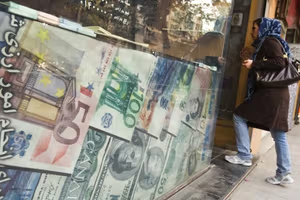
Iran’s currency has tumbled past 1,038,000 rials per dollar on the open market, while inflation hovers near 50%.


Analysts warn that renewed sanctions could push inflation above 60–90% and deepen negative growth.
Despite official assurances, businesses say access to foreign exchange remains a critical obstacle, with many entrepreneurs urging structural reforms and clear rules for investors.
The central bank’s confidence message contrasts with mounting signs of distress, including protests over living costs, reports of suicides linked to financial hardship and warnings from experts that Iran’s energy and fiscal systems are at breaking point.
When Iranian President Masoud Pezeshkian took the podium at the United Nations General Assembly last year, he presented himself as a reformist leader promising “national empathy,” constructive global engagement and an end to conflict through dialogue.
In his 2024 speech, Pezeshkian denounced Israel over its war in Gaza, accused it of genocide, and called for a referendum allowing all Palestinians -- Muslims, Christians and Jews -- to decide their future.
He stressed that Iran had never initiated a war and sought lasting peace and stability in the Middle East, while condemning US sanctions as “inhumane weapons” against the Iranian people.
He also urged full implementation of the 2015 nuclear deal, from which Washington withdrew in 2018, warning that Donald Trump’s so-called maximum pressure only deepened insecurity. “If JCPOA commitments are implemented fully and in good faith, dialogue on other issues can follow,” he told delegates, signaling openness to diplomacy.

A year later, Pezeshkian returns to New York under far darker circumstances.
In June, Israel fought a 12-day war with Iran, ending in US strikes that wrecked several of Tehran’s key nuclear sites. Iran says much of its enriched uranium stockpile now lies buried under rubble.
Months before the Iran-Israel war, the UK Parliament’s House of Commons Library said in a January 2025 report that Tehran’s regional alliances were already weakened. It said Hamas and Hezbollah had lost leaders in Israeli strikes, while Syria’s Assad government collapsed in December, leaving Iran’s network of partners militarily diminished.
Following the conflict, the European parties of the 2015 nuclear deal activated a 30-day “snapback” process at the United Nations, due to reimpose sanctions on September 28, and stoked debate in Tehran over leaving the Nuclear Non-Proliferation Treaty.
While IAEA chief Rafael Grossi says cooperation with inspectors has not been officially suspended, he acknowledged “different voices” in Iran calling for such a step.
The standoff has left diplomacy on a knife edge, with Western envoys pressing Tehran to allow inspections and restore trust as sanctions loom.
As Pezeshkian prepares to deliver his 2025 address on Wednesday, he faces mounting economic strain at home, international isolation and speculation over whether he will soften or harden Iran’s stance in the wake of war.

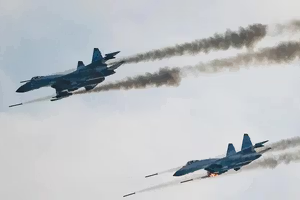
Russian MiG-29 fighter jets have arrived in Iran as part of a short-term plan to bolster its air force, with more advanced Sukhoi Su-35 aircraft to follow gradually, an Iranian lawmaker said on Tuesday.
Abolfazl Zohrevand, a member of parliament’s national security committee, told domestic media that the delivery of MiG-29s was intended as an interim measure while Tehran awaits the arrival of Su-35s “as a long-term solution.”
“Russian MiG-29 fighter jets have arrived in Iran and are stationed in Shiraz, while Sukhoi Su-35 jets are also on the way,” he said.
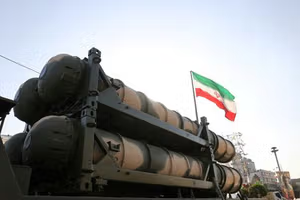
He also said that China’s HQ-9 air defense system and Russia’s S-400 system were being supplied to Iran “in significant numbers.”
Neither Moscow nor Beijing has confirmed the reported deliveries.


Iran has long sought to modernize its aging air force, which relies heavily on US-made jets purchased before the 1979 revolution and a small number of Russian and locally upgraded aircraft.
State media reported in January that the first Sukhoi Su-35s were formally handed over to Iran, but officials have not clarified how many are operational.
Western analysts say Iran’s request for 50 aircraftremains only partly fulfilled, with deliveries slowed by Russia’s own needs in Ukraine.
Tehran also faces vulnerability in air defenses after Israeli strikes earlier this year destroyed its last Russian-provided S-300 systems. Iran had acquired the four S-300 battalions from Russia in 2016.
The head of the UN nuclear watchdog said on Monday that Iran has not formally suspended cooperation with inspectors, despite contradictory signals from Tehran.
“Well, we haven't heard of any official communication to that effect,” Rafael Mariano Grossi, director general of the International Atomic Energy Agency (IAEA), told PBS.
“We know that, in Iran, there are different voices, sometimes in parliament, sometimes politicians, sometimes indicating that they suspend or that they want to suspend. At the same time, there are obligations, because they are party to the nonproliferation treaty. So all of this needs to be clarified. But, for the moment, there is no suspension as such.”
Grossi said the IAEA was still operating under a framework agreed in Cairo this month to resume inspections after US and Israeli strikes on Iranian nuclear sites in June.
Inspectors, he said, would begin by reviewing Iranian reports before conducting visits to facilities including Fordow, Natanz and Isfahan.
He added that cooperation was incomplete, particularly regarding enriched uranium stockpiles, which he said were likely still intact underground.
“Have we gotten everything we want? Not yet. Have we checked on the material? Not yet, but we are working on that,” he said.
Grossi stressed that inspections must continue despite political disputes and security threats. “We cannot afford to have another crisis in the Middle East at this point. We have to avert it. We have to move to a durable, sustainable situation that, in my view, only goes through diplomacy,” he said.
A senior Iranian lawmaker said on Tuesday that Tehran should retaliate if its vessels are inspected following the activation of the UN snapback sanctions mechanism.
Ahmad Bakhshayesh Ardestani, a member of parliament’s national security committee, told domestic media that Iran’s Revolutionary Guard and navy should board and inspect ships belonging to the opposing parties in response.