Iran says Armenia has pledged to respect its red lines, no US forces at border
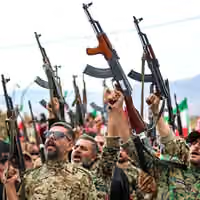
A member of the Islamic Revolutionary Guard Corps (IRGC) during a ground forces military drill in the Aras area near the border with Armenia, East Azarbaijan province, Iran, October 19, 2022
Iran’s foreign minister said on Thursday that Armenia has assured Tehran it will uphold all of Iran’s red lines regarding the Zangezur region and that no US forces will be stationed along the Iranian-Armenian border, amid concerns over the US-brokered deal in the South Caucasus.
Foreign Minister Abbas Araghchi told state media that Armenian leaders had engaged in direct consultations with Iranian officials in recent days to explain recent developments.
“Prime Minister [Nikol] Pashinyan spoke with our president, their foreign minister called me, and the deputy foreign minister of Armenia came to Tehran,” he said. “The Armenians insist on briefing us and have told us they will observe all of Iran’s red lines regarding Zangezur.”
Last week, US President Donald Trump brokered a peace deal between Armenia and Azerbaijan, which gives Washington leasing rights to develop the Zangezur transit route connecting Azerbaijan with its exclave, Nakhchivan. It will be renamed the Trump Route for International Peace and Prosperity (TRIPP).
Araghchi said the situation that has emerged is very different from earlier proposals. “It is natural that the full dimensions of the Zangezur issue are not yet completely clear,” he said. “But what the surface of the matter shows, and what the Armenians are telling us, is that what has happened is worlds apart from what was supposed to happen — a change in the geopolitical map of the region.”
Iranian Foreign Minister Abbas Araghchi during an interview with state television in the Iraqi city of Karbala on August 14, 2025
He recalled that initial discussions had involved the seizure of Armenia’s Syunik province, followed by the creation of a corridor. “We expressed our serious concerns, and that project was shelved.”
According to Araghchi, the current plan involves “an American company registered in Armenia under Armenian law, operating under Armenian sovereignty, to build the road.”
He added, “I am not saying what is happening is without concern. Based on what Armenian officials have told us, this road will be established by an American company registered under Armenian law and under Armenian sovereignty. They tell us they have respected and paid attention to all of Iran’s red lines in this matter.”
Rejecting claims that the project would make Iran a neighbor of NATO, Araghchi said Tehran had conveyed its concerns about any foreign presence to both Azerbaijan and Armenia.
“A US engineering company is to carry out the work, but there will be no American forces stationed at the Iran-Armenia border,” he said.
"Security will be provided by Armenia itself, and even private American companies will not be allowed to provide security. These are the statements from Armenian officials — of course, we will maintain the necessary vigilance.”
Hezbollah leader Naim Qassem warned on Friday that moves to strip the group of its weapons risk plunging Lebanon into war, vowing that the Iran-backed movement would not surrender its arsenal despite a recent government decision to disarm it.
Speaking in the eastern city of Baalbek at a Shi’ite religious gathering marking the Arbaeen, Qassem said “the resistance will not hand over its weapons” and pledged to fight a “Karbala-like battle” if necessary.
The Battle of Karbala, the most iconic event in Shia Islam, was fought in 680 between Imam Hussein, grandson of the Prophet Muhammad, and the forces of Umayyad Caliph Yazid I; Qassem likened Iran’s Supreme Leader to the “Hussein of our time” and named Israel and the United States as the “Yazid of our time.”
Qassem described the group’s arms as central to Lebanon’s “honor, dignity, patriotism, and sovereignty,” and credited the Islamic Republic for its ongoing financial, military, and political support.
Threatening US embassy in Beirut
Qassem also warned the Lebanese government against any moves to confront Hezbollah, saying such action would leave “no life” in the country.
He said Hezbollah and its Shi’ite ally, the Amal movement, had decided to postpone street demonstrations against a US-supported disarmament plan, citing a remaining window for dialogue with authorities.
However, he cautioned that any future protests could extend to the vicinity of the US Embassy in Beirut.
The US submitted a plan through President Donald Trump's envoy to the region, Tom Barrack, setting out the most detailed steps yet for disarming Hezbollah, which has rejected mounting calls to disarm since its devastating war with Israel last year.
Lebanon’s justice minister said on Friday that the government was already working on a plan to collect Hezbollah’s weapons before the US proposal, as part of efforts to strengthen state authority and keep arms solely in the hands of official forces.
"The threat by some to destroy Lebanon in defense of their weapons puts an end to the claim that the weapons are for defending Lebanon," Adel Nassar wrote on X.
The Lebanese cabinet’s August 5 order to disarm Hezbollah during conflict drew sharp criticism from Tehran.
Senior Iranian official Ali-Akbar Velayati called the decision “a dream that won’t come true,” labeling it an Israeli- and US-driven policy. Lebanon’s foreign ministry condemned those remarks as “unacceptable interference” in domestic affairs.
Qassem’s remarks came after Iran’s Supreme National Security Council Secretary Ali Larijani visited Lebanon, meeting Qassem, President Joseph Aoun, Parliament Speaker Nabih Berri, and other officials.
Aoun told Larijani on Wednesday that no group should bear arms outside the authority of the state or rely on foreign backing, while affirming openness to cooperation “within national sovereignty and mutual respect.”
Larijani responded by voicing respect for Lebanon’s government decisions but also urged Beirut to “appreciate the value of the resistance,” calling Israel the country’s true enemy.
He denied that Iran interferes in Lebanon’s affairs and pledged continued political and reconstruction support.
Founded in 1982 by Iran’s Islamic Revolutionary Guards Corps, Hezbollah has grown into Lebanon’s most powerful military force, surpassing the national army in capabilities. The group has fought multiple wars with Israel and has rejected any initiatives to dismantle its military wing.
“The aggression continues,” Qassem said, “and we will confront it as we have always done — with our weapons in hand.”
More than 20 members of Iran’s Baha’i minority in the central city of Isfahan have had their homes, assets and vehicles confiscated in recent weeks, in some cases being informed only by text message, the Baha’i International Community (BIC) said on Wednesday.
The Geneva-based group said the seizures were carried out under Article 49 of Iran’s constitution, which allows authorities to confiscate wealth obtained through illegal means. The BIC accused authorities of misusing the law “without any evidence, legal process, or transparency” to target citizens solely for their religious beliefs.
“Article 49 was designed to return stolen property to its rightful owners, not to plunder the possessions of citizens and deprive families of their homes and livelihoods,” said Simin Fahandej, the BIC’s representative in Geneva.
“What we are witnessing is effectively state-organized theft – confiscation by text message. This action is discriminatory, completely illegal, and aimed at impoverishing a religious minority simply because of their belief.”
The BIC said affected families have faced blocked bank accounts, frozen business transactions, and restrictions on selling or transferring property. In some cases, it said, court files were not recorded in Iran’s official judicial notification system, preventing defendants and their lawyers from reviewing them.
The confiscations were ordered by special courts operating under Article 49, which the BIC said are a branch of the Revolutionary Court overseen by the Executive Headquarters of Imam’s Directive (Setad), a state-controlled conglomerate under the authority of Supreme Leader Ali Khamenei.
The BIC said the measures in Isfahan follow a long-running pattern of property seizures against Baha’is since the 1979 Islamic Revolution, alongside other restrictions including denial of access to higher education, bans on certain jobs, and interference with religious burial sites.
According to the US-based Human Rights Activists News Agency (HRANA), the Baha’i community in Iran has faced systematic repression over the past five years, including the arrest of at least 284 people and more than 1,495 years in combined prison sentences.
HRANA said Baha’is account for an average of 72% of all recorded violations against religious minorities in Iran over the past three years.
Iran’s constitution recognizes Islam, Christianity, Judaism and Zoroastrianism as official religions, but not the Baha’i faith, which emerged in 19th century Iran. Islamic Republic authorities consider it a “cult” and have accused its followers of links to foreign powers, charges the Baha’is deny.
Iranian officials said on Thursday they are seeking ways to prevent the return of UN sanctions and are ready to hold talks with the United States over Tehran's disputed nuclear program, provided they are not used as a pretext for another military campaign.
Foreign Minister Abbas Araghchi and Supreme National Security Council Secretary Ali Larijani both said the Islamic Republic prefers the path of peace and is determined to block the Europeans' bid to reinstate the UN sanctions via the so-called "snapback" mechanism.
“Europeans have until October 28 to trigger the snapback mechanism," Araghchi told the state TV.
He acknowledged the three European countries could technically trigger snapback but argued the move would lack legitimacy.
"In our view—given their positions, including their insistence on zero enrichment despite Iran’s enrichment rights under the 2015 nuclear deal—they lack the legitimacy to discuss or apply any part of the deal, including snapback."
“Iran, China, and Russia are in a legal dispute with the three European countries in the UN Security Council over whether they have the right to trigger snapback. Our view is they do not, and even if they did, it lacks legitimacy,” he said.
France, Germany, and the United Kingdom have told the United Nations they are prepared to reimpose international sanctions on Iran unless it resumes nuclear negotiations with the United States and other powers, according to a letter shared by the French foreign ministry on Wednesday.
“There is no doubt something must be done to stop it, and we will spare no effort until the last moment,” Araghchi said.
The snapback mechanism, part of UN Security Council Resolution 2231, allows any JCPOA party to accuse Iran of non-compliance. If no agreement is reached within 30 days to keep the bans lifted, all previous UN sanctions automatically return, including arms embargoes, cargo inspections, and missile restrictions.
If European powers trigger the snapback mechanism against Iran, the country would face isolation from global financial markets, a sharp drop in oil exports, with foreign investment blocked by legal hurdles, US-based National Security Journal said in an analysis piece on Thursday.
Iran’s Ministry of Intelligence on Monday reportedly issued secret guidance instructing ministries and major companies to prepare for the likely return of UN sanctions.
'Talks with US possible'
Iran's top security official Ali Larijani said on Thursday talks with the United States are possible but only if aimed at a genuine resolution.
“If the United States realizes it cannot defeat the Islamic Republic through war and then seeks negotiations, we will respond positively. But if they negotiate to prepare for the next war, it will be of no benefit to us,” Larijani said in an interview Lebanon’s Al-Mayadeen.
“Some believe negotiations can solve everything. Negotiations are only useful when both sides accept and understand they cannot achieve their goals through war,” Larijani added.
France, the United Kingdom and Germany told Iran they would restore UN sanctions unless it reopened talks on its nuclear program immediately and produced concrete results by the end of August.
Negotiations under the Trump administration began with a 60-day ultimatum to Iran. On the 61st day on June 13, Israel launched a surprise military campaign.
The Israeli strikes began on the eve of the sixth round of negotiations with the United States.
On the ninth day of fighting, the United States bombed three Iranian nuclear sites which US President Donald Trump has consistently said "obliterated" the country's nuclear program.
Two senior Iranian officials said on Thursday that the Israeli prime minister’s attempt to spark protests in Iran fell flat over what they called popular support for the Islamic Republic, two days after Netanyahu urged Iranians to take to the streets.
“God has created our enemies foolish; these threadbare, repetitive and childish tricks no longer work,” Foreign Minister Abbas Araghchi said in reaction to a video message by Israeli Prime Minister Benjamin Netanyahu earlier in the week calling on Iranians to launch antigovernment protests.
Araghchi added that the people of Iran firmly stand behind the Islamic Republic.
Netanyahu, in a video message on Tuesday urged the people of Iran "to be bold and brave, take risk for freedom, take to the streets, demand justice and protest tyranny". "Soon your country will be free. Now is the time for action," he said.
Netanyahu also promised that following a regime change in Iran, Israel would send top water experts to help with the country's ongoing water crisis.
Araghchi downplayed the remarks, saying "our own specialists know the methods of water regeneration and new ways of securing water… the problem has no miraculous solution and cannot be resolved overnight."
A day earlier, Iran's President Masoud Pezeshkian mocked Netanyahu over his offer to solve the ongoing crisis.
“A regime that deprives Gaza of water and food now says it will bring water to Iran? A MIRAGE, NOTHING MORE,” Pezeshkian wrote on X.
'Netanyahu misjudges Iranian public'
Secretary of Iran's Supreme National Security Council Ali Larijani also said Netanyahu misjudged the public mood when he openly urged Iranians to protest during the two countries' 12-day war in June.
“The enemy wanted to create sedition in the Islamic Republic and drag people into the streets — just as Netanyahu openly urged — but this was Netanyahu’s foolishness because he thought the people of Iran like him,” Larijani was quoted as saying by Hezbollah-affiliated Al Mayadeen on Thursday.
Larijani added that even the Islamic Republic's domestic opponents stood alongside the state, and that Israel was the tactical loser in the 12-day conflict.
The top security chief warned that Iran was ready to respond forcefully to any fresh Israeli attack.
Israel was preparing a final wave of attacks aimed at toppling Iran’s ruling system when US President Donald Trump announced a ceasefire, The Washington Post reported last month, citing Israeli and American officials involved in the operation.
“When Trump declared a ceasefire, Israel was moving into a final phase of attacks intended to topple the regime,” said David Ignatius in an opinion piece published by The Washington Post.
The final phase, which Israeli planners believed could bring down the Islamic Republic, was halted when Trump intervened.
The ceasefire announced by Trump on June 23 ended a 12-day conflict between Israel and Iran that was capped off by US strikes on Iranian nuclear sites.
At the height of the conflict, both Netanyahu and Trump hinted at favoring Iranian regime change.
"It’s not politically correct to use the term, 'Regime Change,' but if the current Iranian Regime is unable to MAKE IRAN GREAT AGAIN, why wouldn’t there be a Regime change??? MIGA!!!" Trump said in a post on Truth Social in late June.
A Shi'ite summer school camp in England, known as Camp Wilayah, has been cancelled due to what its organizer described as safety threats, following accusations by a right-wing political party that it has ties to the Islamic Republic of Iran.
“In light of serious threats to the safety of children at the camp, we regret to announce that this year’s Camp Wilayah will not proceed,” the Ahlulbayt Islamic Mission (AIM) said in a statement.
AIM, a charity dedicated to promoting Shi'ite Islam, organizes the annual four-day summer camp for children aged nine to 14.
The event follows specific Islamic rules, such as gender segregation, mandatory hijab for girls, and loose clothing.
The AIM website does not list its leadership or staff, but social media posts from past events show an apparent association with Hasan Ali al-Taraiki, a Shi'ite cleric.
“No evidence of wrongdoing has ever been found at Camp Wilayah, yet our children are being punished simply for their faith,” the AIM statement said. "To attack such a wholesome and positive tradition is shameful, especially when threats are made by the Reform Party to mobilize protests and disrupt children’s camps."
On social media, AIM has repeatedly praised Iran’s Supreme Leader Ayatollah Ali Khamenei, promoted his books, and shared his speeches.
“The idea that children should be allowed to attend camps run by ‘supporters of the Iranian regime’ is concerning,” said Robert Jenrick, the Shadow Secretary of State for Justice.
“AIM operates under the umbrella of the Ahlul Bayt World Assembly, an Iran-based organization whose leaders are appointed in Tehran and have historically been close to Ali Khamenei,” UK-based human rights lawyer Omid Shams told Iran International on Monday.
The push to cancel the camp came from the Reform UK party. Its leader, Nigel Farage, said Camp Wilayah has “clear and troubling ties to the Iranian Revolutionary Regime.”
“We will not be intimidated, we will not retreat, and we will continue to build a stronger, fairer society for everyone,” AIM said in another statement.
Security officials have warned of an increasing threat from Iran, saying Tehran has used groups in the UK to expand its influence.
On June 30, a report by The Telegraph accused Iran of conducting a “shadow war” inside the United Kingdom that extends beyond sanctions violations and includes propaganda, financial networks, and digital disinformation campaigns aimed at dividing society
In July, John Woodcock, Baron Walney, the UK government’s former extremism adviser, said: “We cannot allow propaganda and influence from this theocratic dictatorship to be spread to children in the UK.”
Two London charities with alleged links to Iran — the Dar Alhekma Trust and the Abrar Islamic Foundation — are currently under investigation by the National Terrorist Financial Investigation Unit. Both deny any wrongdoing.