Saeed Jalili gesturing during an appearance on Iran's state broadcaster
A controversial post by hardline figure Saeed Jalili denigrating nuclear talks has triggered a rare public rebuke from within Iran’s security establishment—one that may signal his waning influence in Tehran’s evolving postwar leadership.
The timing is critical.
Following the 12-day war with Israel—a conflict that laid bare Iran’s intelligence and security failures—the Supreme National Security Council (SNSC) has undergone a reshuffle that appears to weaken the ultraconservative camp’s grip.
At the center of the uproar is Jalili’s August 7 post on X, in which he likened the postwar push for diplomacy to a scriptural episode: “It’s as if our nation hasn’t won at all,” he wrote.
“The Children of Israel, after defeating Pharaoh, turned to worshipping the golden calf when their prophet was absent for 40 days. Similarly, today, after the enemy attacked us in the midst of negotiations and the Iranian nation emerged victorious, some are now calling for a return to the same disastrous path as before!”
Jalili is a former chief nuclear negotiator and perhaps the most prominent face of anti-diplomacy in Tehran, whose latest presidential bid was defeated by Masoud Pezeshkian in 2024.
‘What Moses?’
The cryptic message sparked a wave of outrage, confusion, and interpretation.
“Who is Moses? What is calf worship? Who has gone to Mount Tur?” asked Tasnim News, the IRGC-affiliated outlet, which labeled Jalili’s post “wrong and radical.”
The rare, pointed critique from an IRGC platform was widely seen as a blow to Jalili’s once-untouchable persona.
Another conservative outlet, the daily Khorassan, took issue with the implied slight toward Ayatollah Khamenei’s absence from public view:
“Why do you think the Supreme Leader is absent? The nation you call calf worshippers deserves respect,” it wrote in a Thursday editorial.
Former IT Minister Mohammad Javad Azari Jahromi was even more cutting:
“If you possess Moses’ miracle, strike your staff on the ground. If not, in these sensitive times, follow Aaron’s example and avoid sowing division.”
Ali Larijani (left) and Saeed Jalili are the two representatives of supreme leader Ali Khamenei on Iran's Supreme National Security Council
Rivalry peaked
The recent appointment of Ali Larijani as one of Khamenei’s two representatives to the SNSC has been widely interpreted as a shift in direction—despite Jalili remaining in the same role.
The duo’s rivalry is deep and well documented.
Jalili is believed to have played a key role in disqualifying Larijani from the 2021 presidential race. Much of the hardline resistance to President Pezeshkian’s diplomatic outreach to Washington has originated from his camp.
Last year, Larijani accused Jalili’s affiliated Paydari party of leading a “political purification campaign” to monopolize power.
Even before Larijani’s return to the SNSC, frustration with Jalili had been mounting across the political spectrum.
‘Shoes off’
Reformists, moderates, and even some conservatives have criticized his obstructionist posture and refusal to offer viable policy alternatives. President Pezeshkian has said he offered Jalili several posts in his cabinet—all of which were declined.
While Khamenei’s decision to retain Jalili suggests the system still values his ideological loyalty, the rising chorus of criticism—especially from conservative and IRGC-linked voices—marks a potential shift.
Tasnim closed its editorial with a pointed remark:
“Exchanging views is healthy for any government, provided you take off your radicalism shoes.”
Time will tell whether that was merely advice or a written notice.
Iran’s revamp of a top national security body signals a ruling system in decline, former US State Department official Len Khodorkovsky told Eye for Iran, calling it “pure theater” and likening it to “rearranging deck chairs on the Titanic.”
“We’re seeing the leadership desperate and flailing away in various ways to try and preserve its control and its hold on power,” he said. “Whether you stand up the defense council, whether you change the name of the currency ... the ship is still sinking.”
Khodorkovsky served as Deputy Assistant Secretary of State during the first Trump administration, working closely with the Special Representative for Iran on the administration’s “maximum pressure” campaign.
Born in the Soviet Union, he emigrated to the United States as a child after experiencing life under the communist system. From abroad, he watched the country of his birth unravel — a collapse that, he says, offers lessons for Iran today.
His prediction rests on a convergence of forces the leadership cannot reverse: an economy in freefall, a public that has lost faith in the system, and leaders resorting to cosmetic moves to mask deep structural decay.
Drawing on the lessons of the Soviet collapse, he argued that once cracks appear in an authoritarian system, its fall can come faster than expected.
Chaired by the president, it includes the heads of the judiciary and parliament, senior military commanders, key ministers, and two representatives of Supreme Leader Ali Khamenei.
Veteran lawmaker Alaeddin Boroujerdi called it “necessary given the current wartime situation,” saying it would allow military and defense decisions to be made “in a concentrated manner” during critical moments. Esmaeil Kowsari, a former Revolutionary Guards commander, said it would speed the chain of command and “with timely strikes, suppress threats.”
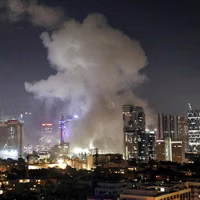
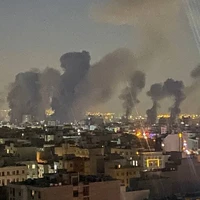
The revival of such a body — last active during the 1980–88 Iran–Iraq War — follows a 12-day war with Israel in June, during which Iranian military and nuclear facilities were hit by Israeli and US strikes.
Larijani’s return: rebrand, not reboot
Two days after the council’s creation, President Masoud Pezeshkian appointed Ali Larijani as SNSC secretary.
Khamenei quickly followed, naming Larijani his personal representative to the body. A political veteran, Larijani previously served as SNSC secretary from 2005 to 2007, was speaker of parliament for over a decade, and has long been an adviser to the Supreme Leader.
Khodorkovsky said Larijani’s appointment will not change the system’s trajectory. “They’re trying to look strong externally, but internally the system is rotting,” he said. “The personnel changes are cosmetic — the fundamentals are the same.”
Mounting internal strain
Iran’s ruling system is buckling under severe economic pressure. The rial has collapsed—dropping from around 300,000 per USD in 2020 to over 1 million in early 2025—losing more than 80 percent of its value. Inflation remains among the highest in the world.
For Khodorkovsky, these are the real forces eroding the state’s foundations — and they cannot be reversed by councils or reshuffles.
“You can change the faces, you can change the names, you can create new institutions,” he said, “but when the people have turned away and the economy has collapsed, the end is only a matter of time.”
When Iran's armed forces chief of staff declared this week that all Iranians are together in one battle trench, the rallying cry rang hollow with many Iranians bewildered by a punishing war last month and worsening standards of living.
“Our home is not your trench. If you're looking for one, use your own house and stop riding on our backs,” one user said in a message sent to Iran International.
The backlash followed a speech by Major General Abdolrahim Mousavi, chief of staff of Iran’s armed forces, who said on Thursday, “All of our houses are like one trench facing the enemy.”
“Mousavi wants to use the civilian population as human shields,” one user wrote on X.
Another opined: "Did you care then that Iran’s wealth should be for its own people, and now you’re using the same people, drowning in your corruption and crimes, as your shield?!"
Iran is currently grappling with water shortages and widespread power outages amid high summer temperatures, while also dealing with recovery efforts following a 12-day war with Israel and its aftermath.
Mousavi also issued threats for any further attacks on Iran, saying there would be severe consequences for what he called any renewed aggression.
“Even if only one Iranian remains alive, you Americans will not be safe from the slap of his revenge," Mousavi said in a broadcast live on Iranian state television.
“Iran’s air defense was damaged early in the 12-day war, but since then Iran has rebuilt and modernized its systems. Israel now realizes that Iran’s air defense in a future war would be multiple times stronger,” Islamic Revolutionary Guards Corps (IRGC) affiliated Tasnim News said on Thursday.
Israel launched a surprise military campaign on June 13 targeting military and nuclear sites, assassinating senior Iranian commanders and killing hundreds of civilians. In response, Iranian missile strikes killed 29 Israeli civilians.
According to an Iranian government spokesperson, 1,062 Iranians were killed during the conflict, including 786 military personnel and 276 civilians.
The United States capped off the conflict with attacks on Iranian nuclear facilities at Isfahan, Natanz and Fordow with long-range bombers and submarine-launched missiles on June 22. Washington brokered a ceasefire on June 24.
Iran is awash in voices claiming to speak for its people: state loyalists, opposition figures and self-styled experts of every stripe drowning out the non-extreme yet critical voices with their din.
Most people I see in Tehran feel suspended in uncertainty, struggling with daily water and electricity outages while fearing the return of United Nationas sanctions and another war. They want change, but can’t see it on the horizon.
Worst of all, they feel they can’t express their concerns and thoughts.
“These days, you have to declare your political stance before you can say anything. And what you say must fit the dominant binaries, even if it’s about the price of beef.”
Shahriar is 36. He was laid off from his HR job just after the Iran-Israel ceasefire. He now delivers food while looking for work.
“There’s no voice that represents us,” Shahriar says. “And by us, I mean those who hate the Islamic Republic but don’t want to see the country destroyed by war. The atmosphere of accusation, labeling and hate online is so intense that I stopped posting on X and Instagram two weeks ago.”
That hostility, he says, has spilled beyond the screen.
“I’ve seen this toxicity enter friendships and family gatherings. If you criticize the war, people assume you support the regime—even though that same regime has imprisoned anti-war activists. Even supporters of the regime can’t tolerate anti-war views.”
Pick a side
Since the widespread protests of 2022, many activists have been calling for unity between those who want to see fundamental change in Iran. But solidarity remains fragile and elusive. A coalition of six high-profile opposition figures offered a glimmer of hope. But the effort quickly collapsed, widening divides and deepening mistrust.
“There’s this illusion that only two camps exist. Either you follow a scripted, militant vision of regime change or you’re a regime collaborator,” says Shiva, a civil society activist in Tehran.
The polarization, she believes, has erased nuance and pushed those like her out of conversations.
“Say Israel committed crimes, and one group calls you a regime apologist. Say the same thing to the other side, and they’ll ask why you’re silent about Iran’s military achievements. You find yourself defending your integrity instead of your argument. Constantly. It’s exhausting—and sad.”
Repeat the line
A recent study by LifeWeb, an analytics group operating under restrictions in Iran, offers a partial window into online activity during and after the Iran-Israel war.
The report says the hashtag #جانم_فدای_ایران (“My life for Iran”)—promoted by former foreign minister Mohammad Javad Zarif—was used in over 514,000 posts generated by only 17,000 users. That’s an average of 30 posts per user, suggesting coordinated repetition rather than broad engagement.
Likewise, in the final three days of the war, the Trump-associated hashtag #MIGA (Make Iran Great Again) appeared more than one million times from just 30,000 users—again averaging 30 posts each. This peak came during a nationwide internet blackout in Iran, raising further questions about the campaign’s authenticity.
While not conclusive, such patterns underscore how coordinated efforts can dominate digital narratives, often overshadowing the quieter voices who oppose both war and authoritarianism.
A man attending a religious ceremony marking the death of the third Shiite Imam, July 2025
Silence yourself
This “distortion” shapes perception, says Navid, a 28-year-old MBA student.
“These campaigns make it seem like most Iranians supported the Israeli strikes. But around me, most people saw war as a dangerous way to bring change. Sure, some defend it—but when the majority stays silent, the loud minority becomes the dominant voice.”
Navid believes this dynamic makes people fear expressing their views, feeling isolated in their beliefs. His friend Sina nods as he speaks before jumping in to vent his frustration at “losing” the only space he had to talk.
“Social media is the one platform most of us have to express our views. And it has been taken over by aggressive minorities and pressure groups.
“How can we reach a shared understanding, a shared purpose, when all we do is attack and cancel each other,” he asks. “The worst bit is we don’t even know if those shutting us up are real people or bots and cyber mercenaries.”
In 1980, months after Islamists took over what appeared to be everyone’s revolution, Iran’s renowned poet Ahmad Shamlou wrote one of his most recited lines to describe the repression: “They sniff your mouth, lest you’ve said ‘I love you.’”
It’s chilling to hear that line whispered again, not in defiance of power, but in fear of each other.
Iran’s Supreme Leader Ali Khamenei on Thursday appointed Ali Larijani as his personal representative to the Supreme National Security Council, two days after President Masoud Pezeshkian named Larijani as the council’s secretary.
With the appointment, Larijani replaces Ali Akbar Ahmadian both as secretary of the Supreme National Security Council and as one of Khamenei’s two designated representatives to the body. Saeed Jalili, who served as SNSC secretary from 2007 to 2013, is the other representative currently serving in that capacity.
“Given Dr. Ahmadian’s assignment to important executive responsibilities, I appoint Dr. Ali Larijani as my representative in the Supreme National Security Council, in accordance with Article 176 of the Constitution,” Khamenei wrote in a formal decree.
Khamenei appoints Shamkhani and Ahmadian to Defense Council
In a separate decree, Khamenei named both Ahmadian and former SNSC secretary Ali Shamkhani as his personal representatives to the Supreme Defense Council, a newly revived body expected to oversee national defense policy and coordinate military planning.
The council is part of a broader institutional overhaul announced after a 12-day war with Israel in June, during which Iranian military and nuclear facilities were hit by Israeli and US strikes.
The Defense Council will include the heads of the executive, legislative and judicial branches, top military commanders, and key cabinet ministers. It will be chaired by President Pezeshkian, according to Iranian media.
Larijani returns to powerful role
Larijani, 67, is one of the most experienced figures in Iran’s political system. He previously served as SNSC secretary from 2005 to 2007, and has held positions including speaker of parliament, Minister of Culture, head of state broadcasting (IRIB), and advisor to the Supreme Leader.
Though considered a conservative close to the Supreme Leader, Larijani has occasionally clashed with hardliners. He registered for presidential elections on three occasions but was twice disqualified by Iran’s Guardian Council. His political tone on diplomacy and domestic issues has softened in recent years.
A young woman in a loosely draped hijab, strands of hair framing her face, flashes a peace sign while holding a photo of a slain Revolutionary Guard commander.
The improbable image fills the front page of hardline daily Vatan-e Emrooz, presented as part of the Islamic Republic’s “new generation of resistance.”
But analysts told Iran International it is less a reflection of reality than a carefully crafted narrative aimed at shoring up support for Tehran after its 12-day war with Israel — the worst direct military confrontation in their fraught history.
The war left hundreds of civilians dead, damaged infrastructure and deepened economic strain. In its aftermath, the Iranian establishment has worked to project resilience and unity, even among citizens who defy its strict social codes.
The Vatan-e Emrooz cover accompanied a story built around a Foreign Policy article by an Iranian-American academic which argued that some young Iranians are rallying behind Tehran’s anti-West, anti-Israel stance in the war’s aftermath.
Following the bruising conflict, Tehran embraced nationalist symbols it long suppressed, with mythological tales and ancient monarchs adorning public billboards.
For author Arash Azizi, whose book What Iranians Want: Woman, Life, Freedom examines political and social change, this type of imagery is part of a familiar playbook.
Referring to a domestic militia and Iran's Islamic Revolutionary Guard Corps, he described Vatan-e Emrooz as “a hardliner outlet, traditionally close to the Basij, which is a section of the IRGC … known for a very sensational sort of tabloid-style headlines.”
The paper, he added, has long featured stylish young who appear supportive of the establishment to imply that “even sections of the population that flout the hijab rules … nevertheless supports its foreign and military policies.”
Holly Dagres, a senior fellow at the Washington Institute for Near East Policy, studies Iran’s younger generations and regularly tracks Gen Z and Gen Alpha trends.
She said that while this visual contrast between appearance and ideology is not new—women without hijab have backed hardliners, and chador-wearing women have voted reformist—the cover is nonetheless a strategic push.
“It’s for the regime to make a point, especially at a time when it has historically high anti‑regime sentiment, that ... we have the support of these individuals too that don’t usually fit the stereotypical box of what a good Islamic citizen in our view is," Dagres told Iran International.
Visual communication expert Siavash Rokni, who holds a PhD in communication and researcher in popular music at McGill University, sees deliberate messaging in the picture’s design: the woman’s ear “out of her scarf,” the bright blue clothes “evoking kind of happiness and rejuvenation and the future,” and her phone with a peace sign “as kind of the representation of Gen Z.”
Rokni also points to the way she holds her phone — not in a natural texting or scrolling posture, but almost like a prop, gripped sideways with fingers loosely wrapped around it. The position, he suggests, looks staged.
It’s an example of what Rokni calls the Islamic Republic’s turn to “soft war”—countering Western “soft power” via curated cultural imagery. The same effect is visible, he added, in rap lyrics and music videos where some artists are either funded or influenced by the IRGC to echo establishment talking points, while others openly align themselves with them.
Gen Z beyond reach?
Activist Tara Dachek, part of Iran’s Gen Z and now living abroad, sees the image as a sign of weakness, not strength. “The Islamic Republic is drowning — these are its last desperate gasps,” she told Iran International. Such visuals, she says, reflect “fear, repetition and desperation” rather than genuine engagement.
Having left Iran six years ago, Dachek believes the cover only affirms that her “generation is on the right path — the regime has already lost us.”
"Even back then, I didn’t trust state media. I never followed their news because I knew it wasn’t truth — it was survival wrapped in a lie," said Dachek.
Among younger Iranians, the dissatisfaction runs deep.
Surveys show that nearly 75% of Iranians—including many Gen Z individuals—opposed mandatory hijab, with 84% favoring a secular state over the Islamic Republic, according to GAMAAN — a Netherlands-based research organization that conducts large-scale online surveys of Iranians.
Gen Z, who wasn't yet born at the time of the 1979 revolution, frequently expresses opposition to both political Islam and compulsory dress codes while embracing global cultural values.
Despite Tehran’s efforts to project unity, young Iranians may not be as passive or easily swayed as officialdom believes. Shaped by years of protest and repression, they remain among the most vocal critics of the Islamic Republic.