• العربية
  • فارسی
Brand
  • Iran Insight
  • Politics
  • Economy
  • Analysis
  • Special Report
  • Opinion
  • Podcast
  • Live TV
  • Iran Insight
  • Politics
  • Economy
  • Analysis
  • Special Report
  • Opinion
  • Podcast
  • Live TV
  • Theme
  • Language
    • العربية
    • فارسی
  • Iran Insight
  • Politics
  • Economy
  • Analysis
  • Special Report
  • Opinion
  • Podcast
  • Live TV
All rights reserved for Volant Media UK Limited
volant media logo
ANALYSIS

A win for Tehran: experts assess Carlson's Iran interview

Negar Mojtahedi
Negar Mojtahedi

Iran International

Jul 8, 2025, 20:00 GMT+1Updated: 07:53 GMT+0

Tucker Carlson's interview with Iran’s president Masoud Pezeshkian was all Tehran could wish for, experts told Iran International: a global stage, no pushback, and a direct line to Donald Trump’s base.
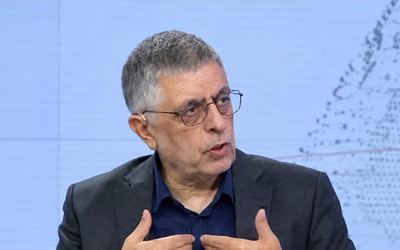

“This was a major victory for Iranian information warfare operations,” said Marcus Kolga, a leading expert on foreign disinformation. “Whether intentionally or not, Carlson is acting as a significant conduit and amplifier for Iranian government information operations.”

The interview was recorded remotely, unlike the one Carlson did with Russia's president Vladimir Putin in February 2024.

"(Carlson) offers Pezeshkian and the Iranian regime a platform—without context or pushback—allowing Tehran to shape the record to Carlson’s viewers and listeners unopposed,” Kolga added.

A moment highlighted by many critics was when Pezeshkian asserted that Israel had tried to assassinate him without offering any evidence.

“He was trying to... put forward the message that this is Israel tricking America into getting involved in this. This really isn't America's war. Iran and America, we have nothing to fight about.” director of the Yorktown Institute's Turan Research Center Joseph Epstein said.

Epstein argued the interview fit Carlson’s broader pattern of offering authoritarian figures a platform to rewrite narratives without scrutiny—an approach that often blurs the line between journalistic curiosity and ideological alignment.

MAGA :' forever wars'

That alignment, analysts say, extended deep into the language Pezeshkian used.

From “forever wars” to calls for dialogue, his remarks were crafted to appeal to Trump-aligned isolationists and feed growing calls for US disengagement from the Middle East.

The use of such language is no accident, said Holly Dagres, a senior fellow at the Washington Institute, who has long studied Iranian strategic messaging.

“One of the main goals of the Islamic Republic is to get the US out of the Middle East... and when you're pushing this isolationist rhetoric or America First, you're basically saying America needs to get out," Dagres told Iran International.

Dagres noted that Pezeshkian’s emphasis on business cooperation with the US and his softened tone on slogans like “Death to America” appeared to be an overture to Trump himself, even if the message didn’t land as clearly in today’s post-war political climate.

The interview was praised by Iran's moderates, but hardline voices slammed the president's for what they called 'appeasement'.

"A lot of conservatives condemned it because (they said) the US just bombed us. Why are you making these appeals to them?”

The messaging, several experts said, fits into a broader long-term goal: undermining the US-Israeli alliance.

“He used this as an opportunity to weaken and to increase America's skepticism of support for Israel,” said Casey Babb, senior fellow at the Macdonald-Laurier Institute. “In 50 years or 100 years, if America and Israel are not aligned the same way they are right now, Israel could be in a very precarious situation.”

Carlson, Babb said, handed that message a valuable platform by failing to press Pezeshkian on Iran’s human rights record, nuclear activities, or assassination plots.

“There were definitely softball questions with no follow-up,” said Dagres. “Carlson didn’t challenge Pezeshkian on well-documented plots to target American officials or on the regime’s broader ambitions.”

“In failing to counter these narratives,” Kolga said, “Carlson becomes a conduit for regime propaganda—allowing this high-profile ‘conversation’ to turn into a successful Iranian strategic disinformation operation.”

Most Viewed

Washington’s economic war on Iran starts in Dubai, not Beijing
1
ANALYSIS

Washington’s economic war on Iran starts in Dubai, not Beijing

2

Iranian banks remain open in UAE as US campaign squeezes Dubai trade - FT

3
ANALYSIS

What the US-Venezuela oil model could mean for Iran’s energy future

4

Iran sanctions reach education: Duolingo blocked, TOEFL and GRE in doubt

5
PODCAST

Iran’s political prisoners are being executed. Why is supporting them controversial?

Banner
Banner

Spotlight

  • What the US-Venezuela oil model could mean for Iran’s energy future
    ANALYSIS

    What the US-Venezuela oil model could mean for Iran’s energy future

  • Washington’s economic war on Iran starts in Dubai, not Beijing
    ANALYSIS

    Washington’s economic war on Iran starts in Dubai, not Beijing

  • Iran’s political prisoners are being executed. Why is supporting them controversial?
    PODCAST

    Iran’s political prisoners are being executed. Why is supporting them controversial?

  • Iran’s missing fuel: Can border smuggling explain it all?
    ANALYSIS

    Iran’s missing fuel: Can border smuggling explain it all?

  • Iran bets on China to blunt Trump’s economic offensive
    INSIGHT

    Iran bets on China to blunt Trump’s economic offensive

  • Iran or the dollar? US makes an example of Banque Misr
    ANALYSIS

    Iran or the dollar? US makes an example of Banque Misr

  • War or deal? Rezaei begins to define Iran’s price
    ANALYSIS

    War or deal? Rezaei begins to define Iran’s price

Banner