US security agencies warn of increased risk from Iranian cyber actors
The US intelligence, law enforcement, and cybersecurity agencies have issued a warning about an increased threat of cyberattacks by Iranian-affiliated actors, particularly targeting sectors linked to Israeli research.
“Defense Industrial Base companies, particularly those with holdings or relationships with Israeli research and defense firms, are at increased risk,” the Department of Homeland Security said on its X account citing a joint statement.
“Based on the current geopolitical environment, Iranian-affiliated cyber actors may target US devices and networks for near-term cyber operations,” the Cybersecurity and Infrastructure Security Agency (CISA) said in the report, issued jointly with the National Security Agency (NSA), Department of Homeland Security (DHS), and FBI.
The report noted that there are currently no signs of a coordinated cyber campaign but urged companies and organizations to remain vigilant and address potential network vulnerabilities.
“During Operation Rising Lion, Israel achieved full air superiority over western Iran and even Tehran, striking nuclear complexes, airfields, and ballistic missile sites,” , Israeli ambassador to the UN said on Monday.
“We neutralized more than half of Iran's ballistic missile launchers that threatened Israel and the entire world. We destroyed over 1,000 unmanned aerial vehicles (UAVs) and intercepted roughly 90% of the missiles fired at our cities. Not a single Israeli aircraft was lost."
Addressing a UN Security Council session on the Middle East, Danny Danon said that Israel focused solely on military targets rather than civilians.
“We targeted the regime’s war machine, not its people. This is another moral line Iran will never respect, as they intentionally fired missiles at our population centers, murdering 28 civilians.”
Iran’s Health Ministry says 610 people were killed and 4,700 wounded during the 12-day war with Israel.
“Tehran’s terror does not stop at its borders. Its money, weapons, and orders flow straight into Judea and Samaria. The rifles and ammunition that reach the hands of terrorists like this one come directly from the IRGC’s supply chain of death and terror,” Danon said.
"The Trump administration and mainly special envoy Steve Witkoff has been in communication both directly and indirectly with the Iranians," White House Press Secretary Karoline Leavitt said.
"The communication continues," she told reporters during a press conference on Monday.
"The president himself has not talked to Iran, which he pointed out in his statement," Leavitt added.
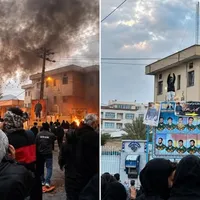
Evin Prison's Hospital in the aftermath of Israel's June 23 strike
On June 23, Israel launched several missiles at Tehran’s Evin Prison, describing the notorious site as a “tool of repression.” While some Iranians initially celebrated the strike, the human cost has been heartbreaking.
Evin Prison, long a symbol of Iran’s political repression, was rocked by explosions that destroyed key facilities, including several wards, its infirmary, and the visitation hall — with immediate and devastating consequences.
Among the dead were two prison officials, Ruhollah Tavasoli and Vahid Heydarpour, as well as Evin's top prosecutor Ali Ghanaatkar. Tens of detainees, medical staff, visiting families — including a young child — and even a bystander were also killed.
A judiciary spokesman said on June 29 that 71 people had been confirmed dead, though the authorities have yet to release a full list of victims.
While Evin is widely known for holding political dissidents, journalists, students, and others charged under vague national security laws, it also houses inmates convicted of financial crimes and debt — people often awaiting bail or legal review, far removed from any political involvement.
The UN Office of the High Commissioner for Human Rights (OHCHR) condemned the strike as a “grave breach of international humanitarian law,” stressing that Evin Prison “was not a military objective.”
Wreckage at an administrative building
Names, not statistics
The victims of the June 23 strike are emerging not as statistics, but as lives brutally cut short.
Mehrad had accompanied his mother, Zahra Ebadi, one of seven prison social workers confirmed killed. Witnesses said Mehrad was playing in a prison playroom while his mother helped inmates draft letters.
When the first missile hit, a colleague rushed to shield him, but a concrete slab collapsed on them both. Neither survived.
Leila Jafarzadeh, a young mother of a one-year-old girl, had come to post bail for her husband, reportedly imprisoned over a financial dispute. Her body was found two days later, after her family scoured hospitals and morgues across Tehran in desperation.
Another victim, Mehrangiz Imanpour, wasn’t even inside the prison. A painter and longtime Tehran resident, she had stepped out for a walk near her home just 200 meters from the facility when the blast hit.
Her ex-husband, Reza Khandan Mahabadi, a former political prisoner, later found her body in the morgue.
“Mehrangiz was the beauty in the lives of my children,” he wrote on Instagram. “The war between two reactionary and warmongering regimes took the beauty of their lives away two days ago.”
Media reports suggest other victims included two prison doctors, a nurse, and several administrative staff and guards — many of them young conscripts, unarmed and unprepared.
Social worker Zahra Ebadi and her son Mehrad Kheyri
Relocation of prisoners
In the aftermath of the strike, survivors described frantic and at times violent evacuations.
“We were handcuffed, chained together and violently dragged out,” said Mostafa Tajzadeh, a prominent dissident, in a phone call to his family.
Inmates were transferred to Greater Tehran Prison, Ghezel Hesar, and the notorious Qarchak Women’s Prison, where they now face severe overcrowding, unsanitary conditions, and a shortage of food and clean water.
Some injured or ill prisoners have reportedly been denied medical treatment and left without access to vital prescription medications.
Meanwhile, many families still have no information on the fate of their loved ones.
Among the missing is Motahareh Goonei, a student activist arrested early in the Israel-Iran war after posting criticism of Iran’s leadership online. She was reportedly held in Ward 209, operated by Iran’s Ministry of Intelligence. Her family has not heard from her since the attack.
Also missing are Ahmadreza Jalali, a Swedish-Iranian physician on death row, and French nationals Cécile Kohler and Jacques Paris, who are held on widely disputed espionage charges. Their families have been denied all contact and updates.
The United States on Monday called on Iran to end its funding and support for regional proxies during a meeting of the UN Security Council, urging Tehran to prioritize the needs and prosperity of the Iranian people.
“At this historic turning point, Iran’s leaders have an opportunity to finally put their people first—to choose prosperity and integration into the community of nations rather than supporting terrorism and pursuing nuclear weapons,” said John Kelly, Acting US Alternate Representative.
“We state again: Iran will never have a nuclear weapon,” he told a UN Security Council session on the Middle East.
Kelly also urged Iran to end its support for regional proxies. “The United States calls on Iran to end its sponsorship of terrorist groups and proxies, including Hamas, Hezbollah, and the Houthis."
"The Americans and Israelis must know we won't let them go," said Yahya Rahim-Safavi, a senior military advisor to Iran's Supreme Leader Ali Khamenei.
"We warn the enemies that if they start a new wave of threats, Iran will respond in a harsher way—beyond their imagination," he said.
"The IRGC is prepared to respond forcefully in the event of any miscalculation. We have their targets in our database, and if there is another mistake, we will respond decisively under the command of the Supreme Leader," he added.
"Netanyahu's death is near," Rahim-Safavi added, referring to the Israeli prime minister.