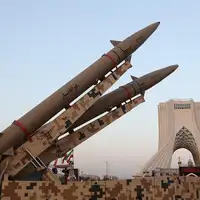
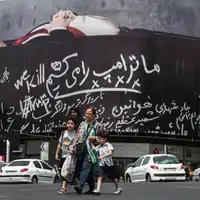
Iran relied heavily on its missile capabilities during the recent conflict with Israel but faced shortcomings in other areas of defense, a member of parliament’s national security commission said on Friday.
“Our military strength was based on missile power, but there were weaknesses in other defense sectors,” Mohammad-Mehdi Shahriari said.
He cautioned against exaggerating Iran’s missile achievements. “We should not overstate the missile success and ignore the deficiencies,” he said.

Iran’s ability to launch ballistic missiles against Israel sharply declined after June 17 due to Israeli strikes that degraded its launcher and missile stockpiles, the Jewish Institute for National Security of America (JINSA) said in a report published Thursday.
The think tank estimated that Iran’s launch capacity fell from 350 to around 100 operational launchers over the course of the 12-day conflict, with daily missile fire dropping from more than 30 missiles to fewer than five by June 24.
“Iran likely diminished the volume of its ballistic missile attacks because Israel degraded Iranian launch capacity by eliminating missile launchers and stockpiles,” the report said.
Iran turned to fewer, more advanced missiles
According to JINSA, as its capacity declined, Iran increasingly relied on longer-range and heavier missiles to continue threatening Israeli cities. On June 22, after US strikes on Iranian nuclear facilities, Iran reportedly launched a Khorramshahr-4 missile — its longest-range system with the heaviest warhead in its arsenal.
JINSA also cited Iranian use of cluster munitions and tactical shifts toward smaller, more frequent missile waves as an effort to stretch Israeli air defenses and maintain psychological pressure despite falling overall firepower.
By the end of the conflict, Iran had likely lost 33 to 50 percent of its pre-war medium-range missile stockpile, which stood at around 2,500, the report said. Israel intercepted most of the missiles, but JINSA noted that Iran’s hit rate increased to 25–37 percent in the final days, as it used more advanced weapons and modified tactics.

More than 130 Iranian nationals have been arrested across the United States in the past week in a nationwide enforcement operation, Fox News reported on Thursday, citing multiple federal sources.
The arrests come as President Donald Trump’s administration increases enforcement targeting Iranian nationals, while officials warn of possible retaliation following recent US strikes on Iran’s nuclear facilities, Fox News reported.
Suspected ties to IRGC, Hezbollah among cases
“The presence in this country of undocumented migrants or Iranian nationals who have links to Hezbollah, IRGC, is, in my judgment, a domestic law enforcement concern of the highest magnitude,” former Homeland Security Secretary Jeh Johnson said on Fox & Friends.
Federal officials told Fox News that some of those arrested had criminal convictions for drugs, weapons, and domestic violence. “We don’t know who they are, where they came from, why they’re here,” former border czar Tom Homan said. “This is the biggest national security vulnerability we’ve ever seen.”
Former acting ICE Director Jonathan Fahey said the situation worsened under the previous administration’s policies. “We have probably 2 million known gotaways come through the last administration… we have no idea who went through,” he said.
Fox News also reported that one of the individuals arrested “had served as a sniper in the Iranian military within the last four years,” and that “some of those arrested have criminal histories, including charges related to drugs, weapons and domestic violence.”
The report said that roughly half of the 1,500 Iranian nationals released into the US during the Biden administration were released into the interior.
A Supreme Court ruling that permits deportation to third-party countries may apply to some of those currently in custody, though legal proceedings are ongoing, Fox News added.
Homeland Security identifies key suspects in earlier announcement
Earlier this week, the Department of Homeland Security released specific details about a subset of the same group of arrests. Eleven Iranian nationals were taken into custody in multiple states, including individuals with past deportation orders, terrorism concerns, and criminal records.
Among them was Ribvar Karimi, a former Iranian army sniper arrested in Alabama, who entered the US in 2024 on a fiancé visa and never adjusted his immigration status. Agents found him with an Iranian military ID. In Minnesota, DHS said agents arrested Mehran Makari Saheli, a former IRGC member who admitted ties to Hezbollah and had a prior felony conviction.
Other arrests occurred in Texas, Arizona, California, Colorado, Mississippi, and New York. Some individuals had been ordered removed years ago but remained in the country. One man was carrying a loaded pistol; others had histories involving domestic violence, drug trafficking, or immigration fraud.
All remain in federal custody pending removal, DHS said.
Iran must remain alert despite a ceasefire following Israel’s aggression, Tehran lawmaker Hossein Samsami said on Friday.
The response to Israel’s attack was “decisive and crushing,” Samsami said, but warned that Israel continues to seek an opportunity to strike again.
“We must not let them use the element of surprise again and inflict irreparable damage,” he said.

The Israeli military has released new details about its 12-day operation against Iran that began on June 13, saying it targeted more than 370 sites linked to Tehran’s nuclear and missile programs.
In a statement published Friday, the military said the campaign, included strikes on three nuclear sites, six airports, and dozens of missile production and launch facilities. It said the strikes resulted in the deaths of nine nuclear scientists and 30 senior Iranian security officials, including three top commanders.
Among the facilities hit were the Fordow and Natanz enrichment plants and the Isfahan uranium conversion site. Israel also said it destroyed more than 2,000 missile-related components and conducted 1,500 air sorties, including long-range strikes as far as Mashhad.
The statement added that 99% of drones launched from Iran were intercepted, and Israeli naval forces downed dozens more in the Red Sea and Mediterranean.

Israel’s twelve days of air attacks on Iran killed hundreds of civilians—among them an eight-year-old gymnast in a red dress whose last joyful dance has become a symbol of the war’s human cost.
A video posted on Instagram by a relative appears to show Tara Hajmiri dancing in a dentist’s office. Her black ponytail sways behind her as she beams with joy and glides toward the treatment chair. Hours later, her short life was over.
Tara died alongside her parents when Israeli missiles struck three six-story residential buildings on Patrice Lumumba Street in central Tehran in the early hours of June 13.
Her father, an estate agent, and her mother were found in the rubble. Israel's military later said the buildings were targeted to eliminate an unnamed nuclear scientist.
Tara's name spread quickly across Iranian social media, where she came to represent innocence lost in war.

The war's youngest victim appeared to be Rayan Ghasemi, a two-month-old infant, who succumbed to burn injuries after an Israeli strike on June 19.
His parents, Behnam Ghasemian, an engineer, and Dr. Zohreh Rasouli, a gynecologist, were also killed. His older brother, Kian, remains hospitalized with serious injuries.
A poet’s last verse
Another victim whose story and face became an instant icon was 23-year-old Parnia Abbasi—a poet and English teacher who loved Coldplay, Italian food and mountain climbing.
She was one of the very few to grab attentions outside Iran, her smile and her verses touching hearts.

Her family said she often wrote about love and longing. One poem, Returning to You, was widely shared after her death:
You crash upon my shore
the rhythmic pearl of your body bursts across the sand
I row toward your embrace
cast your smile like a hook
The fish are caught and I fall in love
all over again.
Parnia was killed with her entire family—father Parviz, a retired teacher, mother Masoumeh, a retired bank clerk and 14-year-old brother Parham—when their building was leveled.
Israeli authorities later said the intended target was Abdolhamid Minouchehr, head of nuclear engineering at Shahid Beheshti University.

Hundreds More
Another victim, graphic artist Saleh Bayrami, was killed while waiting in his car at a traffic light on June 15, en route to a job interview. The strike near Tehran’s Tajrish Square killed several others.
Iran’s Health Minister Mohammad Reza Zafarghandi said on June 23 that 606 people had been killed, without specifying how many were civilians.
Independent tallies put the toll higher—1,190 according to the US-based human rights group HRANA, which reported military deaths just above 400, with the rest either civilian or yet to be determined.
The Israeli government has defended its actions as pre-emptive strikes on Iran’s nuclear infrastructure. But the deaths of Tara, Rayan, Parnia, and Saleh have sparked grief—and questions.
Their names stand for the civilians caught in the crossfire of a conflict paused for now, but which could return with a vengeance at any moment.
Their faces—once full of promise—have become symbols of loss, of questions unanswered, of the cost of ideology and war.