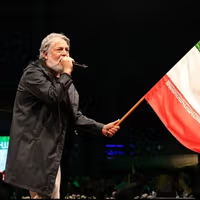
Iranian official calls for tight internet curbs in wartime
All foreign internet access should be tightly restricted for several months as the war with Israel continues, Hardline Iranian official Mohammad-Javad Larijani said Thursday.
“We must abandon open-internet posturing,” said the head of the Institute for Research in Fundamental Sciences.
While domestic connectivity and business access should be facilitated, Iran’s national intranet must impose “complete control, limitations, and oversight” over international links, he added.
A TV broadcast of Iran’s Supreme Leader Ali Khamenei’s video message
Iran’s Supreme Leader Ali Khamenei was not involved in the negotiations or approval of the recent ceasefire agreement between Iran and Israel, according to information obtained by Iran International.
Decision-making regarding the truce was handled instead by Iran’s Supreme National Security Council and President Masoud Pezeshkian, who moved swiftly to respond to a ceasefire proposal from US President Donald Trump.
A source familiar with the details of the deliberations told Iran International that the council intended to respond quickly to the American proposal. However, at the time, there was no opportunity to contact Khamenei. The ceasefire was therefore approved and communicated without the supreme leader’s knowledge.
In recent days, Khamenei’s communication capabilities have been severely limited due to security concerns, particularly fears of an attack on his location.
Iran International previously reported that Khamenei and close family members, including his son Mojtaba, were relocated to a secure bunker in Lavizan, northeast Tehran, soon after the conflict began.
Earlier this month, Iran International reported that Khamenei had transferred key decision-making powers to the Supreme Council of the Islamic Revolutionary Guard Corps (IRGC) shortly after the start of the attacks by Israel. The transfer of authority was viewed as a precautionary step to ensure continuity of command in the event of an escalation or direct threat to the leader’s safety.
Iran has not officially confirmed the location of the Supreme Leader or the details of the internal deliberations surrounding the ceasefire.
First message after ceasefire
Earlier in the day, Khamenei released his first public message since the ceasefire took effect on Tuesday, delivering a televised address in which he declared victory over Israel and said the United States was dealt a blow during the conflict.
“The Zionist regime, with all its noise and claims, was nearly brought to its knees,” he said. “The United States gained nothing and received a harsh slap in return.”
The setting of Thursday’s video matched earlier wartime messages, suggesting he remains in the same secure location.
Trump had previously posted on Truth Social that the US knew where Khamenei was hiding, describing him as an “easy target” and warning that American patience was “wearing thin.”
However, in remarks following the ceasefire announcement, Trump adopted a more measured tone, suggesting that “regime change takes chaos,” and adding, “we don’t want to see so much chaos, so we’ll see how it does.”
He also confirmed that the US is preparing for a new round of talks with Iran in the coming week.
Iran’s decision to enter a ceasefire with Israel was made without the direct involvement of Supreme Leader Ali Khamenei, Iran International has learned.
According to information shared with Iran International, the process was led by the Supreme National Security Council and President Masoud Pezeshkian, who jointly informed the United States of the decision.
In an exclusive report earlier this month, Iran International reported that Khamenei had transferred key decision-making powers to the Supreme Council of the Islamic Revolutionary Guard Corps (IRGC) shortly after hostilities began.
The move came amid reports that the supreme leader, along with close family members including his son Mojtaba, had been relocated to an underground bunker in Lavizan, northeast Tehran, where he remained for days without making any public appearances.
Israeli lawmaker and former defense minister Benny Gantz rebuked Iran’s Supreme Leader for boasting of Israeli defeat.
“Come out of your underground hideout and see what harm and defeat you’ve brought on your own people,” he wrote in a Farsi-language message on X.
“A liar is the enemy of God,” he added.
His post came after Ali Khamenei sais in a video message from an undisclosed place that Israel was “nearly brought to its knees” under Iranian strikes. “Despite all its noise and claims, the Zionist regime was nearly crushed under the strikes of the Islamic Republic,” Khamenei said.
IAEA Director General Rafael Grossi said on Thursday there is “a real window for diplomacy” on the situation in Iran, urging all parties to approach it “with resolve, as the moment demands.”
In a post on X following talks in Paris with France’s Foreign Minister Jean-Noël Barrot, Grossi expressed gratitude for France’s support for the UN nuclear watchdog’s mission.
US Defense Secretary Pete Hegseth on Thursday rejected a leaked intelligence assessment that downplayed the impact of American strikes on Iran’s nuclear facilities, calling the operation “a resounding success” that helped end the 12-day war. “President Trump directed the most complex and secretive military operation in history,” Hegseth said during a Pentagon press briefing, crediting it with creating the conditions for a ceasefire and “decimating—choose your word—obliterating, destroying Iran’s nuclear capabilities.”
His comments followed a CNN report citing a leaked preliminary Defense Intelligence Agency (DIA) assessment suggesting the strikes failed to destroy the targeted nuclear sites or Iran’s stockpile of enriched uranium. According to the report, the attacks may have delayed Iran’s nuclear program by only a few months.
Hegseth dismissed the report as unvetted and incomplete, saying it had not been coordinated with the broader intelligence community and was based on “linchpin assumptions” that could undermine its conclusions. “Even that preliminary report acknowledges likely severe damage,” he said, accusing unnamed officials of leaking it “to muddy the waters.”
Hegseth also pointed to other assessments, saying they supported the administration’s view. These included comments from the Israeli Atomic Energy Commission, which said the Fordow facility was rendered inoperable, and IAEA chief Rafael Grossi, who told French media the strikes caused “enormous damage” to nuclear sites. Hegseth also cited the IDF chief of staff as saying Israel believed the program was set back by “years,” and Iran’s own foreign ministry, which acknowledged serious damage.