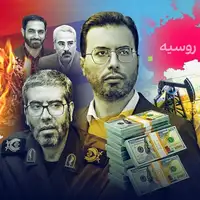
Iranian intelligence forces have arrested over 700 suspected Israeli agents over the past 12 days, targeting an active espionage network following Israel's military campaign on Iran, the IRGC-affiliated Fars News reported on Tuesday evening.
“Agents are accused of operating micro aerial vehicles (MAV) and suicide drones, making homemade bombs, photographing sensitive military sites, and sending intelligence to Israeli forces," the report said.
Based on the report, “over 10,000 MAVs were seized in Tehran alone” and “most arrests occurred in Kermanshah, Isfahan, Khuzestan, Fars, and Lorestan and Tehran.”

Regime change in Iran cannot be imposed from the outside, but the recent Israeli air strikes laid the groundwork for Iranian people to take the lead in ousting the Islamic Republic, Israel's ambassador to the United States told Iran International on Tuesday.
"You can't establish democracy top down. It doesn't work," Yechiel Leiter said in a Washington DC town hall hosted by Iran International, when asked if Israel expected a regime change after its recent air strikes on Iran.
"We have created the backdrop. We've created the props on the stage, and hopefully they're enough for there to be capitalized upon and for change to be brought about," the Israeli ambassador told the town hall moderator Fardad Farahzad.
Prime Minister Benjamin Netanyahu earlier told Iran International that the Israeli military campaign against Iran was giving its people a chance to topple the Islamic Republic, adding that the ruling system's days were numbered.
"A light has been lit—carry it to freedom,” Netanyahu said on June 16. “This is the time. Your hour of freedom is near—it’s happening now.”
Leiter said on Tuesday that Netanyahu spoke "with a tremendous passion and hope that the world will change and that the Iranian regime will change."
"That's a wish, but that can't be a military goal," he said. "Democracy is, in of itself, an expression of the people's will. So how can you ignore the people's will by forcing it?"

'World must join Israel'
The Israeli ambassador criticized other countries especially the Europeans for leaving the Jewish State alone in countering the Islamic Republic, saying it would be much easier for Iranian people to topple the Islamic Republic should other countries help Israel.
"Why is it that the Chancellor of Germany says 'Israel is doing the dirty work for all of us'? We're a tiny little country. Where's Germany? Where's England? England has a huge stake, huge history in your neck of the woods," Leiter said.
"They can feel an affinity for somebody who threatens an ally, like Israel. And it's not just Israel. Who created the sleeper cells in Europe? Why is there fear now in the United States, of sleeper cells? They have interfered with international waterways, with globalization, with maritime trade," he added.
Iran sent a communiqué to Trump in the days before the US air strikes on its nuclear facilities threatening to activate sleeper-cell terror inside America if it were attacked, NBC News reported on Sunday citing sources.
Eleven Iranian nationals, including a suspected former army sniper and an individual with admitted ties to Hezbollah, were arrested by US Immigration and Customs Enforcement (ICE) over the weekend in what officials say is a broader crackdown on individuals with ties to Iran and potential national security risks.

The Israeli ambassador addressed the German chancellor and said, "You're absolutely right. We're doing the dirty work for the world, but it's about time that you helped us. And if they did, it would be a lot easier for the people of Iran."
"You have a minority government with its boot on the necks of, of good people, of innocent people, of tens of millions of people."
Surprises every day with Trump in office
The Israeli envoy said he was not surprised by Trump’s ceasefire proposal, as Israel’s military objectives in the war with Iran had been largely achieved by Tuesday morning when the ceasefire took effect.
He said working as a diplomat in Washington DC under President Trump feels like riding a roller coaster—with no idea when the next sharp turn is coming.
"You're on a roller coaster, and the only difference between Washington during the Trump administration and a roller coaster is that with the roller coaster, you know where the twists and turns are coming," he said.
"Here in Washington at the present time, you just don't know when the roller coaster is going to go sideways and you've got to hold on."
Trump on Monday night announced the unexpected ceasefire in the 12-day war between Iran and Israel via a post on his Truth Social platform, further fueling a sense of unpredictability surrounding US policy decisions.
The recent airstrikes by the United States and Israel will not lead Iran to abandon its nuclear technology, Iran’s Foreign Minister Abbas Araghchi said on Tuesday when asked if Tehran would continue to enrich uranium.
“We have made tremendous efforts to achieve this technology, and our scientists have made enormous sacrifices, even losing their lives for this goal,” Araghchi said in an interview with the London-based New Arab website.
“Our people have endured sanctions for this, and a war was imposed on our nation over this issue. No one in Iran will abandon this technology.”
When asked if Iran would reconsider its stance toward the International Atomic Energy Agency (IAEA), he responded, “I imagine that our outlook on the nuclear program and the non-proliferation regime will undergo changes, though I cannot yet determine their direction.”
US President Donald Trump's statement that "China can now continue to purchase oil from Iran" merely acknowledged that oil from the Strait of Hormuz won't be disrupted, and was not a signal of sanctions relief, the Wall Street Journal reported citing a senior White House official.
“The President was simply calling attention to the fact that, because of his decisive actions to obliterate Iran’s nuclear facilities and broker a ceasefire between Israel and Iran, the Strait of Hormuz will not be impacted, which would have been devastating for China," the official was quoted as saying.
"The President continues to call on China and all countries to import our state-of-the-art oil rather than import Iranian oil in violation of US sanctions.”
Iranian air defense systems have been activated in several cities including Tabriz, Shahr-e Rey in southern Tehran, and Mashhad, according to local media reports.
However, officials have not confirmed any new Israeli attack.
"No attack has occurred. The air defense is countering micro aerial vehicles and securing the airspace,” Tabnak reported citing the Islamic Revolutionary Guards Corps in East Azerbaijan province.

The Islamic Republic will not return to what it was before the Israeli and American airstrikes, but what comes next is uncertain, experts tell Iran International.
The experts say Iran now faces a defining choice: abandon its decades-old doctrine of hostility toward Israel and the US, or double down and risk collapse.
“It's Ali Khamenei, whose worldview is arguably at the heart of why we ended up in this conflict,” said Alex Vatanka, Senior Fellow at the Middle East Institute and founding director of its Iran Program.
Once seen as untouchable, the clerical state is now reeling—its authority at home weakened and its future uncertain, several Middle East analysts told Iran International.
“What pushback comes from within the regime?” Vatanka asked. “The policies of hardliners, of flexing muscle, having ballistic missiles, acts of resistance, fighting the good fight against US and Israel. That brought this disaster on Iran.”
Tehran failed to defend its airspace, protect officials and loyalists, or safeguard its nuclear and missile programs.
While Iran has long fomented regional instability, this is the first time in decades that war reached its own soil. That may prove a turning point.
“So the war against Israel and the United States, that was sold as something you do outside of Iran's borders. That war suddenly was happening on Iranian soil, literally in cities and towns where people live,” Vatanka said.
Change is coming
That internal tremor may not lead to collapse—but it could produce serious transformation.
“I do expect significant aftershock waves within the structure of the regime,” said Avi Melamed, a former Israeli intelligence official and founder of Inside the Middle East: Intelligence Perspectives.
“Change within the regime, not the regime change,” Melamed said. “But again, it may be that the change within the regime will result in dynamic, that will result in, at the end of the day, change of the regime.”
Meanwhile, the Trump administration is taking a victory lap. President Trump posted Tuesday on Truth Social that China can now resume buying oil from Iran—a sharp turn from his previous threats.
“China can now continue to purchase Oil from Iran,” Trump wrote. “Hopefully, they will be purchasing plenty from the US, also. It was my Great Honor to make this happen!”
Only a month after warning the world against buying Iranian oi, Trump told reporters he hopes Iran will be “a great trading nation.”
Experts say the fact that Iran and Israel accepted a ceasefire signal that neither side wanted a prolonged conflict.
Some level of political change now appears unavoidable, according to Kamran Matin, Associate Professor of International Relations at the University of Sussex.
“The kinds of concessions that Iran will be compelled to make in the likely post-ceasefire talks over its nuclear and missile projects far exceeds the political ideological constraints of the current leadership of Khamenei,” Matin said.
“He has been forced to contradict himself on major matters of national security on a rather frequent basis since October 7.”
For now, observers are watching closely to see whether the Islamic Republic—feeling weakened—lashes out internally.
On Monday, Iranian authorities executed Mohammad-Amin Mahdavi-Shayesteh for allegedly spying for Israel.
“The regime might seek to alleviate its utter humiliation by dramatically intensifying its repression of dissidents and even repeat the 1988 mass execution of political prisoners,” Matin warned.
Such a move could spark widespread protests—potentially pushing an already fragile Islamic Republic toward collapse.
The airstrikes may have ended, but the real battle for Iran’s future is only beginning. Israeli strikes shook the Islamic Republic to its core. Its leadership is bruised, its power structure exposed, and its legitimacy at home deeply eroded.