In a statement on Monday, Iran gave Qatar an assurance that the US base attacked by Iranian missiles was far away from residential areas, and that it did not cause any danger to the "brotherly and friendly country of Qatar and its people."
"Iran is committed to maintaining its warm ties with Qatar," Iran's Supreme National Security Council said in a statement.
It added that the operation against US forces in Qatar's Al-Udeid base was successful, and that "the number of missiles used equaled the number of bombs the US employed in its attack on Iran's nuclear facilities."

Iran has launched a direct missile attack on US forces stationed at Al Udeid Air Base in Qatar in a dangerous new escalation that followed the American airstrikes against three Iranian nuclear facilities.
Missiles were fired at the base as part of what Iran's state television is calling “Operation Herald of Victory".
Qatari air defense systems intercepted the Iranian missile attack, Al Jazeera reported, citing the Qatari defense ministry.
Doha condemned the Iranian airstrikes against US forces in Al Udeid, saying it reserves the right to respond directly and in accordance with international law.
It also confirmed that the attack resulted in no fatalities.
The US president is at the White House Situation Room, discussing a possible response to the Iranian attack, according to CNBC.
According to the New York Times and Reuters, Iran had coordinated the attack with Qatari officials and the United States in advance and gave early notice to help minimize casualties.
In a statement, Iran's Supreme National Security Council gave Doha an assurance that the targeted US base was located far from residential areas and posed no danger to “the brotherly and friendly country of Qatar and its people.”
Tehran emphasized that it remains committed to maintaining its “warm ties with Qatar.”
The situation remains fluid as US officials assess the damage and prepare for possible further retaliation. Al Udeid is the largest US military base in the Middle East, hosting thousands of American personnel and serving as a strategic hub for regional operations.
There is an imminent threat of an Iranian strike on US forces in Al Udeid Air Base in Qatar, Fox News reported.
BBC also reported a "credible" threat against the air base.
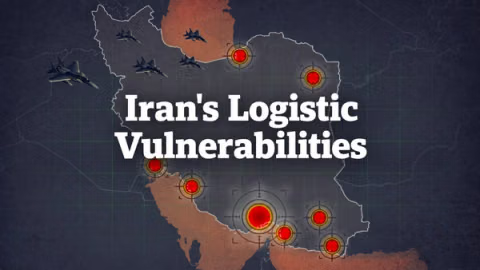
The Islamic Republic is moving missile launchers into place for a potential strike on American forces in the Middle East, The Wall Street Journal reported citing US officials.
Pentagon is also tracking a “credible” threat to US forces in the region, the report added.
“Iranian authorities must release all those arbitrarily detained and should relocate other prisoners away from locations at risk of being attacked by Israel," Amnesty International said Monday.
"Prison security forces must not use force or firearms against distressed prisoners,” the rights group said in its statement.
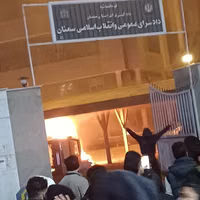
Amnesty also said it is extremely distressed by video footage and reports of Israeli attacks on Evin prison, where hundreds of prisoners, including political dissidents and human rights defenders, are imprisoned.
“Deliberately attacking civilian objects is prohibited under international humanitarian law and would amount to a war crime.”
It also urged prison security forces not to use force or firearms against distressed prisoners.
Qatar has shut down airspace temporarily as part of measures taken amid developments in the region, the Qatari foreign ministry said in a post on X.
The move comes to ensure safety of residents and visitors, the statement added.
The move comes as Iran has threatened to retaliate against the United States after strikes on its nuclear sites.

US airstrikes on Iran’s nuclear facilities are unlikely to cause serious radioactive fallout, nuclear experts told Iran International despite fears of a nuclear disaster.
Their assessments come as Iran threatens retaliation, and the International Atomic Energy Agency (IAEA) holds an emergency meeting on Monday in response to the escalating crisis.
“For most facilities the impact of direct strikes will, to a large extent, most likely be very localized,” said Dr. Kathryn Higley, distinguished professor of nuclear science and engineering at Oregon State University and president of the National Council on Radiation Protection and Measurements told Iran International.
“While enriched uranium is radioactive, it is not terribly so. If the uranium is present and released as hexafluoride, that could also pose a serious but still localized hazard due to the fluorine in the compound being reactive," she said.
Dr. David Albright, founder of the Institute for Science and International Security, told Iran International that concerns over radiation from a strike on Fordow are overblown when compared with past incidents.
“One way to understand the low radiological risk of bombing Fordow is from a comparison to the underground Natanz enrichment site with over 15,000 centrifuges and many tons of uranium,” he said.
“It was attacked with earth penetrators and there is no off-site radiation risk. Fordow has about 2,700 centrifuges and much less uranium, and is more deeply buried underground. Hard to expect worse than Natanz.”
Albright emphasized that the design and location of Iran’s underground enrichment sites inherently limit the spread of radioactive.
Temporary contamination risks are primarily limited to areas near uranium conversion and enrichment plants, according to Andrea Stricker, a research fellow at the Foundation for Defense of Democracies (FDD).
“Response teams going near the destroyed facilities, for example, would need to wear protective gear temporarily due to risks of inhaling or ingesting aerially dispersed uranium chemical compounds,” said Stricker. “There is not concern for dispersal beyond the immediate plants.”
The US strike on the heavily fortified Fordow facility has likely trapped radioactive material underground, limiting any broader hazard, Stricker said.
Iran's response: 'no signs of contamination'
Their comments follow US President Donald Trump’s announcement on Sunday that American forces had struck Iran’s Fordow, Isfahan, and Natanz nuclear sites, which he described as “completely and fully obliterated.”
While Iran confirmed the strikes, it insisted its nuclear program would continue undeterred.
Iran’s National Nuclear Safety System reported that radiation detectors at the affected facilities showed “no signs of contamination” and stated, “There is no danger to the residents living around the aforementioned sites," according to Iran State media.
The IAEA said it had observed “no increase in off-site radiation levels” and would continue monitoring the situation.
Director General Rafael Grossi announced an emergency meeting of the agency’s 35-member board of governors. In response, Iran’s nuclear chief Mohammad Eslami called for an investigation and accused Grossi of “inaction and complicity.”
Isfahan and Natanz—both previously targeted by Israeli airstrikes—have not shown any evidence of radiation release, according to IAEA monitoring.
Experts say Bushehr not likely to be targeted
Bushehr, Iran’s only operational nuclear power reactor, is not expected to be targeted.
“Israel will not have the Bushehr nuclear power plant on its target list, as striking the reactor would cause a radiological disaster in the region,” Stricker said.
Bushehr is used for civilian energy production, not enrichment. The plutonium it generates is not suitable for nuclear weapons, and spent fuel is required to be returned to Russia.
Still, the plant contains significant quantities of nuclear material, and Grossi has warned that an attack on Bushehr could have the most serious radiological consequences of any site in Iran.
Tehran continues to maintain that its nuclear program is for peaceful purposes, but Trump and Israeli officials argue Iran is moving dangerously close to weapons capability.
“There will either be peace," Trump said during a national address following the strikes, "or there will be tragedy for Iran."