There are still no signs of instability within Iran's government a week into its conflict with Israel, the Jerusalem Post reported on Friday, citing three Israeli officials.
“There are currently no indications that the central government in Tehran is losing control — quite the opposite. The Iranian regime appears to be tightening its grip,” the officials were quoted as saying.
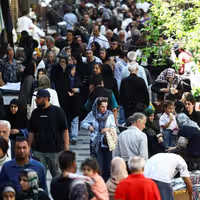
Dr. Raz Zimmt, director of the Iran Program at the Institute for National Security Studies, added: “Most Iranians are hostile to the regime and oppose it, but there is a sense of national solidarity at the moment. Right now, the people are focused on one thing: survival.”
US President Donald Trump said on Friday it is hard to ask Israel to stop its airstrikes against Iran as it is the winning side.
“I think it’s very hard to make that request right now if somebody is winning,” Trump told reporters.
He said he might support a ceasefire in Iran-Israel conflict while negotiations are underway with Iran "depending on the circumstances".
Trump also stressed that Washington has been in contact with Iran, adding that Tehran does not want to engage with European countries.
"Europe is not going to be able to help with this one," he said.
He warned that Iran is weeks or months away from developing a nuclear weapon.
Trump said that Director of National Intelligence Tulsi Gabbard was wrong to suggest there is no evidence Iran is building a nuclear weapon.
Trump questioned Iran’s justification for enriching uranium for civilian energy purposes.
“When you’re sitting on one of the largest oil piles anywhere in the world, it’s a little bit hard to see why you’d need that,” he said, when asked about allowing Iran to enrich uranium up to 3 percent under a potential nuclear deal.

After the first meeting between Iranian and Western officials since the state of the Israel-Iran war last week, European foreign ministers said on Friday that Iran expressed openness to diplomacy a wide array of issues.
Foreign ministers from Germany, France and UK plus the European Union foreign policy chief that their meeting with Iranian Foreign Minister Abbas Araghchi marked a positive step.
“The Iranian side is fundamentally ready to continue talks about all the important issues," German foreign minister Johann Wadephul said. "It is very important that the United States of America are involved in these negotiations and a solution."
French Foreign Minister Jean-Noel Barrot also said Tehran appeared open to broad dialogue. ”We were clear Iran cannot have a nuclear weapon and the E3 and Europe have been clear for many years that that cannot happen.”
Before the meeting, Iran had made clear it was not open to discussing the most sensitive disagreements with the West such as its missile program.

Iran will lose its ongoing conflict with Israel and its nuclear program, President Trump’s former Iran envoy and prominent neoconservative Elliott Abrams told Eye for Iran, as the conflict between the two countries entered its second week.
"I really think this is going to end by a negotiation,” said Abrams, who served as US Special Representative for Iran from 2020 to 2021.
"They're going to lose this nuclear weapons program, and the question is whether they do it the hard way or the easy way."
Even if the Islamic Republic refuses to surrender, Abrams said more Israeli strikes—followed by a possible US attack targeting an underground nuclear facility—would eventually lead to negotiations, much the way talks settled the Iran–Iraq war.
Eliminating the underground Fordow site in central Iran would likely hinder Tehran’s ability to quickly rebuild its nuclear program but it may not necessarily prevent it from using suspected secret sites to produce nuclear weapons, a prominent nuclear expert said this week.
According to Richard Nephew, a former negotiator during the Obama administration, the United States and Israel must acknowledge that Fordow is not the only pathway for an Iranian nuclear weapons program.
Iran, he argued in a Washington Institute thinktank report, may have other centrifuges available, including at secret sites, and is “probably already at work.”
For his part, Abrams said Fordow is essential to Iran’s program and a necessary military objective, but not a total solution without a broader diplomatic or military campaign.
Abrams was a prominent advocate of preemptive military action against Iraq during George W. Bush’s presidency.
Weapons of mass destruction alleged to be held by Baghdad were never found and the invasion led to a civil war which killed several thousand US troops and tens of thousands of Iraqis.
Trump’s two-week window is ‘strategic’
"Khamenei will soon have that choice: preserve the regime—or risk its collapse under American attack," said Abrams.
White House Press Secretary Karoline Leavitt told reporters Thursday that Trump would decide within two weeks whether to authorize a military strike on Iran.
Trump has previously given himself two-week deadlines on other major decisions—particularly related to the Russia–Ukraine war—and then failed to meet them.
Questions about how Trump will handle the conflict between Israel and Iran have swirled over the last week, and the president has yet to give a straight answer.
Based on Abrams' tenure as Trump’s Iran envoy, he sees this two-week window as a psychological negotiating tactic to throw his adversaries off balance.
It also provides the president with time to explore more options, he added, to see where negotiations may head, and to assess what Israel can accomplish on its own inside Iran.
If Israel is unable to destroy Iran’s fortified Fordow nuclear facility, Abrams believes Trump will likely order a US airstrike using bunker-buster bombs, without deploying troops. That window also allows the US to position its military assets and to give Iran a final chance to negotiate.
“He is moving planes and ships, particularly aircraft carriers and carrier task forces from far away into the Gulf area, the Eastern Mediterranean area, and it takes a week or 10 days,” Abrams told Eye for Iran. “So I don't read into this that he's decided not to do anything.”
“It's a way of giving yourself options until the very last minute.”
Trump’s inner circle
During his tenure as special representative on Iran, Abrams viewed influencing trusted inner-circle figures—like Pompeo during Trump’s first term—as the most effective way to shape Trump's decisions.
Trump’s decision-making is shaped by a small group of trusted advisors, not outside pressure or foreign leaders. Those around him—especially top generals and intelligence officials—play a key role in what happens next.
Currently, his trusted circle, according to Abrams, includes Vice President Vance, Secretary of State Rubio, Generals Kane and Kurilla, and CIA Director Ratcliffe—all of whom remain deeply committed to preventing a nuclear Iran.
“I think he's paying a lot of attention to these two top generals—General Kane, who's the Chairman of the Joint Chiefs of Staff, and General Kurilla, who's the head of CENTCOM, both very experienced four-star generals,” Abrams said.
The generals do not make their opinions known, but from what Abrams gathers, they tend to have a more aggressive stance on Iran and its proxies.
As tensions escalate and the clock on Trump’s two-week window ticks down, all eyes are on Fordow—and on Tehran’s next moves.

Air defense systems were activated in several Iranian cities on Friday night as explosions were heard across the country, according to messages sent by eyewitnesses to Iran International.
Eyewitnesses in Isfahan, in central Iran, reported that air defenses were active in multiple parts of the city, including Sepahan Shahr.
In Tabriz, northwestern Iran, several witnesses reported widespread activation of air defense systems. One resident said a flash from an explosion was visible in the northwest of the city, near a military airbase.
In Mashhad, northeastern Iran, a witness reported a loud explosion, describing it as the most powerful sound heard in recent days. It remained unclear whether the blast came from a missile interception or a direct hit.
In Shiraz, southern Iran, a loud explosion was heard and was believed to have come from either the Ahmad ibn Musa or Imam Ali military base, a resident told Iran International.
The war may have begun as a clash between Israel and the Islamic Republic, but for many Iranians now caught in the crossfire, it has become an intimate reality, marked by both grief and rare solidarity.
Iranians across social media are offering shelter, food, and medical help. Families far from the strikes are hosting refugees, doctors are providing free virtual consultations, and volunteers are caring for the elderly, infirm, and even abandoned pets.
Israeli airstrikes have hit Tehran and other cities with little or no notice, drawing criticism from many Iranians and some international observers.
Read more here.