Unlike the jammed roads out of Tehran, the city itself is quiet—until it isn’t. Then come the missiles, the drones, the air defenses. Silence shatters. We brace. Then wait. Then do it all over again.
People’s reactions are far from uniform.
Some still cling to the idea that this war isn’t really theirs—that it’s between Israel and the Islamic Republic and will not touch their homes or families. They believe, somehow, they’ll be spared.
They have chosen not to let reality shake their belief, not to allow the mounting rubble and growing number of deaths register.
Today I overheard someone at the grocery store say Khamenei had fled to the mountains, and that the war would end by Tuesday. I told him this is Tuesday. He nodded and said, “Exactly—so it ends today.”
Others saw what was coming and hit the roads by Day 3, hoping to reach safety outside the capital. Many didn’t get far.
The highways are still choked with cars; people are running out of fuel, out of options. Many are stuck—no way forward, no way back. Tehranis are heading north, toward the Caspian provinces that have neither the space nor the infrastructure to absorb them.
There’s fear of what’s waiting on the other end: food shortages, fuel scarcity, and overcrowded shelters. And yet, people keep fleeing.
For those who stay behind, the fear is different but no less consuming.
Israel’s defense minister has declared that Tel Aviv will take revenge not just on the Islamic Republic—but on Tehran itself. And so the city waits.
It’s hard to grasp how fast everything collapsed. Just last week, we believed we were in a “tense but manageable” phase. Now, even that looks like a golden age.
Few believe the Iranian leadership will prioritize the people over their own survival. You can feel that abandonment hanging in the air.
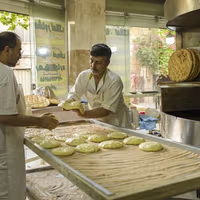
I asked the grocer if deliveries are still coming. “So far, just dairy,” he said. “We’re waiting on bread and soda.” Most shops are shuttered. Workplaces are closed. It feels like the city is holding its breath.
The government says the metro can be used as a shelter. But for those who remain, home still feels safer—if only psychologically.
Most people I know or encounter just want the war to end—with a deal, a collapse, or just a pause in the strikes. “One way or another,” as my partner puts it.
Wasn’t this about nuclear facilities, many ask. Why target city ministries? Why strike targets nestled inside residential neighborhoods?
We’re friends of the Iranian people, Israeli officials say. Well, the dead and wounded beg to differ. So far, the casualties are overwhelmingly civilian. Homes have been flattened. Lives erased.
Tragic stories abound.
A young man is missing. His pregnant wife lies in a hospital bed, her body broken. A young poet and her entire family are gone. Painful images that the regime’s media machine tries to use and misuse.
On social media, the battle over the truth is as fierce as anything in the skies.
People are still hoping the power and water systems will be spared. Just imagine: no electricity, no water—on top of everything else.
I saw a woman today carrying water half her weight. Many are stocking up, but for a few days’ need only. They can’t imagine the war lasting longer than that.
But what if it does? Worried whispers are starting. What if this becomes another Ukraine? Or another Gaza?
We drift between disbelief and dread, clinging to the same fragile wish: that this nightmare ends—one way or another—soon.